Podcast is also available on the versions below:


Get Notified Of Future Episodes on Apple Podcasts | Spotify | Youtube
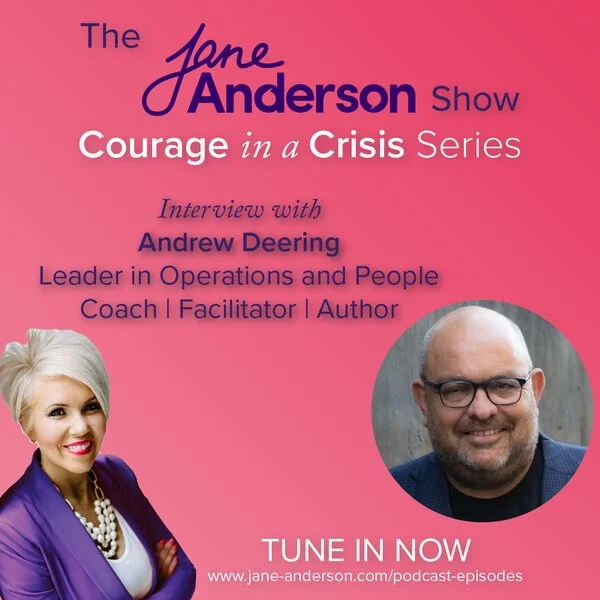
When the ground moves under a leader's feet, what do you actually do next?
I put that question to Andrew Deering in Episode 50 of The Jane Anderson Show, part of my Courage in a Crisis series, recorded in the thick of the COVID-19 pandemic. Andrew is the CEO of the Deering Group, a coach and facilitator, and the author of Create the Shift. He has spent more than 20 years working with organisations and their leaders on operational and organisational development and change programs, including work with Shell, the West Australian Government and Santos.
Andrew and I go back a long way. He was head of capability at an energy company when he sat through one of my training programs, and we have stayed good friends ever since. We are both based in Brisbane, although for this interview we were in isolation, not sitting side by side.
In our conversation, I focused on three ideas from his book that felt especially relevant to leaders in a crisis: the limiting beliefs we carry, how we invest our time, and whose feet we choose to sit at. You can listen to the full episode on Apple Podcasts, and here is what stood out for me.
Why Andrew Talks About a Shift, Not a Pivot
Andrew left corporate life four and a half years before our interview. He saw an opportunity to work with many organisations rather than just one, and today the Deering Group helps organisations "do people better". That means working out the capabilities an organisation needs, then building the frameworks, processes and skills to support them. He has a particular bias towards organisations with a frontline, high-risk workforce, having grown up himself "swinging a spanner". His team has also helped build national qualifications and frameworks for industries.
Alongside that sits his own mentoring and coaching practice for senior leaders, with a leaning towards the resource sector, although he told me the approach is useful wherever organisations are doing work. His summary of that work has stayed with me: it is about helping leaders get out of their own way, because they usually have remarkable people doing remarkable things. As he put it, the greatest shadow we can cast comes when we "hop in front of our own light".
So why a shift? Andrew explained that business is full of words like "pivot", and he does not dismiss them, but they felt less real to him. He pictures a ballerina's pivot as quick, easy and fast. A shift is harder work. It takes a while and takes effort. And if you think about moving house, you usually need a hand, because doing it alone is incredibly hard, if not impossible.
He wrote Create the Shift in a personal way, as though he is talking with you through each chapter. It includes activities and notes to help you have the conversation you need to have with yourself.
Key takeaway for leaders: A shift takes work, and it takes help. A real shift is more than a quick repositioning. Expect effort over time, and expect to need a hand from others, just as you would when moving house.
Andrew's Own Shifts: A Back Injury, a Pay Cut and Leaving Corporate
Andrew is clear that he has lived this himself. The first big shift he describes in the book's introduction began with his back. He had a severely strained disc, and the disc at L5-S1 was completely gone, which meant bone rubbing on bone. He could not walk more than 100 metres without crying. After meeting a doctor he describes as "cracking", he had a great outcome and has not had a piece of pain since.
While he was lying in a hospital bed, children nearby said something limiting, and he replied, "You can be anything you want to be. The choice is yours." That triggered a question for him: did he truly believe and live that? He saw that he had songs to be sung but was not currently singing them.
The answer involved changing organisations and careers, and stepping into a brand-new job with an $80,000 pay cut. His wife at the time wondered if he had lost his mind, and Andrew says to a degree he had, and that was okay. He needed to trust what he fundamentally believed. Years later, when he left corporate life, people asked what was wrong when things were tough out there. He simply knew he needed to create another shift.
The Noise Problem: Three Years of Change in Three Months
I asked Andrew what limiting beliefs he was noticing in the leaders he was working with during the crisis. His starting point is that people are truly amazing, and that most of the limits we live inside are ones we choose to create. Some limits are contextual, but largely we live inside our own box.
What he saw at the time was a lot of noise, from two sources. The first was the news and media: negative, unhelpful stories that may not be true, but that people take on and own. They are not the person's own story, but it is a story they choose to carry.
The second was the speed of change. In Andrew's words, we had experienced three years' worth of change in about three months. He pointed out that a "new normal" happens every day. What had changed was that we had compressed three years of it into three months, which is incredibly uncomfortable.
I added that more people were online and consuming more content at the time. I shared that content consumption had doubled, at levels I had not seen since 2012, after the GFC. The risk is that we absorb stories that may or may not be true without questioning them.
Is It Real, Is It True, Where's the Data?
Andrew's process starts with giving yourself time to pause, reflect and listen to your own self-talk. Spend time each day asking how you are feeling and thinking, and write down whatever comes out. When you hear a sentence in your self-talk, write it down.
You will probably find fear-based conversations in there, and Andrew says that is normal and natural. Do not beat yourself up about it, because that is pointless as well. Instead, pull the statement out and question it:
Is it real?
Is it true?
Where is the data?
So rather than accepting "the sky is falling, the world is ending", you test it. When people do this, Andrew says, they realise they are playing a story that somebody else has written and being a character in it, instead of writing their own. He compared this to a showreel that plays all the time. We can choose to be a character in it, or grab the showreel and play it for ourselves.
He added the step that sits behind those questions. If the belief is not true or not useful, what are you going to change it to? What is the belief that is useful?
For me, the part worth underlining is that question of whether it is helpful. If it is not, spend your time on something else.
Key takeaway for leaders: Test the story before you carry it. When you notice a fear-based thought, write it down and ask whether it is real, whether it is true and where the data is. Then choose a more useful belief.
Limiting Beliefs Often Exist to Protect You
One of the points I valued most was Andrew's caution about people who become evangelical about getting rid of limiting beliefs. Most of them, he said, are there for a reason. They are there to protect us and keep us safe, and he linked this to the guests I have had on the show who speak about psychological safety. We put these layers in place to keep ourselves safe, and if you tear them all down you leave yourself wide open.
His approach is to look at one belief at a time and be conscious about shifting to another conversation. He suggests being mindful that the belief is not there because it does not love you; it is there because it does. A limiting belief can be in service to you. So be mindful of it, challenge it, and then replace it in a useful way.
I agreed that it is easy to jump on the treadmill and follow what is being said. It takes real mindfulness at the moment to notice when that is happening.
Key takeaway for leaders: Replace a limiting belief; don't just demolish it. Many limiting beliefs began as protection. Challenge one at a time, and replace it with something useful.
Invest Your Time, Don't Spend It
The second area I asked about was time. In my conversations at the time, people sat at two ends of a spectrum. Some said they were flat out and wished for more hours in the day. Others had plenty of time, were updating their website and, as I put it, twiddling their thumbs with a bit of Netflix in there too. A chapter in the book on investing your time rather than spending it felt relevant to both.
Andrew drew on his earlier experience with investments: be mindful of what you have and how you can make the best use of it. Be conscious of the time you have and ask whether you are using it wisely, in a way that brings returns. He was honest that it is easy to sit and watch Netflix, Stan or Hayu, and that there are times he does too. Occasionally switching off your brain is important, he said, but not the whole time. The question is whether something is an investment or whether you are just spending.
For the leaders who are crazy busy, Andrew sees a risk in the busyness. Some people experience something he described as close to survivor guilt: they are doing exceptionally well while others are not, and they feel guilty. His advice is to be thankful and grateful, but not to own the unhelpful belief. He also encourages them to remember the whole person. There is more to us than work, so check in on family, friends, health, spiritual awareness and mental wellbeing. A calendar that is full can be great, and it can also be problematic.
For those who feel the rug has been pulled out, Andrew says there is nothing wrong with feeling a bit crappy about it. That is natural. The work is then deciding what you need to do.
He also showed me a simple model that he draws with people. One axis is the value you offer and the values you hold. Another is your purpose, why you are here and what you are meant to do. At the bottom, spending time means you are not adding value, probably not acting on your values, and not on purpose or on task. At the other end, when you are on purpose and adding value, the investment of your time yields the greatest results. When things get hard, he suggests asking what your purpose and value are, and anchoring into those. The model is on page 21 of the book.
Key takeaway for leaders: Treat your time as an investment, not a spend. Ask whether how you use your time brings returns, and anchor into your purpose and values. Keep the whole person in view, not just the work.
Busy or Quiet, Overwhelm Looks Similar: Find Your One Thing
Andrew sees overwhelm at both ends of the spectrum, just in different forms. One person has too much to do. The other asks where to begin. Or, as he put it, one is overwhelmed by an abundance of time they do not want, and the other by an abundance of opportunity they struggle to manage.
His answer is a simple process called the one thing: what is the one thing I can do right now that will make a difference?
If you are unsure what that is, the first chapter of the book covers the elements of life. Andrew works with people on a wheel of six elements and asks which is the most significant for them right now. It might be work or health. If you have more capacity, you can choose one thing for each of the six elements. What you should not do is think about the 25 things on your list. Work on one thing. When it is underway or done, find the next.
He suggests that every decision is a test: will this yield a reward that is substantial and useful for my one thing?
Two things I took from this. First, wherever you sit on the spectrum, centring on one thing is a way out of overwhelm. I like the saying that if you chase two rabbits, you will not catch one. Second, overwhelm and opportunity are different. In overwhelm you feel paralysed and may reach for Netflix, while the person who sees every opportunity can send themselves into overwhelm just as quickly. So I ask: what is the one thing that will create the greatest shift for you?
Key takeaway for leaders: Choose your one thing. Ask what single action will make a difference right now. When it is underway or done, choose the next.
The Feet You Sit At Matter
Chapter 10 of Create the Shift is one of my favourites. It is called "the feet you sit at matter". The idea is that we are all, in effect, in a classroom, with a teacher at the front and everyone else listening. So who are you listening to? Who is teaching you?
Andrew's first response was a challenge. If you think you do not sit at anybody's feet, you do. There are always people influencing us. If you are not conscious of who you are deliberately sitting with, you are probably sitting at the feet of the media, and he says that is not a healthy place to be.
The good news is that we have never had such access to wise people. Andrew pointed to podcasts, books and TED Talks. It does not have to be the literal person; it can be the figurative person. For the kind of work I do, he said he would come to me and listen to a podcast. On vulnerability, he named Brené Brown, whose research centres on vulnerability and courage. On leading or speaking better, he mentioned Matt Church, founder of Thought Leaders.
How Leaders Can Choose Who Shapes Them (and Their Teams)
When Andrew works with leaders on this, he starts with two steps.
Become conscious. Accept that you are always sitting at someone's feet, and that someone is choosing to lead you.
Become deliberate. Go back to the elements of life, pick the one you want to work with right now, and avoid overwhelm by focusing on one thing. Then ask what your goal and agenda are, what you want to achieve and who can help you.
Andrew is comfortable saying he does not know it all. He has people, including some he named in our conversation, who are astute in their own areas, and he sits at their feet depending on what he needs. For the leaders he coaches, he does the same: he introduces them to people, gives them a book or points them to a podcast, because he knows he cannot do it all.
He also turned this around for leaders. Too often, he said, leaders try to be everything, or the filler of the cup at all times. There are amazing resources, so how are you introducing your people to the wisdom you are accessing, and how are you helping them become more? His model is based on servant leadership: the more you serve your team, the more success you will have in your organisation.
I added that this matters even more in isolation. When we were physically in workplaces, we had some of these influences in our space. Online, quite often that means a Facebook or LinkedIn feed, and some of those are helpful and some are not. Making conscious choices about what you take in shapes the narrative and the mindset you adopt, whether you are playing above or below the line. And I think leaders are under more pressure to be change-makers, not just change agents.
Key takeaway for leaders: Choose your influences deliberately. You are always sitting at someone's feet. Be conscious about whose, choose people who fit the one thing you are working on, and introduce your team to them as well.
About Andrew Deering
Andrew Deering is the CEO of the Deering Group, a coach, facilitator and the author of Create the Shift. He works one-on-one with leaders, facilitates teams and leads organisation-wide initiatives, drawing on more than 20 years of operational and organisational development and change work. He is based in Brisbane.
Andrew's website: where you can find the book and his contact details
Andrew also offered listeners a tool from the book, the six elements of life, to help you work out what you are working towards and what your one thing is.
Frequently Asked Questions
What is the difference between a shift and a pivot?
Andrew Deering describes a pivot as quick and easy, like a ballerina spinning, whereas a shift is harder work that takes time and effort. He compares it to moving house, where you usually need a hand. A shift is a significant change rather than a repositioning.
How do you challenge a limiting belief?
Andrew suggests pausing each day to write down your self-talk, then asking of any statement: is it real, is it true, and where is the data? If the belief is not true or useful, decide what belief would be useful and replace it with that.
Should leaders try to remove all of their limiting beliefs?
Not according to Andrew. He notes that most limiting beliefs exist to protect us, and tearing down every layer can leave you wide open. His advice is to look at one belief at a time, challenge it and replace it in a useful way.
What does it mean to invest your time rather than spend it?
It means being conscious of the time you have and using it in a way that brings returns. Andrew says occasional downtime such as watching Netflix is fine, but not the whole time. He suggests anchoring into your purpose and values to test whether the time is adding value.
What can you do when you feel overwhelmed?
Andrew recommends finding the one thing: the single action you can take right now that will make a difference. When it is underway or done, find the next one thing. He notes that people at both ends of the busy-to-quiet spectrum can feel overwhelmed.
What does "the feet you sit at" mean?
It is the idea, from chapter 10 of the book, that we are always being influenced by someone. Andrew says that if you are not deliberately choosing your influences, you are probably sitting at the feet of the media. He encourages leaders to choose influences figuratively as well as literally, through books, podcasts and talks.
Conclusion
What I took from Andrew is that leading through a crisis begins with an internal shift. Before we help other people through it, we need to look at the stories we are carrying, how we invest our time and who we are listening to.
He offers a practical order of play. Question the story with three plain questions. Replace the belief rather than demolishing the protection behind it. Pick one thing, and keep the whole person in view. And choose the voices you learn from deliberately, then share them with your team.
As I said to Andrew, leaders are often focused outward on helping others through change. This conversation is a reminder to take some time to look at the shift you need to make in yourself, so that you can lead with courage.
Work With Jane Anderson
If Andrew's conversation resonated with you, here are some ways to take the next step:
Women With Influence: Join a community of B2B women consultants, coaches and advisors building world-class practices.
1:1 Coaching: Work directly with me on your personal brand and business growth strategy.
Grow With Influence: Explore my coaching for B2B practices.
✨ Tune in to hear Andrew Deering on limiting beliefs, investing your time and choosing the feet you sit at.
Key Takeaways from Today’s Episode:
-
It is more than a pivot: expect effort over time and a hand from others.
-
Ask whether a fear-based thought is real, true and backed by data.
-
Many began as protection, so challenge one at a time and choose something useful.
-
Anchor into your purpose and values, and keep the whole person in view.
-
Work out the single action that makes a difference now, then find the next.
-
You are always sitting at someone's feet, so decide whose, and bring your team along.