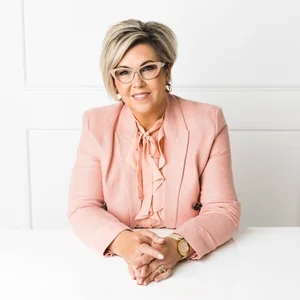
Episode 98 - How to Adopt AI in Your Business Without the Overwhelm: Lessons from AI Expert Inbal Rodnay
Podcast is also available on the versions below:


Get Notified Of Future Episodes on Apple Podcasts | Spotify | Youtube

If you feel like everyone else has already automated their entire business with AI and you're the only one still figuring it out, you're not behind. You're just listening to the loudest voices on LinkedIn.
That's one of the first things AI adoption expert Inbal Rodnay wants business owners, coaches, and consultants to hear. Rodnay has spent more than 25 years in software development and digital transformation, beginning her career building targeting software for fighter jets before moving into technology leadership roles and, eventually, full-time AI education and consulting. She now runs the AI for Accountants course and has presented to more than 30,000 professionals across Australia and New Zealand.
In the episode above, Rodnay shares the practical playbook she uses to help businesses adopt AI with confidence instead of fear, and the framework that helped her turn deep technical expertise into a thriving speaking and consulting practice. This article breaks down her approach: where to start with AI, how to get a whole team on board, and how to turn what you already know into content, authority, and growth.
Why So Many Businesses Feel Stuck on AI
Most professionals now have access to the same AI tools for roughly the same low monthly cost. The barrier isn't price. It's confidence.
Rodnay points out that some people use these tools constantly, some use them occasionally, and many barely touch them at all, the same way many businesses already underuse the Microsoft or Google licenses they're already paying for. The gap isn't access. It's adoption.
That gap shows up in the data, too. According to the National AI Centre's AI Adoption Tracker, a monthly Australian Government survey of small and medium businesses, roughly four in ten Australian SMEs currently report any level of AI adoption. In other words, most small businesses genuinely haven't started yet the fear of being the "only one" left behind isn't backed by the numbers.
The Fear of Falling Behind
A lot of the anxiety around AI comes from social media, not reality. Scrolling through posts about fully automated businesses can make it feel like everyone else has already figured it out and you're the only one who hasn't.
Rodnay is direct about this: that fear is mostly unfounded. Most businesses are still working it out. The businesses broadcasting total automation online are the exception, not the norm.
Early Adopters vs. Early Majority vs. Laggards
Rodnay uses a simple framework to help business owners locate themselves honestly: are you an early adopter, part of the early majority, or a laggard?
Her point is that most people don't need to be first. Being part of the early majority; adopting tools once they're tried, tested, and proven; is a perfectly sound strategy. The goal isn't to chase every new app the moment it launches. It's to avoid being left behind entirely.
The First Step to AI Adoption: Get Executives on Board
Before rolling AI out to a team, Rodnay always starts in the same place: the leadership room.
Her reasoning is straightforward. Any adoption effort becomes far harder later if the executives or partners aren't aligned from the start. So the first move in her process is running an executive briefing.
Running an Executive Briefing
In these sessions, Rodnay opens her own ChatGPT, Microsoft Copilot, or Google Gemini account, whichever tool is most relevant to that business, and shows leadership exactly how people are really using AI. Not the hype. Not the theoretical future. What's actually happening in businesses right now.
This step matters because it replaces speculation with evidence. Leaders stop guessing about what AI can do and start seeing it.
Answering the Hard Questions
Executive briefings also surface the questions that actually block adoption: data security, client confidentiality, staff training, and how to maintain quality of work when AI is doing some of the heavy lifting.
Rodnay treats these as valid concerns, not obstacles to talk people out of. Working through them directly, rather than glossing over them, is what gets skeptical leaders on side.
This lines up with what's happening more broadly across Australian businesses. The National AI Centre's own research found that around 65% of businesses that haven't adopted AI point to distrust in AI decision-making, or a preference to keep humans in control of their processes, as the reason. Trust, not capability, is the real barrier which is exactly what an executive briefing is designed to address. Once leadership is aligned, the rest of the rollout becomes significantly easier.
The Two AI Tools Every Business Should Start With
Rodnay is deliberately unspecific about which tool to master first, with one exception. When asked what to start with, her advice is simple: pick two.
ChatGPT and Advanced Voice Mode
If someone is only going to do one thing, Rodnay recommends opening a ChatGPT account and using its advanced voice mode; a feature that lets you have a spoken, conversational exchange with the AI on any topic, similar to a phone call.
She also recommends turning on memory options so the tool learns context over time: your location, your spelling preferences (Australian or New Zealand English, for example), your role, and your industry. That way, the tool becomes more relevant with use instead of requiring the same explanation every time.
If you want to see what this looks like when it's built specifically around one person's expertise rather than general knowledge, Jane's own AI-powered coaching tool works on a similar principle; trained on a specific body of knowledge so it gives relevant, contextual answers instead of generic ones.
AI Meeting Assistants
The second tool Rodnay recommends is an AI meeting assistant, a tool that connects to your calendar, joins scheduled video calls automatically, and transcribes the conversation.
The value goes beyond meeting minutes and action items. A written transcript of every conversation becomes searchable material you can hand back to AI for far more: drafting blog post ideas, coaching feedback on how you facilitated a session, or brainstorming next steps ahead of a follow-up call.
Rodnay recommends going one step further: set the meeting assistant to automatically save every transcript as a document in a folder. This protects your history if you ever switch tools, and it means every conversation you've ever had becomes something you or your team can search later.
Jane has put this into practice herself. On Rodnay's recommendation, she set up an AI meeting assistant and connected it to her project management tool, so tasks from meetings are automatically created and assigned to the right person. Her executive assistant then reviews anything assigned to Jane, so nothing slips through the cracks between a conversation and the follow-up action.
Turning Conversations Into Content and IP
Once conversations are captured as text, they stop disappearing. This is where Rodnay's approach becomes genuinely useful for coaches, consultants, and other experts who are constantly generating insight out loud but rarely capturing it.
From Transcript to Blog Post
Every recorded talk or meeting is a potential source of content. Rodnay's own workflow includes pulling questions the audience asked out of session transcripts which, she notes, is one of the most useful outputs, since audience questions double as ready-made blog post ideas.
From Keynote to Book Manuscript
Rodnay used this same approach to write her upcoming book, currently in final edits. Rather than sitting down to write from scratch, she worked from an outline of chapters and topics, then had an editor work through transcripts of her past keynotes and meetings; recorded via an AI meeting assistant, to extract the material.
Her reasoning: talking through a topic repeatedly, out loud, was something she could do easily. Writing the whole thing from a blank page would have been far harder. The recordings did the heavy lifting.
This is close to the same method behind Jane's Content Creation Bootcamp, which uses AI and transcripts to turn spoken ideas into publish-ready content and manuscripts.
Speaking as a Growth Engine for Consultants and Coaches
Tools aside, Rodnay is candid that the single biggest shift in her business came from speaking.
She started by speaking for free. Growth followed once she learned not just to get on stage, but to let audiences know clearly, what she actually does. Early on, she'd finish keynotes to praise and a common follow-up question: "What do you actually do?" That was the sign her talks were giving value but not converting it into visibility for her services.
How Speaking Builds Authority and Trust
Once Rodnay adjusted her talks to include not just information but how she gained that information, from being inside real businesses and working with real teams, audiences began to understand her expertise and her offer at the same time. Every talk since has brought more people into her audience: some ready to work with her immediately, others simply now aware she exists.
There's a compounding effect here worth noting for any expert building a practice: speaking doesn't just generate leads directly. It builds pre-existing trust before a sales conversation ever happens. It's the same principle behind how speaking builds a consulting practice.
Positioning: Why a Framework Beats Reinventing the Wheel
Rodnay is exceptionally good at her technical craft AI, digital transformation, teaching technology. What she says she lacked, for years, was a structure for running the business side of her expertise.
She describes owning a well-known thought leadership framework for roughly a decade before it made any real difference to her business. Reading it alone wasn't enough. What changed things was having someone help her apply it - translating a general framework into a specific, sequenced plan for her particular practice, similar to the structure behind Jane's Grow With Influence program.
The result, in her words, was a level of business growth she hadn't previously thought possible, it is not because the information was new, but because she finally had a structure and someone guiding the application of it.
For another example of a technology-focused expert who built her practice this way, see how another technology transformation leader built her practice.
Overcoming Bias and Building Presence as an Expert
None of this : the tools, the framework, the growing audience, happens in a vacuum. Rodnay has also had to work harder than most to be taken seriously in the rooms where she's introducing AI in the first place, as a woman, and as an immigrant, in technology and innovation roles that were often dominated by men.
Why Small, Deliberate Choices Changed How She Was Perceived
Early in her career, she made a deliberate choice: to walk into meetings with a firm handshake, a serious expression, and without smiling too readily small, intentional adjustments designed to disrupt assumptions before a single word was spoken. She also stopped small gestures like holding doors, choosing instead to let people form an impression of her expertise before deciding how to categorize her.
Over time, and as her reputation and visibility (largely through speaking) grew, this changed. Now, she says, she can walk into a room with warmth and a smile and still hold that same authority because the audience has often already seen her on stage before they meet her in person.
It's a useful reminder for any expert, particularly those who don't fit the default mold of "authority" in their industry: credibility can be built deliberately, and visibility is one of the fastest ways to build it.
Frequently Asked Questions
What's the easiest way for a small business to start using AI? Start with two tools: a ChatGPT account with advanced voice mode and memory turned on, and an AI meeting assistant that transcribes your calls. Together, they cover the most common starting points with minimal setup.
What is an AI meeting assistant, and do I need one? An AI meeting assistant connects to your calendar and automatically joins and transcribes scheduled video calls (Zoom, Teams, Google Meet). Beyond minutes and action items, the resulting transcripts can be used for coaching feedback, content ideas, and searchable business records.
How do I get my team or leadership on board with AI? Start with an executive briefing rather than a company-wide rollout. Show leadership real examples of how people are using AI, and address their specific concerns: data security, confidentiality, training, and quality control.
Is it too late to start adopting AI in my business? No. Most businesses are still in the early stages; Australian Government data shows roughly four in ten SMEs have adopted AI so far. Aiming to be part of the "early majority" adopting proven tools once they're established, is a realistic, sound approach.
How can speaking engagements help grow a coaching or consulting practice? Speaking builds visible authority and trust before a prospective client ever has a direct conversation with you. It also expands your audience with every event, some of whom will be ready to work with you immediately and others who simply become aware of what you do.
Can AI really help turn talks or meetings into a book? Yes. Recorded transcripts of talks and meetings can be organised around a chapter outline and refined by an editor, turning spoken material into a rough manuscript is far easier starting point than writing from a blank page.
Conclusion
The overwhelm so many business owners feel about AI usually isn't about the technology itself. It's about not knowing where to start, and assuming everyone else already has.
Inbal Rodnay's approach cuts through that noise: align leadership first, start with two accessible tools, and record everything, because the conversations you're already having are more valuable than you might realise. Layer on a genuine, applied framework for growing your own practice, and the combination of expertise plus visibility becomes the real engine for growth not the tools alone.
Work With Jane Anderson
Want to build a practice like Inbal Rodnay's, one where your expertise, your visibility, and your framework all work together? Explore Jane's Grow With Influence program to see how a structured framework can help you grow your own business.
Key Takeaways from Today’s Episode:
Executive buy-in comes first. AI adoption efforts stall without leadership alignment - start there before rolling tools out to a wider team.
Aim for the early majority. You don't need to be first to adopt AI, and being cautious doesn't mean you're falling behind - roughly four in ten Australian SMEs have adopted AI so far, according to the National AI Centre.
Start with two tools. ChatGPT (with advanced voice mode and memory turned on) and an AI meeting assistant cover the most ground for the least effort.
Record everything. Meetings, talks, and keynotes become searchable content - and potential blog posts, coaching feedback, or even book material.
Speaking builds trust before the sales conversation starts. It's one of the fastest ways for an expert to build visible authority.
A framework only works once you apply it. Access to information isn't the same as having a guided, sequenced plan for your specific business.


Most of the guests interviewed are current or alumni members of the Women With Influence community. Click here to find out more