Podcast is also available on the versions below:

Get Notified Of Future Episodes on Apple Podcasts | Spotify
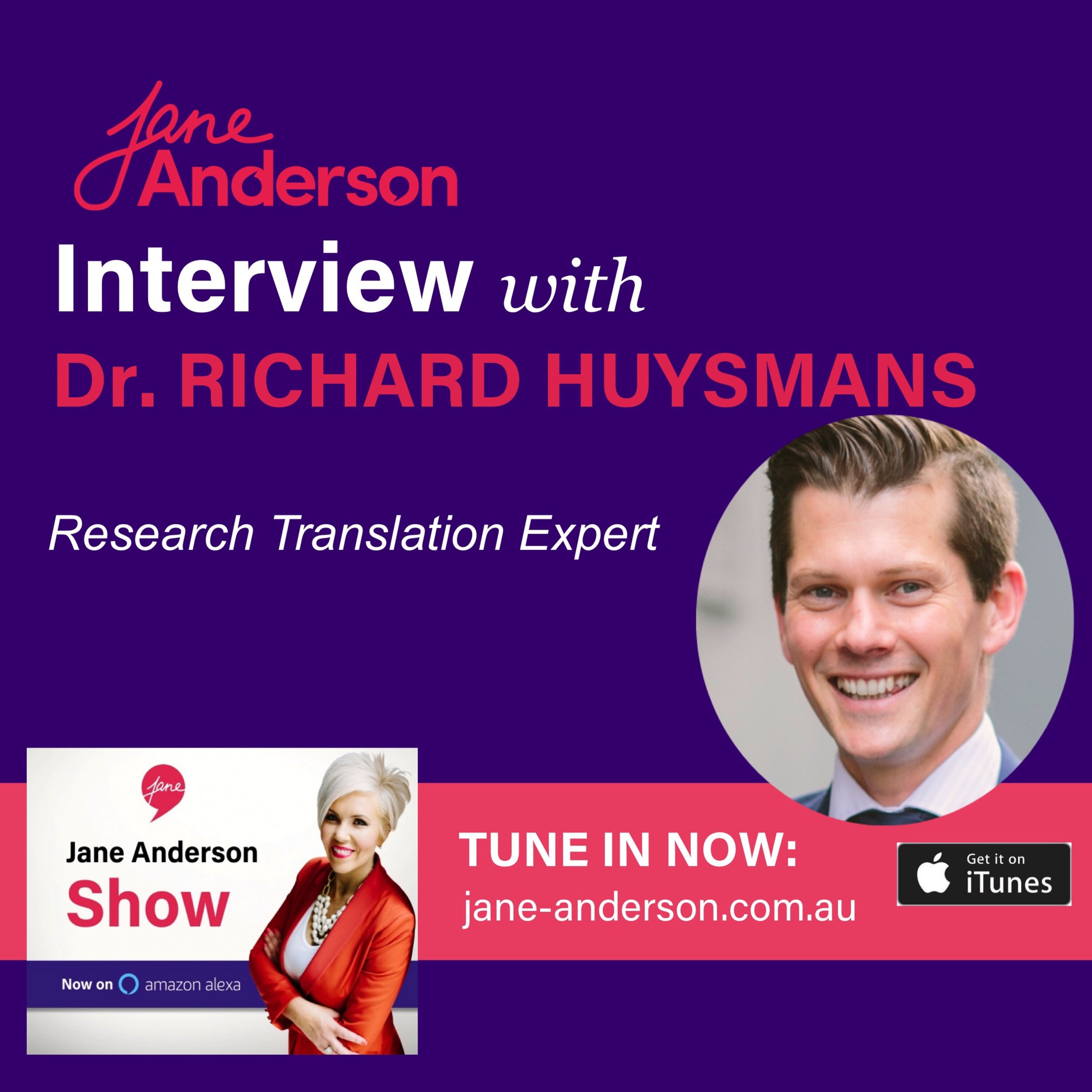
You have spent years becoming an expert in your field. So what do you do next?
That is the question my guest, Dr Richard Huysmans, helps researchers answer. In this episode of The Jane Anderson Show (listen on Apple Podcasts), I sat down with Richard, a research strategist who works with PhD students, established researchers and research leaders to turn their training and research into real opportunity.
Richard and I have worked together with universities and research institutes for some time, so we went straight to the practical questions. Why does personal branding for researchers matter? How do a personal website and LinkedIn give you control a university page cannot? Why are funders paying more attention to impact? And how do you approach a potential industry partner without handing a business card to a stranger?
What Research Translation Really Means
As I explained at the start of the episode, research translation is about taking the work researchers have done and putting it in language the general reader can understand.
Richard's own focus is a question that people with a PhD, or on the way to one, keep asking: "What do I do next?" For PhD students that is often a career question. For established researchers it might be how to make the most of their research, how to find an industry partner or how to use social media. Much of his work is coaching, training and workshops that take people from not knowing what to do next to knowing, and then to implementing it.
He helps researchers understand the skills they have, what their audience might want to hear about, and where the two meet. He pictures a Venn diagram, where "in the intersection of what you know and what they want is relevance."
He is also candid about the word "translation". It is easily confused with translating English into German, when what he means is translating from scientist to non-scientist. In his experience, people care less about the label and more about how they are relevant to others, and how others are relevant to them.
Why Researchers Should Own Their Name Online
Many researchers hesitate to set up a yourname.com website because being the centre of attention feels uncomfortable. Richard agrees it is a massive barrier. His advice, though, is that you should do it, because "you can control that environment."
You can control your own website and social media profiles, including Twitter and LinkedIn. You cannot control what your employer, grant providers, funders or collaborators do with information about you. Universities often limit how long a staff website can be and what it can refer to. Your own site, within the legal constraints we all work under, can hold your earlier work and your new work.
This is not only for researchers planning a consultancy. If you simply want to be known in research, a personal site will be "far more findable than if you live buried on a university website." You can link between the two in both directions.
The High Street Analogy
Richard compares the university to the council that manages a high street. The council encourages people to visit, but it cannot force anyone to buy or sell. You, the researcher, are an individual store on that street, and you manage how your brand is presented within the constraints the council sets.
His example comes from Melbourne, where high streets put small discs on the ground to show how far a café's chairs can go, so that passers-by can still walk along the footpath. The café works within that constraint while still serving its customers. Thinking of yourself as a small business operating within someone else's constraints, he says, is more effective than waiting to see whether the university helps or hinders you.
From Lurker to Participant on LinkedIn
I asked Richard whether researchers are getting more comfortable with LinkedIn. He sees more and more of them there, partly because universities are encouraging PhD students to join. But he sees a gap between being on social media and being a participant.
Many researchers end up as lurkers. Richard was clear that he does not mean this as a criticism. They join, then feel uncomfortable about how to behave. His analogy is a conference. If you have something good to say or a good question to ask, you ask it. If you like what someone presents, you clap. On social media, the equivalent is a like. Become a participant, he says, and people will see you there.
He also made a point about audience size, and I agreed with him. "It doesn't matter whether you've got 10 or 100 followers," he said. What matters is how many of them engage. If 9 out of 10 followers engage with your content, that is far better than 1 person in 1,000 engaging.
Richard and I also teach this together. We created a program called LinkedIn for Research Translation, with an online course and workshops. I come from the technical side of LinkedIn, such as building a great profile. Richard comes from the question of how it is relevant for an academic researcher.
Why Funders and Rankings Increasingly Reward Impact
Richard explained why this matters beyond personal visibility. The Australian Research Council (ARC) and the National Health and Medical Research Council (NHMRC), he said, are looking for researchers to have more impact. By impact, he means end-user impact, which often means impact on non-researchers and non-academics.
In his view, one acceptable way to show it is to build a large social media following that you can communicate your research to, so that others pick it up in print media, on television and on other people's blogs. At a talk at Monash University, he told the audience they can build the communication side of a grant before they know which grant they are after, simply by growing a following around good content in their space. That is why he sees social media as a good idea for researchers all the time, not only at grant time.
He also pointed to Excellence in Research for Australia (ERA), which he described as a periodic national review of how effective Australian research is. Richard noted that the most recent results at the time of recording, for the first time, included impact statements, and that the equivalent exercise in the United Kingdom has used them for longer. If you cannot show impact, he said, you can expect to be marked down. This does not carry a massive amount of funding weight yet, but it may. For context, the ARC describes its Engagement and Impact assessment as separate from ERA, with 2018 as its inaugural round.
International university rankings, Richard added, also look at industry and social impact. One of their biggest measures is a survey in which people, including non-academics, list the universities they think are best in a topic area. If people know you are from your university because you are active on social media, you can give your university, and your own research, a boost.
Be Findable: Google, Journalists and the Second Page
Social media now allows people whom researchers might consider non-experts to be found and seen as experts. Anyone can search the internet on any topic, and Google decides what ranks first. That could be an academic. It could also be someone with non-mainstream views, or someone whose views are backed by research.
If you want to be heard as an academic, you have to be found on Google. I have a line I use: the best place to hide a dead body is the second page of a Google search. Richard could not agree more. Who goes past page two?
Journalists do not usually ask who the best academic on a topic is. They look for who knows a lot about it and go to that person. Richard pointed out that I get called regularly, and that while I am not an academic in this space, I bring plenty of real-world experience. Researchers who want to be included in those conversations need to be findable in the same places.
Do Academics Need to Lift Their Game?
During the Women With Influence leadership program I ran with Griffith University in Brisbane, I explained that I could create a certification around my own intellectual property and teach it to marketing consultants. I would be competing with a Cert IV in social media, and I do not need to put it through a tertiary qualification, because most people who come to me say they just want to learn the real skills and implement them.
I also mentioned Tracey Hughes, whom I interviewed not long ago and described as the world's most awarded hairdresser. She made the same point: you no longer have to go to TAFE to become a world-class hairdresser. You can watch a YouTube video, and if you can follow it and get results for people, you have a business. I asked Richard whether academics now have to lift their game.
"Definitely," was his answer. If you want to be asked for your opinion as an expert, you have to be on social media. If you are not being asked and are comfortable with that, you do not need to be. But he sees a big push towards industry and impact, which is why the assessments and rankings above matter.
It is your call, Richard said, and you can choose not to play. But "choosing to ignore it is, I think, not the right thing."
Too Busy, Misquoted or Out of Control?
A recent group I worked with raised a fear that putting themselves out there would make them busier. We also talked about PR and television interviews, where there is a worry that your message might be misconstrued.
I put it to Richard that people often think getting on social media means losing control, when it is actually the best way to gain it. He agreed. He pointed out that we were producing this very video with no one's permission other than our own. The editing and the message were entirely up to us, and it would go wherever it went based on that, not on whether a university thought it was good.
Inside Connect the Docs: A Guide to Getting Industry Partners
Richard had his book sitting beside him, "strategically placed", as he put it. Connect the Docs (that is D-O-C-S, not D-O-T-S) is a guide for researchers on getting industry partners. In it he shares ways he has helped both organisations and individuals do that, plus tools that improve your chances.
You Probably Have More to Offer Than Your Results
Researchers who describe themselves as basic researchers, for example those studying how a cell works, often do not see themselves as able to work with industry. The end use of their knowledge may be a long way off.
Richard's response is that you already do many things people are interested in. Your research techniques, research writing and technical writing could all be something you connect with industry over. He has seen people successfully commercialise the process they use for research rather than the outcome. That can be easier, he said, because you are less attached to your method than to your results. And because academics teach, he asks, why couldn't an academic go into an organisation and teach something?
The Same Fears Show Up Across Disciplines
Richard has worked with social workers, engineers, biomedical scientists and psychologists. He finds that all disciplines struggle in similar ways, with a fear of social media and a fear of industry. He calls these legitimate fears. Getting onto social media for the first time is daunting, and then you realise nobody is listening, which creates a different problem: you need an audience.
The book covers building an audience, and it recognises that people are more or less extroverted, so different approaches will suit different people. It also deals with time. Social media can become a time sink, and if you are already busy, spending more time on it is not good for a lot of people.
Turning Journal Articles Into Content That Gets You Noticed
When I asked Richard for LinkedIn tips, he started with content, because that is what people struggle with most. If you are not putting out content, it is hard to be seen as an expert.
His encouraging observation is that academics already have "a ream of content" in their journal articles. If you lack confidence posting opinion rather than what you consider fact, you can rest on peer-reviewed work and talk about it. The key is to make it accessible:
Avoid the jargon from the article, and avoid being overly technical.
Do not simply post that you have a new journal article, unless it is a Nature paper, which comes with its own kudos.
Explain what you did and what you found, then link to the science. In his words: "Here's what we did. Here's what we found."
Richard said this approach has worked for researchers, who have gone from essentially zero interaction on LinkedIn to literally a quarter of a million dollars in grant funding for research. It is possible, he said, and it makes a difference.
How to Approach Industry Partners on LinkedIn
I asked Richard what the first steps are. Here is the approach he recommends:
Know what you want from LinkedIn. Not everything you do will be something you want to commercialise or talk about, so decide before you start.
Research the companies and industries you are interested in. Richard joked that "stalking's good" here, meaning find out who they are.
Treat it like meeting someone at a conference. You would not tap a stranger on the shoulder and hand over a business card. The LinkedIn equivalent is to just click connect, which he advises against.
Identify someone worth connecting with, such as the research and development manager at a company you would like as an industry partner.
Explain why in the connection request. Say why you think the relationship would be useful.
Start a conversation, not a pitch. You would not tell someone at a conference you want them to spend a million dollars on your project. Say who you are, what you are interested in, what they seem interested in, and suggest a chat.
Richard added that he got most of this advice from me, so he felt he was telling me my own advice back. It has been very much a team effort, and I have learned a lot from Richard too.
What Richard Planned Next
When we recorded, Richard was keen to build a bigger networking group for people working with industry, off the back of the book. His invitation was for anyone interested to reach out and say they would like to be involved.
He described Connect the Docs as the first of three books. Join the Docs would look at industry coming to academics, and Doc to Doc would cover academics collaborating with each other. But where he most wanted to head was working closely with PhD students. He sees them as a great foundation for the economy and for the research and non-research sectors, and felt they were massively underserved and underused as a resource for companies. He wanted to work on both the training side and the employment side.
Frequently Asked Questions
What is research translation?
It means taking the work researchers have done and putting it in language a general reader can understand. Dr Richard Huysmans thinks of it as translating from scientist to non-scientist, and frames it as relevance: the intersection of what you know and what your audience wants to hear about.
Why should researchers have their own website?
Richard says you can control your own website, but not what an employer, funder or collaborator does with information about you. A personal site can hold your earlier and newer work, and he believes it will be far more findable than a page buried on a university site.
How can LinkedIn help researchers find industry partners?
Richard recommends knowing what you want from LinkedIn, researching the companies and people you are interested in, and explaining in your connection request why a relationship would be useful. Open with a conversation rather than a pitch.
Do funders care about social media?
Richard said the ARC and the NHMRC are looking for researchers to have more impact on end users, often non-academics. In his view, a large following that helps you communicate your research is one acceptable way to show it.
What should researchers post on LinkedIn?
Richard suggests starting with your journal articles, made accessible. Avoid jargon, explain what you did and what you found, and link to science.
About Dr Richard Huysmans
Dr Richard Huysmans is a research strategist who helps researchers get the best out of their training, their research and their careers, with a focus on research translation. He works with PhD students and researchers, as well as research managers, centre and institute directors, deputy and pro vice-chancellors and faculty managers, on areas that include career growth, research teams, strategic planning and taking research to industry. He is the author of Connect the Docs, a guide to getting industry partners as an academic.
In my introduction I noted that all of his proposals for new research institutes and centres have been funded, that 67 per cent of his clients' grants and tenders have been funded, and that 80 per cent of his clients return for new work.
Connect with Richard.
Conclusion
Personal branding for researchers, as Richard describes it, comes down to control, relevance and being found by the people who could use your work. A personal website lets you decide how your research is presented. LinkedIn lets you take part in the conversation rather than lurk at its edge. In his view, funders and ranking bodies are paying more attention to impact, and accessible content is one way to show it.
If there is one thread through our conversation, it is that you can choose not to play, but ignoring the shift is a different matter. Richard's advice comes back to a few simple steps: decide what you want from LinkedIn, put a journal article into plain language, and approach one potential partner with a thoughtful connection request.
Work With Jane Anderson
If Richard's story resonated with you, here are some ways to take the next step:
Women With Influence: Join a community of B2B women consultants, coaches and advisors building world-class practices.
Grow With Influence: Explore my coaching for B2B practices.
1:1 Coaching: Work directly with me on your personal brand and business growth strategy.
Toolkit: Take a free scorecard to see where your personal brand, marketing and business development stand.
✨ Tune in to hear Dr Richard Huysmans on personal branding for researchers, LinkedIn, and turning research into industry opportunity.
Key Takeaways from Today’s Episode:
-
Research translation starts with what you know and what others want to hear about. The overlap is relevance.
-
A personal website gives you control that an employer, funder or collaborator does not, and it can be far more findable than a university page.
-
Become a participant on LinkedIn, the way you would clap at a conference. Engagement matters more than follower numbers: 9 engaged followers out of 10 beats 1 in 1,000.
-
Richard says the ARC and NHMRC want end-user impact, and that national assessments and rankings are paying attention to it too. Social media is one way to communicate it.
-
If you want to be heard as an academic, you have to be found on Google. You can choose to stay out, but Richard says choosing to ignore the shift is not the right thing.
-
Research techniques, research writing, technical writing and teaching can all be points of connection, and a process can be easier to share than an outcome.
-
Skip the jargon, explain what you did and what you found, and when you reach out, say why a relationship would be useful and start a conversation, not a pitch.