Podcast is also available on the versions below:

Get Notified Of Future Episodes on Apple Podcasts | Spotify
If you went and got an Australian business number tomorrow, what would your chances be of still trading in three years?
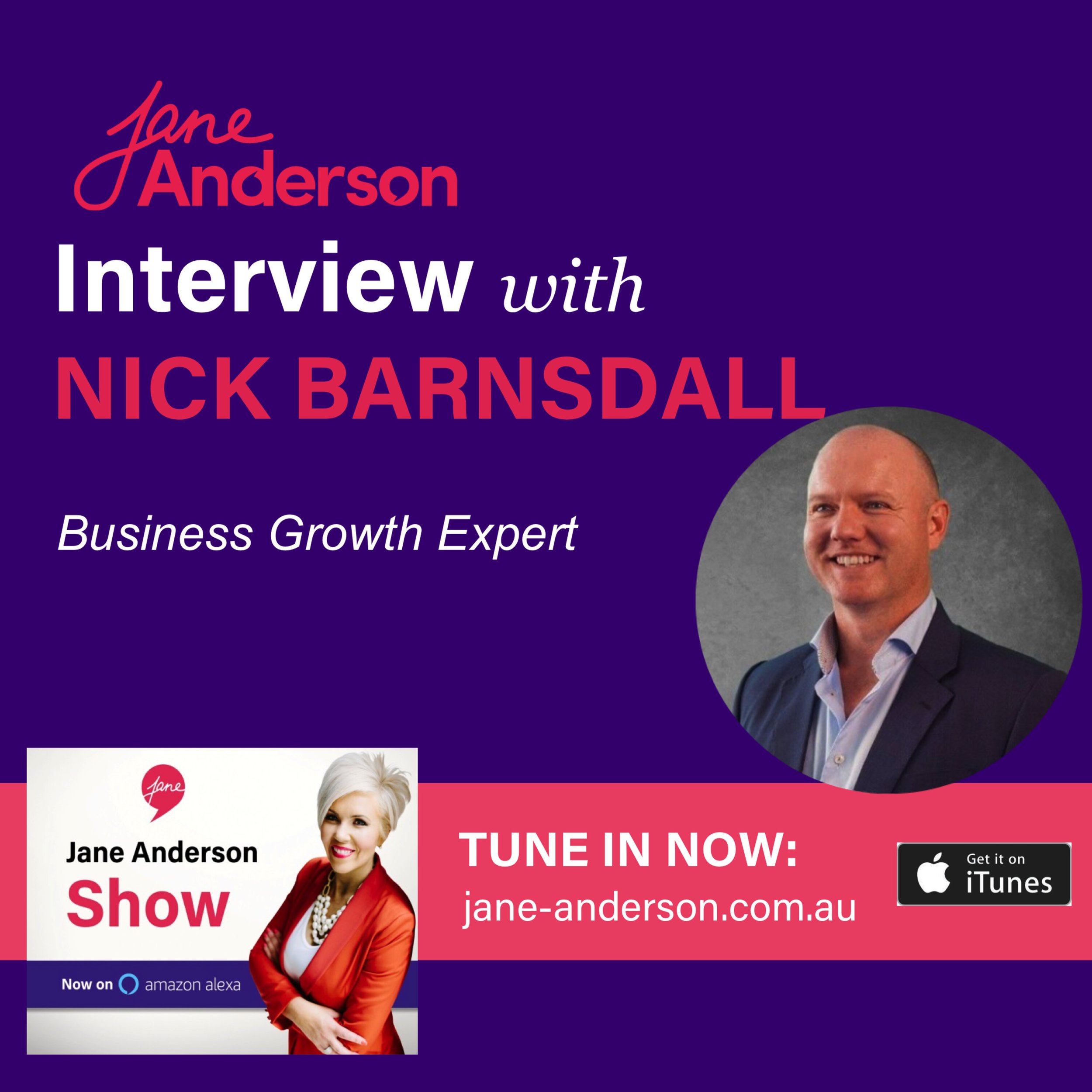
That question sits at the centre of my conversation with Nick Barnsdall on The Jane Anderson Show. Nick is a business investor, mentor and author who has had ownership of 34 companies across more than 25 years, and he was involved in 12 at the time of recording. I first met him around 2011 or 2012, just after the Brisbane floods, when his business coach introduced us and suggested I write his LinkedIn profile.
In this episode, Nick walks through the research he pulled together on the small business failure rate in Australia, and why he believes a turnover of more than $2 million and a team of at least five is a real sweet spot. We also talk about knowing yourself before you build, and why a personal brand works best when it is not about you.
From Three Jobs at School to 34 Businesses
Nick grew up in Hamilton, New Zealand. His parents moved there from Auckland when he was very young, he says, to give him and his sister a better standard of living. His father started a business when Nick was about three, buying a bread run: delivering trays of bread to convenience stores in the early hours of the morning. His parents later bought a fish and chip shop. That business failed, their marriage deteriorated, and the family's quality of life changed dramatically.
By the age of 10, in 1985, his parents had separated and were rebuilding their lives, so Nick started working after-school jobs. By about 12 he was working several jobs: at a radiator repair workshop after school, at service stations on weekends, and on a night shift moving freight at a courier firm during the week. In his last year of school, at 15, he was working close to 40 hours a week on top of study. "I left school early," he told me. "I'm not recommending it, but that was my journey."
He describes his first business mentors as his parents, "through good and bad", along with the small business owners he worked for. Looking at who was doing well, he noticed a common theme in property. He bought his first investment property at 16, together with his mum because he could not sign for a mortgage himself, and his second by 19. He founded his first company that same year, in 1994.
Nick has since had some form of ownership in 34 companies, whether by founding, buying, leading, non-executive directorships or shareholdings. For 12 years he was CEO of Hyundai Construction Group in Australia, a business started from scratch in 2003 and grown to $100 million a year in turnover with more than 100 staff. His view is that "you learn anything quicker when you do it at scale".
In 2007 he woke up and told his wife that he really wanted to help people in business. For the last four or five years he has been a full-time investor in businesses, looking for startups, high-growth companies and turnarounds. Money alone is not the point. He asks whether his skill set can help accelerate a business, because that is where he finds his satisfaction: a better outcome for the owner, the customers and the employees around it.
Why Nick Wanted to Scale His Message
Investing in or consulting to a business is one-to-one work, and Nick calls it a narrow channel of help. So he asked himself how he could scale it. His answer has been online courses (being developed in audio and video versions), keynote speaking and his book, Better Business Better Life: 5 Key Skills to Have a Thriving Business, Break Through Plateaus and Create the Lifestyle You Want.
The title matters to him. For the owner of a small business, he explains, the business sits at the core: when it is well, home life is well, and everybody around the family is well. The building blocks he emphasised in our conversation were people, persona, promotion and profit. Or, as he put it, "if you're not growing, you're shrinking". He asks a pointed question of every owner: are you the right person today to lead this business, or do you believe you can become that person?
He is candid that many people say they do not like sales. He does not claim to be a naturally gifted salesperson, but he spent a lot of time selling throughout his career and learned. He is just as direct about profit. When people move from being an employee to owning a business, he says, they often get confused about what the business needs to earn, and money is still treated as taboo. Yet profit, he argues, is a driver of everything owners want, from schooling to holidays.
The Small Business Failure Rate in Australia: What Nick Found
Nick has a methodical mind. If he wanted to help more people in business, he needed to understand where things go wrong, so he went looking for the failure rate.
The starting figure he found was a number put out by the Australian Bureau of Statistics: 60% of all businesses fail within three years. That leaves a 40% chance of survival. "If you went and saw a doctor and they told you that, you wouldn't be very happy," Nick said, yet people start businesses on those odds. ABS figures on business entries, exits and survival vary by industry, business size and the years measured, so the ABS Counts of Australian Businesses publication is a useful place to read the underlying tables yourself.
Nick's next thought was that 60% is a very broad statement covering very different businesses. When he broke it down, he found that some industry sectors perform worse than others, and so do some company structures. Sole traders and owner operators carry far more risk. A business formed as a company or a trust has better survival rates. Employee numbers and turnover then add further layers.
Where the Risk Concentrates
Take the worst of each segment and the picture changes. A business in a weaker industry, run by a sole trader with no employees and turnover below $200,000 a year, can face a failure rate as high as 80%. Nick notes that this profile describes about 90% of all businesses in Australia. I added that many personally branded businesses, which are often the people listening to this show, sit in the same group.
At the other end of the spectrum, with turnover above $10 million and 20 or more employees, the survival rate becomes very high. Nick puts the failure rate there at about 20%.
Between those ends sit many scales: one to four employees, five to 19, and turnover from $200,000 up to $2 million.
Why $2 Million and Five Employees Is the Sweet Spot
From that breakdown, Nick developed a simple idea. If you can start a business with a plan to have at least five employees and reach $2 million in turnover, he says, the industry sector matters less, although it is still a factor. It is worth looking at which areas you want to go into.
He knows many listeners will think they will never reach $2 million a year. That is where the work comes in. You need to get educated on how to build a business plan that takes you north of $2 million, and once turnover reaches a reasonable level you will need staff anyway, so the team comes organically. The main thing is to start with a plan for how you could reach $2 million, $5 million or $10 million. Nick is not talking about one year. He asks whether it is three years or five.
This is where he says his expertise lies: building a business plan above that $2 million mark, and taking people through the mind shift. As he describes the mentoring side, you break down barriers such as "I don't really want to have staff" or "I don't want the business to be this big".
In my own work with clients, I aim to get them past the million dollar mark first. Nick called that the launch pad. Once the platform is set, we can look at what comes next.
Why Sole Traders Are the Most Exposed
Nick uses an analogy often. If you are a sole trader with turnover under $200,000, you are in what he calls the most at-risk demographic. When the business hits a downturn or the economy gets tough, "there's no one else left to fire". You are it.
Your tolerance for a drop in turnover, which is where your income comes from, is very slim. The ability to cut costs is almost nothing. As Nick joked, what are you going to do, turn the lights off an hour earlier? There are things you can do, and he covers them in the book.
The larger a business becomes, the more levers it has. They are probably the same levers, he says, but each one has a greater impact, and, like a gear stick with more slots, more room to adjust. If it is just you and your tools in the garage, you are putting a lot at risk. "There's a lot of naivety there," Nick said, and the owner becomes very vulnerable. I have seen this with clients I have worked with, and I have been there myself.
The Human Cost Behind the Numbers
This was the most serious part of our conversation. Nick compared the choice to a health diagnosis. If you were given a serious diagnosis and could make choices that improved your chances of survival, you would make them. In business, he says, the choices can be much the same.
If an owner decides the business will simply stay a certain size, Nick points out that the outcomes can include divorce, suicide and domestic violence, which he says feature heavily in small business. People talk about those outcomes, he told me, but not often about the root cause: the pressure and stress around finances, long hours and not making ends meet, which build up over time. I agreed that these outcomes do show up often.
If this section resonates with you personally, Lifeline offers free, confidential support 24 hours a day on 13 11 14.
Business or Hobby? Be Real From the Start
Nick is firm on one point: be real from the start. Are you building a business or is it a hobby? Unless you have the financial backing to treat it as a hobby all day, he says, you might be better off keeping what you love as a hobby while building something else. The two do not have to be mutually exclusive, and they can connect. But you certainly need a business plan that builds a strong enough engine for the business to survive the tough times.
I raised the idea of the expensive hobby, and Nick agreed, noting that he covers this in the book too.
Know Yourself: Using the Quiz as a Data Point
Nick's website has a quiz, and his book includes links to it. You answer a series of questions and get a result such as entrepreneur, hobbyist, manager or leader. I think it is a great little quiz because it asks people to stop and consider whether this is really what they want, rather than building a business because of what others expect.
Nick sees the quiz as a data point. Can anyone be in business? To a point, he says, but you have to know yourself. The people with natural entrepreneurial traits are fine. The people without them who are not aware of it are in what he calls the danger zone. The aim is not to tell anyone they should not be in business. It is to create a pathway so you know what to change, such as shifting your mentors or the group of friends around you. Nick calls this a filter: if you cannot get through one way, a slight change may make it work.
He pairs this with the matrix of business structure and survival rates. Knowing the structure of the business, its likely survival rate, and your own strengths and weaknesses gives you something to act on. And it is a journey: after 25 years of owning and running businesses, he says, he is a very different person in his business decisions from who he was 25 years ago.
If you would like a similar data point on your own practice, the diagnostics in my toolkit are a good place to start.
A Fluid Mindset and a Personal Brand That Is Not About You
When I wrote Nick's LinkedIn profile, he reacted like most CEOs I meet. Many worry that they will be harassed by salespeople and recruiters, or that a profile looks showy. Nick was apprehensive too, and says the profile I crafted was carefully about the business and its products. His big realisation was that LinkedIn is a selling platform, and that it was not about selling himself. In the early years, around 2011 to 2013, results were hard to measure. The most important thing, he says, was making a start.
Eight or nine years on, he is on every platform. He describes his investing and mentoring as the quiet work and his personal branding as the noisy work, because the noisy work is what now drives his passion to help more people at scale.
Nick's reasoning is simple: "it's not about you, it's about what you're trying to do." He says it is not really about Nick Barnsdall. It is about the journey, the successes and the failings along the way. You do not need to be technology savvy either, because you will have people to guide you.
He also argues for a fluid mindset rather than a fixed one. You need to almost argue with yourself, asking "Can we do that? Can we not?", and explore new markets and avenues. As he puts it, when you own a business you are the ultimate responsibility, and the people who depend on you deserve you exploring options that may be uncomfortable or new.
That is also why he wrote the book, despite finding it a difficult journey as someone who was not particularly academic. He thought there could be one person out there with the bank closing in and the walls closing in, feeling they were letting down their family and employees, who might take one useful idea from it.
From working with Nick, what stood out to me was his humility and curiosity. I find a personal brand works best with leaders who are humble, because once they realise it is not about them, they are happy to put themselves out there for someone else. Nick agreed, and put it as a question: what is the greater good? If you want help turning that into a visible brand, you can explore my coaching for B2B practices.
Nick added a caution for senior people. After a successful career, anything that feels beneath you can start to feel limiting, such as social media. Self-awareness matters here: what are you trying to achieve with this life, and what is the driver? For me, that driver is the purpose.
There Is Room for Everyone
Another fear I hear is, "Why would anyone listen to me?" Nick has a good answer. People respond to different voices, much like choosing between books in a library that may share the same storyline. Some will not like his accent, and they will listen to someone else. The more credible voices from a good place, the better.
In Australia and New Zealand, he adds, it is not a noisy space, and our mentality about putting ourselves out there differs from the US. You can do it with humility, without it sounding like bragging. If the message helps, great. If not, move on to the next one. I feel the same: plenty of people do not like me, and that is fine.
Practical Tools From the Book and Quiz
When people complete the quiz, they also receive an email with resources. These include a cash flow forecast, budgeting tools, a start-up budget template that helps you see the true costs, and reporting templates for management reporting. Nick describes himself as hyper practical, and says the templates were put together by someone who has started a lot of businesses, so they cover things you may not have thought about.
He has taken big business experience and broken it into bite-sized pieces that make sense for small business, blending the two because many big business practices do not belong in a small one. He sees himself as having been at all ends of the spectrum.
Frequently Asked Questions
What is the small business failure rate in Australia?
Nick cited an Australian Bureau of Statistics figure of 60% of businesses failing within three years, which leaves a 40% chance of survival. He stresses that this is a broad number. When he broke it down by industry, structure, employees and turnover, he found failure rates ranging from as high as 80% to about 20%.
Which small businesses are most at risk of failing?
According to Nick, sole traders and owner operators carry far more risk than businesses structured as a company or trust. The worst combination he described is a weaker industry, a sole trader with no employees and turnover below $200,000 a year, which he says describes about 90% of all businesses in Australia.
Why does Nick Barnsdall recommend aiming for $2 million in turnover?
Nick sees $2 million in turnover, with a plan for at least five employees, as a sweet spot where the industry sector matters less. He suggests starting with a plan to reach $2 million, $5 million or $10 million over a period of perhaps three to five years.
Why are sole traders so vulnerable when business slows down?
Because, as Nick puts it, there is no one else left to fire. A sole trader has very little ability to reduce costs, while a larger business has more levers to adjust, and each lever has a greater impact.
How do you know if you are building a business or a hobby?
Nick says to be real from the start. If you do not have the financial backing to treat it as a hobby, you may be better off keeping what you love as a hobby and building something else, then creating a business plan strong enough to survive tough times. His quiz can offer a data point on whether you lean towards entrepreneur, hobbyist, manager or leader.
How can a personal brand help a CEO or business owner?
Nick found that LinkedIn worked as a selling platform for his business and its products rather than for himself. He and I agree that a personal brand works best when it is not about you, and that humility and curiosity help leaders put their message out for the benefit of others.
About Nick Barnsdall
Nick Barnsdall is a business investor, mentor, speaker and author. He has had ownership of 34 companies over more than 25 years, was CEO of Hyundai Construction Group in Australia for 12 years, and was involved in 12 companies across Australia, New Zealand and the UK at the time of recording. He is the author of Better Business Better Life and has created online courses for business owners.
Conclusion
The most useful idea from my conversation with Nick is that an average hides the real risk. A headline figure of 60% failing within three years says little about your business until you look at its structure, its size, its industry and the person leading it. Nick's research points to a practical response: plan from the start for scale, with a target of more than $2 million and a team of at least five, and be honest about whether you are building a business or a hobby.
Just as important is the human side. Pressure around money and hours can spill into home life, so Nick urges owners to know themselves, adjust the people around them and stay open to uncomfortable options. And when it comes to being visible, his message is the one I share with clients: it is not about you. It is about what you deliver, and the greater good it serves.
Work With Jane Anderson
If Nick's story resonated with you, here are some ways to take the next step:
Women With Influence: Join a community of B2B women consultants, coaches and advisors building world-class practices.
1:1 Coaching: Work directly with me on your personal brand and business growth strategy.
Grow With Influence: Explore my coaching for B2B practices.
Tune in to hear Nick Barnsdall on business failure rates, the $2 million sweet spot and why your personal brand is not about you.
Key Takeaways from Today’s Episode:
-
Nick pulled apart the broad 60% three-year failure figure by industry, company structure, employee numbers and turnover, and found the risk varies widely.
-
In Nick's breakdown, a weaker industry, a sole trader with no employees and turnover under $200,000 can mean a failure rate as high as 80%, compared with about 20% above $10 million and 20 employees.
-
Nick sees this as a sweet spot, and suggests building a plan to reach $2 million, $5 million or $10 million over several years.
-
With no one else to let go, a downturn leaves very little room to move, whereas a larger business has more levers with greater impact.
-
Without the financial backing to run a hobby, keep what you love as a hobby and build a business plan strong enough to survive tough times.
-
Nick's quiz is a data point, not a verdict. Use it to adjust your mentors and the people around you.
-
Humility and curiosity, a fluid mindset and a focus on the greater good let leaders put themselves out there for the benefit of others.
-
Profit is a driver of the life owners want, and Nick's cash flow, budgeting and reporting templates help turn that into daily practice.