Podcast is also available on the versions below:

Get Notified Of Future Episodes on Apple Podcasts | Spotify
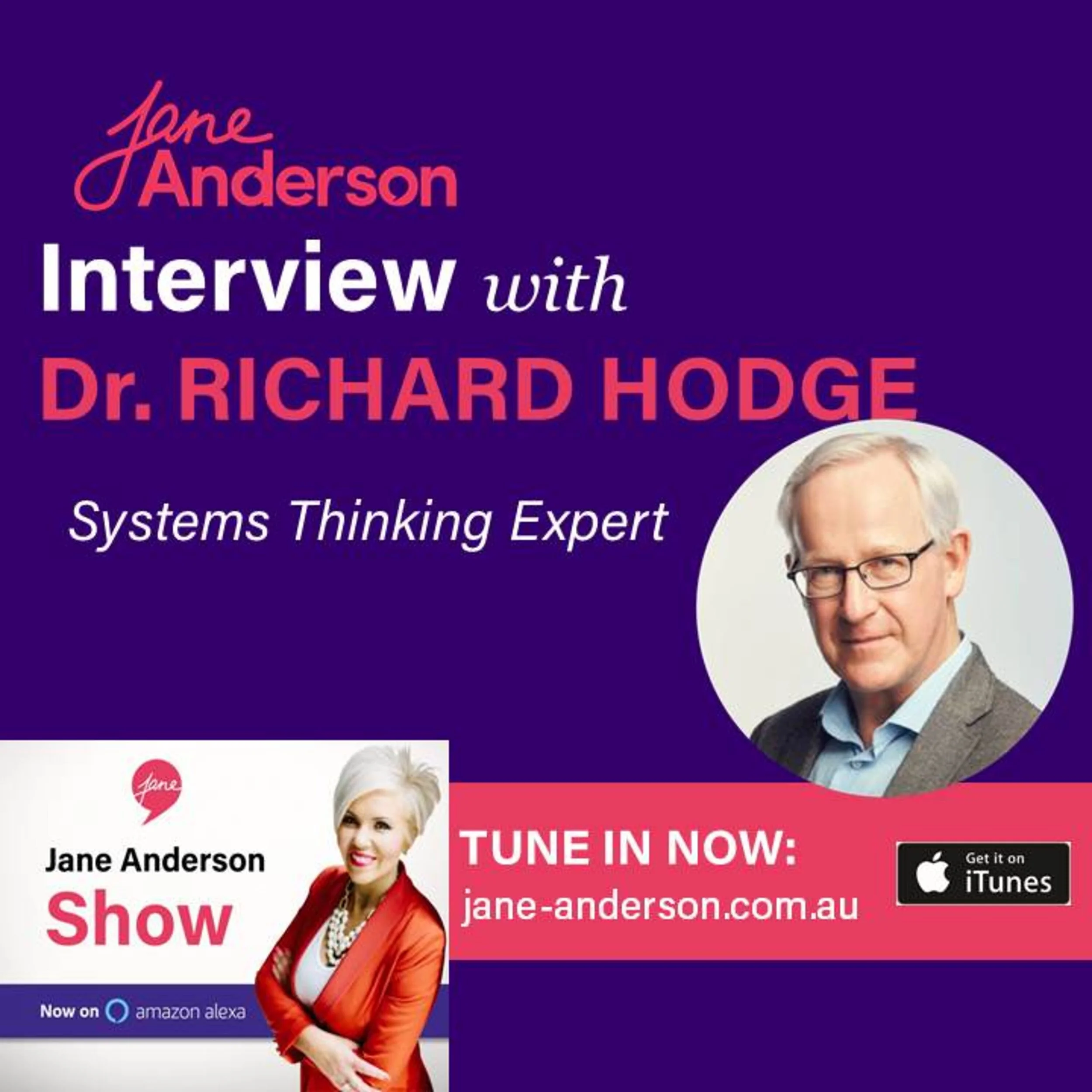
Many of us care deeply about the work we do, yet we still feel unable to create lasting impact. Where does that gap come from, and what can one person actually do about it?
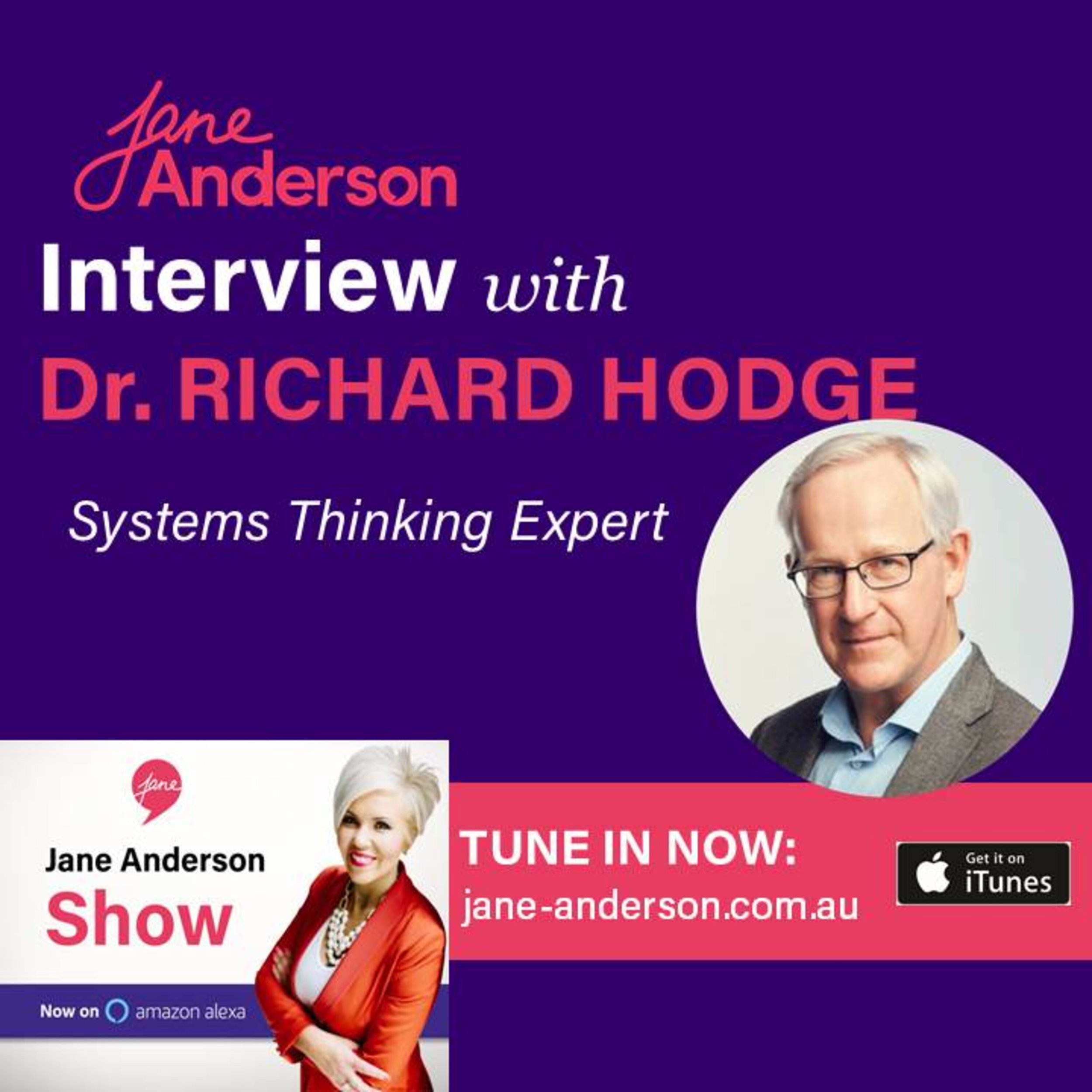
That question sat underneath my conversation with Dr Richard Hodge on The Jane Anderson Show. Richard researches, teaches and applies systems thinking to some of the hardest problems people face today. He is a partner at Brook Global, a consulting firm that helps large organisations, including government departments, build the capability to make the changes they want to make. He is also one of the first friends I made at Thought Leaders Business School. We had lunch together on the very first day, when I was feeling daunted and wondering whether I had signed up for the wrong thing, and he put me at ease straight away.
In this episode, Richard and I talk about why we have more control than we give ourselves credit for, why leadership is better understood as a system, and what that means for anyone building a personal brand. If you are an expert, consultant or leader weighing up whether to put yourself out there, his thinking on trust, video, humility and the tall poppy problem is well worth your time.
Why Good Questions Matter More Than Confident Answers
When I thanked Richard for putting my anxiety at ease in those early days, he shared a story about confidence from his own career. In his mid-30s he was the youngest student on what was then the defence senior course at the Joint Services Staff College. He walked into a room of about 40 other students, many of whom had led men and women into battle or commanded ships, and it felt like running into a wall of confidence.
When the commandant asked how his first day had gone, Richard told him it was daunting. The commandant's reply stayed with him: sometimes that confidence can be misplaced. The real lesson, Richard says, was learning to ask good questions. You might not need to know the answer, but being able to ask a "bloody good question" is a very good place to start.
A General Practitioner for Complex Problems
Richard describes his background as that of a scientist, a consultant and a general manager. Whether you are an internal or an external consultant, he says, the job is to work out what the real issue is and then help people think it through. He likens it to being a general practitioner: providing a sense of primary care for people living in a complex world.
That complexity shows up in familiar ways. Richard pointed to organisations that keep getting larger and more complicated, where the short term always seems to win over the long term, profit seems to beat investment, and people end up mortgaging the future. People also tend to focus on the parts or the individual rather than the whole. His work is about helping people think through these patterns so they gain greater control over the future they want, whether as individuals or as leaders trying to drive change in a large organisation.
He also offered a memorable line: "If culture eats strategy for breakfast, controls eat innovation for lunch. And all that's left for dinner is communication." If organisational culture is the topic on your mind, my conversation with Melanie Marshall on leading culture in hospitals, councils and government agencies is a good companion to listen to.
We Have More Control Than We Give Ourselves Credit For
Richard told me he is "quite obsessed" with one idea: we have more control than we give ourselves credit for. In his view, we are often overcome by culture and controls, and his work is about helping people understand the controls they already have, and how individuals or small teams can fix the problems that matter most to them.
Control has been a theme in my own work from the start. In my first year, back in 2014, the word I kept coming back to was "take control". When Richard and I realised early on that we shared a similar obsession with controls, I found it incredible to meet someone who used the same lens in such a different space, and it made so much sense. I had been writing a blog that week about what holds us back from regaining control when things go wrong, and that is largely a question of mindset. Richard takes the same idea to a much larger scale. Most of us feel the outcomes of what happens at that level in our day-to-day lives without ever seeing how those decisions are made.
Leadership Is a System, and It Starts With One Person
Richard told me he was teaching on governance, which he describes as a form of control, at the International Council on Systems Engineering conference in Washington in July. One of the keynote speakers there was Professor Barbara Kellerman of the Harvard Kennedy School, who appears on the list of keynote speakers at INCOSE's 2018 International Symposium. Richard summed up her main message as: stop focusing on the people at the top. Leadership is a system, and you are part of it.
For Richard, the practical conclusion is that you can take control of the issues that matter most to you, think about how best to take them forward, and build a body of support. He borrowed my language here: if you want to have impact, you need to create influence and move your expertise into other people, building capability as you do. He also tied it back to that wall of confidence at the staff college. You can take confidence in your own ability, he said, because you are not running into a brick wall. You are building a set of followers, one person at a time, who can see that what you want to do will achieve some social good, whether for a business, a community or a family.
Richard was clear that no problem is too big, because every time it starts with one person. He used the old story of the grain of rice on a chessboard: one grain on the first square, two on the next, and so on. The doubling soon becomes so large that there would not be enough rice in the world to fill the board. His point was about the propagation of good ideas. Sell the outcome, he said, not the problems of getting there.
Governance Designed In, Not Bolted On
Richard's current focus is governance, and his mantra is that governance needs to be designed all the way down to the individual, not bolted on as a board across the top.
This also explains why he works as part of a collective rather than alone. Large institutions rarely engage just one person to make a change, because they will ask what happens if that person is hit by a bus. They need capacity, and he does not mean only arms and legs. They need competent thinkers who understand the approach and can step into coaching, mentoring and facilitating people to build their own capability inside the organisation. Brook Global, Richard explained, gives people like him a home to work as a collective. The aim is less about driving change and more about helping people make the change they want to make in their own large organisations. As I put it to him, that is about enabling change to happen, and he agreed: it is done by building capability.
Rainmakers, Ambassadors and Building Your Own Paradigm
I had recently written a blog about four types of influencer an organisation can draw on, which are often overlooked while money goes into traditional marketing. I call them rainmakers, ambassadors, advocates and social stars. A rainmaker often has a personal brand and is paid for work outside the organisation, such as speaking. An ambassador works inside the organisation and may not have built a commercial personal brand. Advocates tend to come from customer advocacy. And social stars are the people who get paid very large amounts for a single post. I find that some rainmakers worry I am trying to turn them into social stars, and that is not what I am suggesting.
I asked Richard how this plays out at Brook Global. He explained that the collective was formed by people who had held several senior executive positions and no longer wanted to be part of the machinery of large organisations. They felt they could have more impact by working together to help others build capability. They also deliberately kept a mix of people. You need a few rainmakers, Richard said, but if everyone is a rainmaker you have a flood and no one managing. He described the value of having people who can work with those who produce great ideas but may not have the capacity or interest in taking them out into the world. The rainmaker, in his words, helps formulate the ideas and then connects them to the people who own the problem.
As for ambassadors, Richard believes everyone needs to be an ambassador for thought leadership these days. He thinks part of the challenge is that our schools and universities teach us other people's paradigms, when what we all need is to create our own. His approach is to focus on the social good you want to achieve, look at what works and what does not rather than adopting best practice from elsewhere, and mix methods in your own way to suit the problem.
He added one big caveat: your choices must first do no harm. Almost every one of us, he said, needs to take the business equivalent of the Hippocratic Oath. From there, he encouraged people to advance their own learning, be brave enough to have a voice, take a stand, know what they stand for and be prepared to adapt.
Tall Poppy Syndrome and the Value of Regular Pruning
Speaking up is not easy in Australia. We have a culture of tall poppy syndrome, and there is a lot of fear associated with it. It takes courage to have a go, and it is not our norm. I see that as the greatest opportunity we have, precisely because so few people do it.
Richard's reaction was to ask how good it would be if everyone just said "to hell with the tall poppy syndrome". He believes in getting that change inside and being the change. His response to being called a tall poppy is: have a go at cutting me down. He reckons he has been cut down a few times in his life, and "regular pruning is good for future growth". I always call that grounding.
Why You Need a Tribe Around You
I was curious how working with like-minded people had shaped Richard's willingness to put his face and voice out there. I put it to him that choosing to work as a collective with a shared focus on driving change must reduce the tall poppy effect, because the organisation does not have one figurehead while everyone else wonders who that person thinks he is. He agreed totally. It is also why I write about the value of having the right people around you in my book Expert Influencer: building a personal brand in isolation is really quite hard.
I asked Richard whether he would have taken up the video on his own. His answer was immediate: "No, not even close." He credited the encouragement he has had from me and from his daughter, who works with him as his social media manager and, in his words, has been pushing and prodding him. He put it as pulling a horse hard to the trough to drink.
Richard wondered whether part of his reluctance comes from 40 years of training and working with large organisations about how things used to be done. The question now, he said, is how people consume messages, and getting the message out matters more than being nervous about the channel. He is candid about doubt too: however confident he may look, he lives with doubt every day, "just like every other human being". The question is how much you let it control you versus you control it. Then, he says, you push on anyway.
He also shared an idea from our friend and mentor Matt Church: you don't matter, they're not listening, they don't care. Richard was careful to explain that this is not a claim that people never listen. It is a reminder that if you start from that assumption, it focuses you on how you deliver the message.
What Video Does for Trust
I asked Richard what he has noticed since starting to use video. He agreed with something I see myself: people feel they already know you. They can see you, and they get a sense of authenticity, including whether you are speaking from the heart or reading a script. Richard told me that, for the first time in his life, someone he had just met said he had been "stalking" him on LinkedIn. His videos also create a catalogue that new contacts can go back through to see where he is coming from.
I think there is so much trust built when you hear a voice. A polished headshot is one thing, but people now want to see and hear the real you. With so much noise, they are looking for a source of truth, someone who can make sense of things for them. People trust people. They trust brands less, because they know a brand usually has a commercial agenda. When someone shares knowledge generously, people can feel whether that person is just trying to be a know-all or genuinely cares about their world. That is the role of the sense-maker: translating for others amid the noise.
Richard added a point for people working inside organisations. He encourages more of them to see themselves as intrapreneurs or infopreneurs, with a voice that distinguishes them. When people compare that voice with the organisation's brand, they will see whether it is congruent or just a smokescreen. If what people say through social media matches the brand, he says, it builds trust back into the brand. If trust is the thread you want to pull on, my conversation with Dr Amy Silver on psychological safety and building trust goes further, and my conversation with Gillian Smith on personal brand versus business brand covers the brand side.
Personal Brands Inside Organisations: Humble Leadership in Practice
I put a question to Richard on behalf of CEOs and firm partners who are thinking about leveraging their own brand, or the brands of their executives, to set the organisation apart and rebuild trust. We had just come through the Royal Commission, and there was a great deal of talk about rebuilding trust. I mentioned that in KPMG's last global CEO survey, as I understood it at the time, brand was among the top three concerns for CEOs in 2017, when it had previously sat somewhere around 15th or 16th. Many CEOs in Australia tell me they prefer to sit behind the scenes and let others be the rock stars. I am the first to put my hand up for humble leadership, but I put it to Richard that visibility is now part of the role.
Richard's reply was that humble leadership can be humble on video. You have a channel, so be authentic. If you know you are not the rock star, do not act like one. Let the authenticity of your leadership come through in your message and keep it simple. If your leadership is outcome oriented, say what social good you are doing, what has to happen to achieve it, how you make money in the process, and which values tie it all together.
He drew on his military days: the first principle of war is to secure and maintain the aim. For a CEO, that is the primary job. If you do not know why you are in business, you cannot express it to a society that increasingly looks for social good alongside the social licence to operate. The next step is making sure it cascades through people living the values. Described that way, he says, there is no reason to fear tall poppy syndrome.
Richard connected this to Jim Collins's concept of Level 5 leadership and the image of the mirror and the window. As Richard described it, a level four leader looks out the window to assign responsibility and in the mirror to assign credit, while a level five leader does it the other way around: in the mirror to assign responsibility, and out the window to assign credit. Any leader who can show that through their videos, he said, will naturally come across as empathetic and humble, and people will follow them.
It Isn't About You
One of the ironies I often share with clients is that personal branding is not even about you. Richard agreed, and linked it to a mantra from Thought Leaders Business School: it is not about the money, but it is all about the money. First make it not about the money, he said, and people will follow you and the money will follow too. If you want to wrap that up as branding and marketing, it enables marketing as a conversation to continue.
I think we are in an era where marketing and sales blur together, and there is no longer a separate marketing department. Everyone is an ambassador, whatever their role. Richard agreed, with one caveat: people have to recognise it. How you show up says something about the company, the business, your family or you as an individual.
The Power of Believing in Someone Else
I could not finish without telling a story about Richard. When I was writing my first book, Impact, over Christmas, I put up a pre-order page on my website. I had been working away and came back to my computer after a break to find an order from Dr Richard Hodge: the first copy, invoice number 0001. I thought, "Oh my God, now I've really got to write it," and I typed like a mad woman after that. It is a reminder of how powerful it is to have someone who inspires you and believes in you. I am forever grateful for that.
Frequently Asked Questions
What does Dr Richard Hodge mean by control?
Richard says we have more control than we give ourselves credit for. His work is about helping people understand the controls they already have, and how individuals or small teams can help fix the problems that matter most to them. He describes governance as a form of control and argues that it should be designed all the way down to the individual, not bolted on as a board across the top.
Why does Richard say leadership is a system?
Richard drew on a keynote by Professor Barbara Kellerman of the Harvard Kennedy School, whose main message he summarised as: stop focusing on the people at the top. If you see leadership as a system, you are part of it, and you can take control of the issues that matter most to you, take them forward and build a body of support.
Where does change start in a large organisation?
With one person. Richard says that every time, it starts with one person, and he used the chessboard and rice story to show how doubling spreads good ideas. He also recommends selling the outcome, not the problems of getting there.
How can a leader build a personal brand without acting like a rock star?
Richard's advice is to be authentic and humble on video, keep the message simple and not act like a rock star if you are not one. He suggests explaining the social good you are working towards, what must happen to achieve it, how you make money in the process and the values that tie it together.
Why does video help build trust?
Richard says people can see you and sense your authenticity, including whether you are speaking from the heart or reading a script. It also creates a catalogue of your thinking that new contacts can look back on. I would add that people want to see and hear the real you, because they trust people more than brands.
What does "first do no harm" have to do with building your own paradigm?
Richard encourages people to create their own paradigm by looking at what works and what does not, rather than adopting best practice from elsewhere. His big caveat is that your choices must first do no harm, and he describes this as the business equivalent of the Hippocratic Oath.
About Dr Richard Hodge
Dr Richard Hodge researches, teaches and applies systems thinking to some of the hardest problems people face today. He has been a scientist, a consultant and a general manager, and he is a partner at Brook Global, where he helps large organisations, including government departments, build the capability to drive their own change. He speaks at institutions such as MIT, and at the time of our conversation he was writing a book on control, developing an education program for individuals and corporates, and planning to do more speaking.
Conclusion
Richard's message is that we have more control than we give ourselves credit for, and that lasting change starts with one person. He encourages us to ask good questions even when we do not have the answers, to design governance rather than bolt it on, and to create our own paradigm, always with the commitment to first do no harm.
If there is one thread through our conversation, it is that influence grows when you show up as yourself, with a clear aim and a tribe around you. Video and voice give people a real sense of who you are. Humble leadership gives them a reason to follow. And as Richard and I agreed, the irony is that none of it is really about you.
Connect with Dr Richard Hodge: Visit drrichardhodge.com to learn more, and follow Richard on LinkedIn to see his videos. Listen to the full episode on Apple Podcasts.
Work With Jane Anderson
If Richard's thinking resonated with you, here are some ways to take the next step:
Women With Influence: Join a community of B2B women consultants, coaches and advisors building world-class practices.
Grow With Influence: Explore my coaching for B2B practices.
✨ Tune in to hear Dr Richard Hodge on systems thinking, control and why building influence starts with one person.
Key Takeaways from Today’s Episode:
-
You do not need to have the answer. Richard's lesson from the staff college is that asking a bloody good question is a strong place to start.
-
Richard's work is about helping people understand the controls they already have, and using them to fix the problems that matter most to them.
-
Rather than focusing on the people at the top, take control of the issues that matter to you and build a body of support, one person at a time.
-
Good ideas spread by propagation, like the grain of rice doubling across the chessboard, when people can see the social good you are working towards.
-
Look at what works and what does not rather than adopting best practice from elsewhere, mix methods to suit the problem, and keep your choices harmless.
-
Authenticity, voice and a catalogue of your thinking help people decide whether to trust you, and people trust people more than brands.
-
Be authentic, keep the message simple, state the social good and the values behind it, and look in the mirror for responsibility and out the window for credit.