Podcast is also available on the versions below:


Get Notified Of Future Episodes on Apple Podcasts | Spotify | Youtube
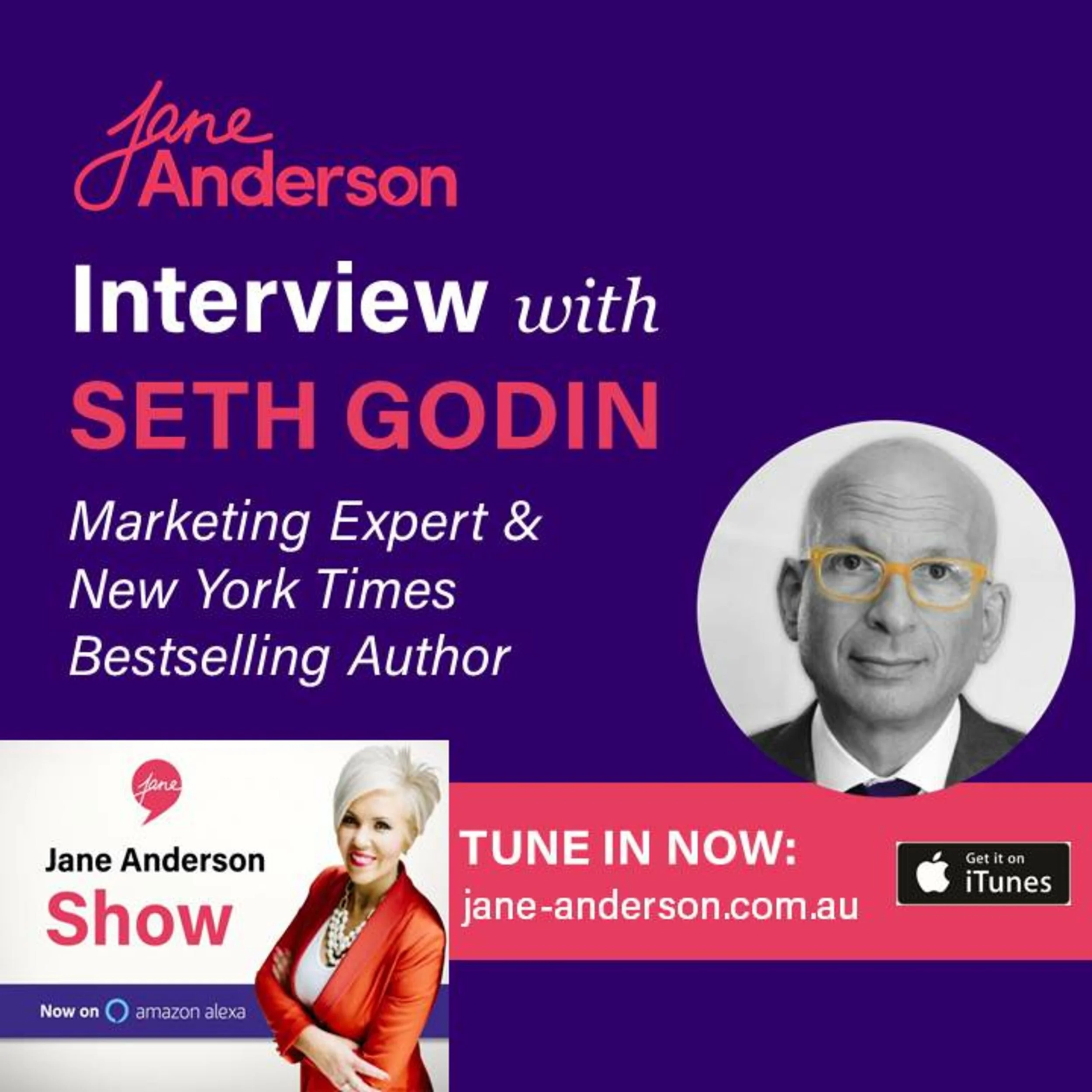
I remember seeing Seth Godin's book Permission Marketing around the time I finished uni, when I first started reading around this kind of work. At university, marketing had been about billboards and advertising, and permission marketing and tribe building weren't really talked about. In 2010, when I started my training and coaching business, I kept coming back to Seth's work. Whenever I knew a client needed the right book, Linchpin and Tribes were the two I reached for.
In 2017 I completed Seth's Marketing Seminar, and today I share something from his work at least once a week. So I was thrilled when he agreed to join me on The Jane Anderson Show.
Seth is the New York Times bestselling author of 19 books and was inducted into the Marketing Hall of Fame in 2018. In this Seth Godin interview, we talked about his then new book, This Is Marketing, and what it means to do marketing on purpose. I also put questions to him from my own community, so you will hear from consultants, coaches and leaders across Australia and Germany.
If you are an expert who wants to be known for work that matters, rather than work that is merely noticed, there is a lot in this conversation for you. You can listen to the full episode on Apple Podcasts.
Why This Is Marketing, and Why Seth Wrote It Now
I asked Seth why he needed to write this book, and how it differs from his other books. His answer started with history. He was there at the beginning, more than 20 years ago, and he started online before the World Wide Web. Permission Marketing began a cycle of paying attention to attention, and of realising that advertising and marketing are not the same thing.
Yet most of the time and money people spend on what they call marketing still feels like mass advertising to him. He pointed to people counting Twitter followers, spamming us, and pop-unders. It is all obsolete, he said, and we still talk about it. On the 20th anniversary of Permission Marketing, he wanted to draw a line in the sand and say, "This is marketing, not that."
He started by creating the Marketing Seminar, which he described as his most popular seminar, with more than 10,000 graduates. The book is the textbook: if you want to see step by step what he thinks matters, here it is.
The book also makes a wider point. Marketing is not just getting a stranger to buy something. It is what we do when we lead someone, when we engage with someone, and when we organise an institution. Those are all marketing choices, Seth said, so let's make them on purpose.
I did the Marketing Seminar in August 2017, and hearing Seth on video is a different experience from reading him, even though the ideas are the same. The big thing I took away was doing work that matters: empathy, insight, understanding, and the difference between what people want and what they need. I read him a passage he wrote about this. If you simply ask people what they want, you probably won't find a breakthrough. It is our job to watch people, figure out what they dream of, and then create a transaction that can deliver that feeling.
I asked whether more people are talking about empathy and insight in marketing now. Seth said it is definitely happening, and he explained why.
Why the Internet Rewards the Minimum Viable Audience
The internet feels like a mass medium, Seth said, but it is not. It is a micro medium: hundreds, thousands or tens of thousands of them lined up side by side. "You can't buy the homepage of the internet, because there isn't one."
He gave an example. If you bought the most popular TV show on YouTube, he said, you would reach 0.1% of the people watching YouTube, not 3% or 30%. So we should not pay extra to reach a big audience. We should pay less, because what we want is specific.
If you can talk to that specific group, the minimum viable audience, then you have an obligation to talk to them. Not to everyone, but to the people who are listening to you. That requires focus, and it requires us to go out on a limb and say, "I made this for you, not for you." Seth said this is what has led to a newfound conversation about empathy, actual practical empathy.
I pointed out how counterintuitive this feels. There are all these people out there, so why would you not go for the mass market? The challenge is having the patience, the discipline and the willingness to take the risk of going for that minimum viable market. Seth agreed.
Be Missed, Not Merely Popular
Seth added a test. Ask someone who they aspire to be like, or which brand they want to be like, and very few people will pick a generic market leader. He pointed out that Kraft Singles cheese slices and Heinz ketchup are in a huge number of US refrigerators, and that nobody wants to be those people.
What people actually say is that they would like to be someone with a strong, significant voice, someone like Bob Dylan. Seth then turned it on himself. By his own estimate, 99.8% of the people on the planet have never heard of him, and he thinks that is great, because what he would need to do to be heard of by a larger group would not be work he would be proud of.
So the objective is to be the kind of brand, individual and contributor who would be missed if you were gone, not one who is simply popular. I summed it up as impact for a specific, viable market, and Seth said, "Exactly."
Tall Poppies, One-Star Reviews and the Lifeguard Question
In Australia we have the tall poppy, and I asked Seth about it. We fear standing out, and we fear our audience cutting us down, as in, "Who the hell do you think you are to have an opinion?" So we hold back. Seth talks about not waiting to be picked and picking yourself, and most of the people who listen to this podcast are consultants and coaches who feel that fear. What would he say to them?
Seth said he loved the question, and he was blunt. He has spoken with people in more than 130 countries, and in every one of them someone says, "We have this thing in our country," and then describes the tall poppy. "So sorry, Australia." Seth called it resistance, a chance to hide, and a trap.
His advice is simple. If someone wants to criticise you and they are not your customer, walk away. "Don't read the comments. Just walk away."
To make the point, Seth talked about J.K. Rowling. He said that if you look at any book she has written on Amazon, there are tons of one-star reviews. And if she had told herself she'd better not write a book because someone might write a one-star review, she never would have written it. What a one-star review means, Seth said, is "it wasn't for you." You don't need to read any more, because the reviewer has told you who they are: someone this is not for.
For consultants, freelancers and entrepreneurs, he said, the only chance you have is for someone to be happy that you are a tall poppy. If they are not, why would they hire you? "So if you're not willing to be seen as a tall poppy by anyone, go get a job." I said the fear of shipping becomes crippling, and meanwhile your audience is waiting for you.
The Lifeguard Message
Seth then reminded me of the lifeguard message from the Marketing Seminar. Imagine you are walking past a pond and you see someone drowning. You could say, "I don't have Red Cross certification," or "There are people who are better swimmers than me," or "What right do I have to inflict myself on this person?" Seth said those are all the wrong questions. The right question is whether this person would like you to save them.
If the answer is yes, then you are not saving at them, you are saving with them. They wanted you to come. If you can't work out how to bring that to market, he said, then you are being selfish. If you are busy spamming people because you want to sell basement waterproofing they don't want, you should sell something else. But if you can sell something people are eager to engage with, you are like a lifeguard, and you should not worry about someone saying you have no right to save that kid's life.
I added that many of us get caught up in whether we have the right certification or accreditation, and the better question is whether we are solving a problem. Seth agreed.
Trust as a Marketing Opportunity: Lessons From Banking
At the time of our conversation there was a trust deficit in Australian financial services. I explained that the country was just off the back of a Royal Commission, which had identified a lot of misconduct, and that some CEOs of big banks had resigned. Some bankers had done nothing wrong and felt tarred with the same brush, while others had been criticised scathingly. What would Seth tell clients in that sector?
He started with Zappos. When Tony Hsieh began, Seth said, he could have optimised for a low price or for faster shipping. He optimised for customer service, even though delight and shoes had never been associated before. He understood that people would happily pay $5 extra for a pair of shoes if they were treated like a person.
The banking industry, Seth said, thinks that what everyone cares about is basis points, the difference between 4% and 4.2%. Most people don't care about that, and even if most did, some wouldn't. From what he was hearing, what had been highlighted in Australia was that people care about having a bank they can trust, one that doesn't cut corners or hide.
"What a marketing opportunity," he said. A bank could proudly say, "We don't pay you the most interest because we don't cheat." It could regularly publish more information than it is required to.
Good Actors Should Criticise the Bad Ones
Seth recalled a conversation with a banker who was complaining about government regulation. His reply was that regulations exist because bad actors ripped people off and the government felt it had no choice. So the good actors need to criticise the bad actors before everyone catches them. If you are one of the good bankers, he said, you should be putting out a report every week about bad actors in your industry. For example: "Here are the 17 things that will let you get ripped off in a mortgage. Look for these sentences in your mortgage application."
Your competitors will be furious that you are giving away the secrets. So Seth asked: what is more important, having competitors who are happy with you or having customers who are happy with you?
He gave a second example. Years ago in the US, a man started a blog about swimming pools. When you buy a $50,000 or $100,000 pool, Seth said, you are almost certain to be ripped off because you know nothing about buying one. This man published every secret, every trick and every way they try to steal from you. His competitors were furious. But, Seth asked, who would you buy a pool from? I said that of course you would buy from the one who was educating you.
I told Seth that I think it takes courage to do this, and that the people who find the courage to stand up and use their voice are the ones who will win. He offered a third story: a bank in New York that took down all the glass between the teller and the customer, which was against some city or state regulation. They kept paying the fine instead of putting the glass back up. In Seth’s telling, they said they were going to organise their bank around customers, not bank robbers. I said it was transparency, literally.
Early Adopters First: How New Ideas Spread
Next came the first of the questions from my community. Dr Peter Stevens is a high performance team psychologist who works with teaching teams in schools. He asked about something Seth says in his book: early adopters have different needs from the majority. In a small business like his, he often has to market to both at once. Should he run parallel marketing? Or start with early adopters and switch? And what are the principles for knowing when to move to the majority?
Seth said we could talk about this all day, and pointed to Geoff Moore, who wrote the book on it, Crossing the Chasm. His short version goes like this. Early adopters are not "early adapters". They don't adapt because they have to. They adopt because they want to. They want something new, and that is its primary benefit to them: no one else has this. It is exploratory. The majority want something that works, and they want something safe to use because the rest of the majority is already using it.
Every idea, every political campaign and every technology launches with the people who pick the one on the fringe because it is new. Every morning they wake up asking, "What's new?" So you have to amplify the riskiness and newness, not the performance but the audacity. Those people will then model the performance for the masses.
There is one more requirement. It is not enough that the offering is new and works. It also has to help the early adopter's status to talk about it.
The Shoes Example
Seth used the shoes he was wearing. They were a pair of Cloud shoes, and he did not recall the exact brand. He joked that they are so light they fly up into the air, and he bought them because he is an early adopter, not because he is a runner. He thought they looked cool and that he would be seen as smart, alert and aware. If someone asks him about them, does he have a story that will make him sound smart? Does he have a way to make them feel their status is lower because they are not wearing them?
If he does, the majority will notice, and wait to see whether they see someone else wearing them. If enough early adopters are wearing them, the majority will conclude that everyone is, and they will have to get a pair. I said, "and therefore, they're safe." Seth said that is right.
Making an Idea Visible in a School
I asked how this works in a school, where the channels for conversation are not obvious. Seth said you start by offering an after-school training session for teachers who voluntarily want to hear about a new idea. You don't force everyone to come, and you stop trying to persuade the other people. It is just for the ones who want it.
Then you build something that becomes visible to everyone else in the school as a teacher uses it. It is public, not private. Seth said he was making up the example as he went. Imagine you teach a maths idea using coloured rubber bands, and the kids leave class wearing them. The next teacher sees students turning up with coloured rubber bands on their wrists and asks what they are. The kids say it came from another teacher's class. Now that teacher has to get on board, because you have made a flag. I said that's how the idea spreads.
The Mistakes Worth Worrying About
Sharon Francisco, from Brisbane, asked what mistake had taught Seth his most valuable lesson.
He said there are so many, and then gave a short answer: "97% of them are things I didn't do." That, he said, is the lesson. We spend most of our time fearing the things we do, and most of our time holding back from things we might do because they might be a mistake.
His mistakes, he said, are the project he didn't launch, the person he didn't meet and the question he didn't ask. I told him I loved the answer, because in this game there is so much we hold back from because of fear.
Attracting Top Talent: Be the Kind of Place You Say You Are
Christian Konrad, an expert in magnetic culture from Bremen in northern Germany, asked for the one single trait companies need to attract top talent.
Seth said to go back to the minimum viable audience. There is no such thing as top talent. There are top talents, and some are attracted to one place while others are attracted to another.
He told a story from when he was building Yoyodyne, the internet company that pioneered internet email for commercial purposes. He was at a meeting at Disney with the head of its internet division, and on the man's desk was a pile of resumes. Seth needed three people and could not see why anyone would need 300. The Disney executive told him that every day, dozens of resumes come in because people want to work on the Disney internet division. Seth's senior people made millions of dollars, he said, while the people who ended up at Disney made nothing, but they applied to Disney.
Why? Because that subset of top talent isn't early adopters. They don't want to tell friends and family they work for a company nobody has heard of. They want to say they work for the famous company, because that gives them a certain kind of status. In Silicon Valley, Seth said, the line to work at Google is 100 times bigger than the line to work at Superhuman, with no economic rationale for it. Superhuman is not going out of business, you would be paid just as well, and the stock options are worth more. Google is simply famous. That is one group of top talent.
The Other Group of Top Talent
There is a very different group, Seth said, and at the time he spoke to them every week through his Linchpin Jobs newsletter. They are looking for a boss who will treat them like a human, won't force them to fit in, and will give them extra responsibility. That boss cares less about rank and more about how people can learn. If you said that to people applying at Disney or Google, they would freak out. It is not what they want.
So the answer, in Seth's view, is to act in a way that lines up with the kind of person you seek to attract. The mistake many HR people make is to pretend they have a Linchpin job when what they really have is a high-paid cog job, and that confuses everybody.
I checked what I was hearing: it is not just saying what you are looking for, you have to be that. Seth said that is right, because if you do attract the person you said you wanted, "she's going to hate you." I added that they won't stay anyway, which costs you more money in the long term because you have to go back to the market.
A Brand Is a Promise
Julia Steele, who helps organisations turn their potential into progress, asked a simple question. At what point did Seth Godin the man become Seth Godin the brand?
Seth said everyone has a personal brand, whether you like it or not. A brand is not a logo. A brand is a promise: the expectation people have when they engage with you. It is not a mission statement or a clever elevator pitch. "No one ever bought anything on an elevator." It is the result of consistently showing up and doing the thing you said you were going to do.
He said he wasn't sure Julia was asking when the outside world first formed expectations of him, because that started when he was 10, just as it did for me. A teacher knows what kind of question you will ask when you raise your hand, and that is your brand at 10. The question might instead be when he decided to aggressively colour outside the lines and not be a cog in the system.
That happened in July 1977, when he was teaching somebody how to paddle a canoe. He realised he was seeing something that most people were too busy or too uncaring to see. If he could talk about it, he could change that person's life. Once he saw that he could teach like that, he realised it was all he ever wanted to do.
I told Seth that in the programs I run, we talk about how a big part of your brand is what you teach and educate. Using that to get through fear shows that it is not even about you. It is about serving and helping, and Seth said, "Exactly." If you would like to hear more on the idea of a brand as a promise, it also comes up in my conversation with Dr Amy Silver in Episode 40.
What Excites Seth About the Future
Flavia Formica, a leadership and executive coach from Melbourne, asked what excites Seth most about the future.
He said that how he measures himself is by what the people he teaches go on to teach others. He has now taught enough people that they are teaching others far more than he is teaching. If he has done anything well, that will be the dividend, and it feels like it is starting to scale.
He was also frank about what lies ahead. There are a lot of tough times coming, he said. He believes the Earth is melting and that sea levels will rise far more than most people fear. It will not be easy, and "we don't need to make more cat videos." We need to figure out how to change the culture in a way that makes us more resilient and caring. He can't do that by himself, but he is hopeful that the people he is shining a light for can do it for others.
I said it really is about getting other people to share the message with their tribes and networks. Seth is in so many people's inboxes every day, and his body of work makes that message easy to access. Showing up, I said, is how you put something out that keeps going.
How to Avoid the Polarised Media Cycle
The final question came from Dr Richard Hodge in Melbourne, who works on next generation governance and teaches the design of controls. Richard Hodge was also my guest in Episode 37. He asked what strategy we could use to promote long-term sustainability without being dragged into the polarised, politicised, short-term, 24/7 media cycle.
Seth said the reason we are so polarised is that the media makes money by polarising us. It did not used to, and now it does. If you are being polarised, you are a victim of that. But that does not mean you have to do free work for the media.
He gave three steps. Turning it off is a great first step. Figuring out how to get outside your circle is a great next step. The third step is inventing your own media company: publishing regularly, and putting your ideas into the world to normalise the fact that it is normal for us to be in sync. "It is not normal for us to turn every single issue into an angry debate."
Where to Put Your Attention
Seth shared an example from a blog post he had read the week before. Some vegans had stopped eating avocados because they were upset that bees are exploited to pollinate the trees. He said he feels for the bees and supports any vegan's right to speak up. But as soon as someone wrote that, the anti-vegan people jumped on it, and it became an instant "let's have a fight about it" moment.
At the same time, there are all these blog posts, pictures and videos that no one argues about, because they are simply good. If we move our attention toward those, he said, there will be more of them. That is how he tries to spend his day and write his blog: how can he put his attention on something that emphasises possibility, so that he gets more of it? I said that is playing above the line and driving it to where it needs to go. Seth's reply was, "Why not? It's up to us."
Frequently Asked Questions
What is a minimum viable audience?
Seth described the internet as many micro media lined up side by side, not one mass medium. If you can talk to a specific group, the minimum viable audience, he said you have an obligation to talk to the people who are listening to you, not everyone. It takes focus and a willingness to say, "I made this for you, not for you."
How should consultants handle tall poppy syndrome?
Seth said he has spoken with people in more than 130 countries, and every one of them describes their own version of the tall poppy. He calls it resistance and a trap. If someone wants to criticise you and is not your customer, walk away and don't read the comments. A one-star review, he said, means the work wasn't for that person.
Should you market to early adopters or the majority first?
Seth's answer is to start with early adopters, who adopt because they want something new. Amplify the newness and audacity rather than the performance, and make your work visible so that early adopters gain status by talking about it. The majority will follow once they see enough early adopters using it.
What is a brand, according to Seth Godin?
Seth said everyone has a personal brand. It is a promise and the expectation people have when they engage with you, not a logo, a mission statement or an elevator pitch. It comes from consistently showing up and doing what you said you would do.
How can a business rebuild trust after a crisis in its industry?
Using banking as the example, Seth suggested optimising for what customers actually care about, which in that case was trust. He proposed publishing more information than required, having good actors criticise bad actors, and educating buyers about how they can be ripped off, even if competitors are furious.
What did Seth Godin say about his biggest mistakes?
He said 97% of his mistakes are things he didn't do. We spend most of our time fearing the things we do, he said, when the real cost is the project we didn't launch, the person we didn't meet and the question we didn't ask.
About Seth Godin
Seth Godin is a New York Times bestselling author and marketing thinker. His books include Permission Marketing, Tribes, Linchpin and This Is Marketing. He created The Marketing Seminar, which he said has had more than 10,000 graduates, and the altMBA was another of his programs when we spoke. He told me he built Yoyodyne, an internet company that pioneered commercial email. He was inducted into the Marketing Hall of Fame in 2018.
Conclusion
Across every question, Seth kept returning to the same few ideas. Marketing is leadership and service, and we should make those choices on purpose. Pick the specific people you can serve and be willing to be missed rather than merely popular. Walk away from critics who were never your customers. Make trust and education part of how you market. Choose what you give your attention to.
For consultants and experts, the practical question is where you are still trying to appeal to everyone, or holding back because someone might not like it. As Seth put it, most of his mistakes are the things he didn't do. If this conversation has shown you one thing worth shipping, start there.
Connect with Seth Godin: When we recorded, Seth pointed listeners to akimbo.com for workshops and to altmba.com, where the altMBA was accepting applications. He also said a workshop for freelancers would launch within a week or two. Programs change, so check Akimbo's workshops page, which now lists where past offerings such as the Marketing Seminar, the Freelancer's Workshop and the altMBA can be found.
Work With Jane Anderson
If this conversation resonated with you, here are some ways to take the next step:
Women With Influence: Join a community of B2B women consultants, coaches and advisors building world-class practices.
Grow With Influence: Explore my coaching for B2B practices.
✨ Tune in to hear Seth Godin on the minimum viable audience, why tall poppies need to be seen, and how trust turns marketing into service.
Key Takeaways from Today’s Episode:
-
Marketing is not just getting a stranger to buy something. It is what we do when we lead, engage and organise, and Seth wants us to make those choices deliberately.
-
The internet is many micro media, so focus on the specific people you can serve and create work they would miss, rather than chasing popularity.
-
The tall poppy fear is a trap. Seth's advice is to skip the comments, treat a one-star review as a sign the work was not for that person, and be seen.
-
Don't ask whether you have the right to help. Ask whether the person would like you to, and if they would, bring your help to market so that you are working with them, not at them.
-
Seth's banking examples were to serve what customers actually care about, publish more than required, call out bad actors and educate buyers, even if competitors object.
-
Early adopters want something new, so amplify the newness. Give them something public that raises their status to talk about, and the majority will follow.
-
Seth said 97% of his mistakes are the projects he didn't launch, the people he didn't meet and the questions he didn't ask.
-
A brand is the expectation people have of you, built by consistently doing what you said you would do. The same goes for attracting people: act in line with who you want to attract.
-
To step out of the polarised media cycle, Seth suggests turning it off, getting outside your circle, publishing your own media and putting attention on what emphasises possibility.