Podcast is also available on the versions below:


Get Notified Of Future Episodes on Apple Podcasts | Spotify | Youtube
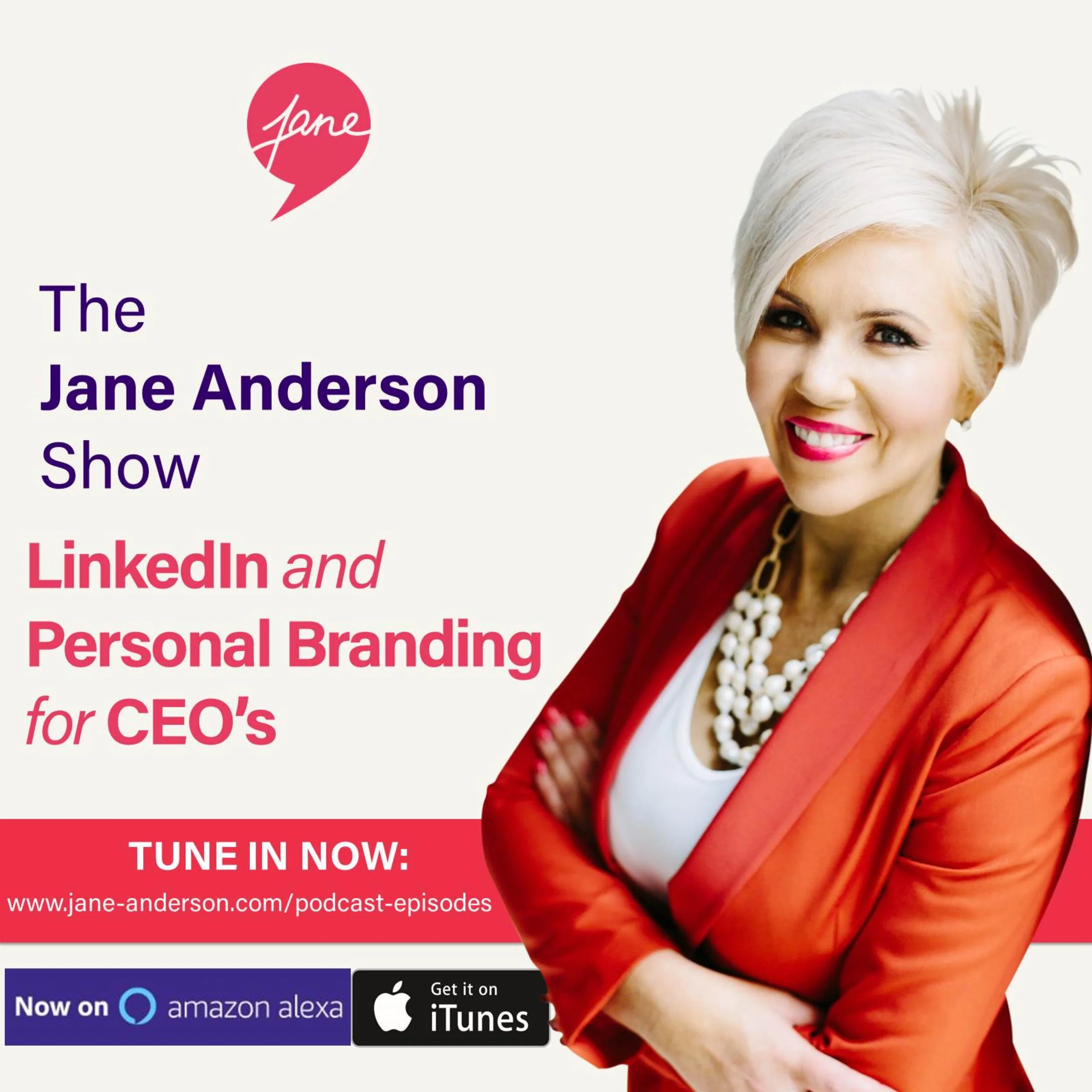
Many of the CEOs I work with are nervous about LinkedIn. Some hide away from it altogether, or put up the bare minimum and hope nobody looks too closely. If that sounds familiar, this one is for you.
In this episode of The Jane Anderson Show, first released in 2017, I set out to dispel a few myths about LinkedIn for CEOs. You might be the CEO of your organisation. You might be the rainmaker in your business. Or you might be a CEO whose strong personal brand is already part of the identity of the business. In every case, I think many CEOs are missing a real opportunity to use their LinkedIn profile to grow the business.
Here is what I hear from CEOs, why I understand the fears, and the three pieces I build a CEO's profile around: your customer, your organisation and your talent.
Why a CEO's LinkedIn Profile Is Such a Powerful Position
Something I find fascinating is what happens when you hold the title CEO on social media. On LinkedIn, and on Twitter too, you tend to get the most followers more often than not. On Twitter, the research shows that a CEO gets followers around 20 times faster than any other profile. I am focusing on LinkedIn today, but the point carries across: the positioning that comes with the CEO title is a powerful tool, and it can be leveraged for business growth.
Most of the CEOs I work with are in a similar place. They can be a little isolated, and when they are working they feel a bit alone. They are not always the expert at social media, so they often tell me they want to understand it really simply. When they work with marketing teams, the marketing, SEO and social media jargon can overwhelm them or make things so confusing that they are not sure they are making the right decision.
I can completely empathise. When I started another business, I personally lost around $30,000 on search engine optimisation, and it just about broke my heart. I still get goosebumps thinking about it. Early in business I thought SEO was what it was all about. It is certainly part of the picture, but I think there are other ways around it. I really feel for CEOs because I have been in that position myself, and being bamboozled by marketing jargon can be very frustrating.
The Fears I Hear From CEOs
The CEOs I work with have generally been dragged to me kicking and screaming by a mentor, a coach or someone else who understands the value of LinkedIn and has told them it is part of their program. Along the way I hear a familiar list of worries.
One is that if they write a profile, they will be harassed by recruiters or salespeople. There are definitely ways to manage your profile with that. Another is that it will open a can of worms: do I connect with my staff, do I not, what if I do not want to? My advice is that this is more of a Facebook concern. On LinkedIn, I think you do want to connect with your staff. Some CEOs are also concerned about connecting with suppliers, or about being spied upon.
Beyond those, I think there are three key areas where LinkedIn puts the fear of God into CEOs. Here are the fears I hear when I work with them.
Will My People Leave?
The first fear is that people will go. If I do a LinkedIn strategy for myself and then with my staff, they will be harassed by recruiters and leave. CEOs see LinkedIn as a recruitment tool, which is true to an extent, but I think that is a really small part of it.
My experience with the profiles I have worked on is that when a profile is positioned around the organisation, and less around the pure identity of the individual, fewer recruiters harass the staff. You will not necessarily get people poaching them. If the profile is written correctly, it shows that the individual is so connected to the organisation, as part of their identity, that they do not look like a passive candidate at all.
Will I Look Like a Job Seeker?
A CEO can also worry about looking like a job seeker, and that is not the case at all. Again, it comes back to how the profile is written. If it is written around the purpose of why the profile is there, and how people can take action, it does not read as a job hunt. It depends on your goal. You might be looking at strategic alliances, or at the growth of your business and how to leverage your profile for that.
Will I Look Like I Do Not Know What I Am Doing?
The other fear I meet when I work with CEOs is a fear of looking stupid, or of looking like they do not know what they are doing. It is easier to put nothing on a profile than to put something up.
And the Rest
There are other concerns. If you see something a team member has put up that you do not agree with, you may not know how to handle it, and that comes up. There is also time. I have coached a lot of CEOs, and my background is in productivity, so I know that you seriously do not have time to breathe half the time. Maybe your EA is managing your profile. CEOs worry that I am going to tell them to spend 20 minutes or an hour a day on this, and they simply do not have that time. I completely understand that.
Finally, there are competitors. CEOs ask about people stalking and watching what they are up to. What if they try to steal my clients? If I am connected to clients, how can I protect my connections? That comes up a lot.
What Changes Once a CEO's Profile Is Up
None of that changes my view that there is a massive opportunity here. The CEOs I work with, once the profile is up and they see the difference, get better traction at meetings. They are able to open doors more effectively and people take them more seriously. When they get to those meetings, they are more influential. If you have more profile, more opportunities open up and you can remove some roadblocks.
I want to be honest about this: I do not think it is for every CEO. You have to be really comfortable with it. If it is not in your nature or personality to be accessible, or you deliberately need to be inaccessible, LinkedIn might not be the right tool. But we certainly know that networks make some of the biggest differences, and these days you are validated online even before people meet you face to face.
If you have good positioning as a CEO, and most do, the question is how that translates into a LinkedIn profile. How can you make sure your personal brand is as good online as it is out in the real world? I think there are three pieces to this puzzle.
Three Pieces of the Puzzle: Customer, Organisation and Talent
1. Build Your Profile Around Your Customer
The first piece is to build your profile around your customer, with your customer in mind. Who are the customers you work with? What problems and challenges do they have, and what are their concerns and fears? The content on your profile, the plug-ins and the search engine optimisation all need to make you easy for the customer to find.
Research done in 2012 indicated that around two-thirds of customers make a decision about an organisation based on what they know about the CEO. For context, Weber Shandwick's 2012 research found that 66 per cent of consumers said their perceptions of CEOs affect their opinions of company reputations. The branding on your profile is highly leveraged. If you have nothing there, a customer will make up their own mind about you, so you need to educate them.
Make sure your profile is customer-centric, not you-centric. When it is about you, that is when it feels weird and awkward. Maybe that is why you have not put anything up, because your instinct says it feels a bit "look at me". If you are Australian and you have watched Kath & Kim, you might feel a little uncomfortable putting yourself up. Your instinct is right if that is the case, because your profile is not about you. It is about the customer.
2. Position It Around Your Organisation
The second piece is to position your profile around the organisation. A good CEO profile is more about the identity of the business and less about you. It is about the kind of business you have, and why where you work is a great place to work.
We know that 75 per cent of job seekers will validate their future manager on LinkedIn before they apply for a job. I worked with a health fund that introduced a rule once the profiles were written: no job adverts go up on their website, on LinkedIn or on Seek until the leader's LinkedIn profile has been written, so that the leader validates well. We also know that 50 per cent of the time people stay because of their boss, and 50 per cent of the time they leave because of their boss. Potential employees want to see who they would be working for. They may be asking whether you are a good cultural fit, but they are also asking whether they would belong, and how they would feel working there.
So if you are a CEO building your brand on LinkedIn, think about these questions:
Why are we a good place to work?
How do we contribute to the community, and what is our corporate social responsibility?
What is the vision of the organisation?
That last one is the big one. When I work with CEOs, I find they are really good at telling me what they do. Around 99 per cent of the CEOs I work with, and they have often been CEOs for some time, are so close to the day to day that they struggle to tell me the vision. They cannot always articulate it, and that is the greatest challenge I find.
So ask yourself what you want to be known for, and what you want your company to be known for. People are aspirational beings. They want to know where you are going, and my message to CEOs is: inspire me, because if I am inspired, I will help you. Your vision might be to be the world's number one preferred supplier in a particular field, for example. What is your aspiration? If you woke up tomorrow and had the ideal business, what would it be? That is what inspires someone to say, "I want to be part of that. I want to work with them." It is not just about you. It is the vision and goals for your organisation.
3. Show Who Would Be a Good Fit
The third piece is to show the type of person who would be a good fit for the organisation. You can see the whole integration of organisational branding here, leveraged through the CEO.
If you want to attract team members who could be a good fit, you have to spell it out: we are a great fit for you if you are looking for this, and we are not a great fit for you if you are looking for that. Be clear about who you want working for you. That might include sharing your turnover or attrition rates, or a great Hewitt score. Maybe you went through a great place to work survey and got fantastic results, or you have been nominated for awards.
This matters if you are part of a talent drive. I think recruitment teams often overlook the personal branding of the CEO on LinkedIn. It is not always part of the strategy.
Where the Pieces Overlap
If you look at the customer and the organisation together, this is about the problems you solve: what problems do our customers have, and what do we do to resolve them. Where the organisation and the talent meet, it is about your people. Why are we a great place to work, and why would we attract you as a potential employee?
Where customers and talent meet, it is about how you feel. This is about heart. If I am a customer, how are you going to make me feel when I work with you, and what will you make me feel better about? If I am talent, how are you going to help me achieve my potential?
Capture the Head and the Heart
The way to do this is to personalise your profile. It has to capture the heart of you. There are two types of people here. Carl Jung's work on thinking versus feeling preferences shows up in the Myers-Briggs Type Indicator, one of many personality profiles out there. To keep it simple, the Myers-Briggs has been around since the 1940s, and I believe about 100 million people have been through it. People have either a thinking preference or a feeling preference when they make decisions. Thinking focuses on outcomes, results and tasks. Feeling focuses on feelings, emotions and values.
Both kinds of people will be deciding whether they want to work with you or for you. When you put together a profile for a CEO, you need to capture the head and the heart, the logic and the emotion.
Frequently Asked Questions
Do CEOs really need to be on LinkedIn?
I do not think LinkedIn is for every CEO. You have to be really comfortable with it. If it is not in your nature to be accessible, or you deliberately need to be inaccessible, it might not be the right tool. For the CEOs who do use it, I see better traction at meetings, doors opening more effectively, and people taking them more seriously.
Will a CEO's LinkedIn profile attract recruiters and salespeople?
It is a common worry, and there are definitely ways to manage your profile with that. With staff, I have found that profiles positioned around the organisation, rather than purely around the individual, attract fewer recruiters. The profile shows how connected the person is to the organisation, so they do not look like a passive candidate.
Should a CEO connect with their staff on LinkedIn?
Yes. I think the worry about whether to connect with staff is more of a Facebook concern. On LinkedIn, I think you do want to connect with your staff.
How do you stop a CEO's profile looking like a job search?
It comes back to how the profile is written. If it is written around the purpose of the profile and how people can take action, it does not look like a job hunt. What it should say depends on your goal, such as strategic alliances or growing your business.
What should a CEO's LinkedIn profile focus on?
I build it around three things: your customer, your organisation and your talent. It should be customer-centric rather than you-centric, positioned around the identity and vision of the business, and clear about the type of person who would be a good fit. It also needs to capture both the head and the heart.
Why does a CEO's vision belong on their LinkedIn profile?
People are aspirational beings and want to know where you are going. I find that around 99 per cent of the CEOs I work with struggle to articulate their vision, even though they are good at saying what they do. Ask what you want to be known for and what you want your company to be known for. If people are inspired, they are more likely to want to help you or work with you.
How does a CEO's profile help with hiring?
I tell CEOs that 75 per cent of job seekers validate their future manager on LinkedIn before they apply. A profile that shows why the organisation is a great place to work, and who would be a good fit, supports a talent drive. I worked with a health fund that decided no job adverts would go up until the leader's LinkedIn profile was written.
Do CEOs have time for LinkedIn?
I completely understand that CEOs are time poor, and I know many of them worry I will tell them to spend 20 minutes or an hour a day. In this episode I did not set a daily time commitment. I did note that your EA may be managing your profile.
Conclusion
If you are a CEO and on the fence, I understand. The fears are real: people leaving, looking like a job seeker, looking like you do not know what you are doing, and having no time. Many of them come back to how the profile is written. Built around your customer, your organisation and your talent, with both head and heart, a profile can help you open doors, remove roadblocks and be validated online before you ever meet someone.
I would encourage you to have a look at your own profile and see whether it covers those things. If you are doing a lot of rainmaking to grow your business, I think LinkedIn is a fantastic way to do it. If you know a CEO who generally knows there is potential but is not sure how to make the most of it, please pass this episode on.
If you would like to start with your own profile and then look at where a LinkedIn strategy fits, including brand ambassadors, you will find more in my book Connect, available through my Books page. I also run presentation skills training and work on blogging, and I have an online program that includes my full masterclass. If you need any help, please let me know.
Work With Jane Anderson
If this episode was useful, here are some ways to take the next step:
Women With Influence: Join a community of B2B women consultants, coaches and advisors building world-class practices.
Grow With Influence: Explore my coaching for B2B practices.
1:1 Coaching: Work directly with me on your personal brand and LinkedIn strategy.
✨ Tune in to hear me bust the myths about LinkedIn for CEOs and share the three pieces I build every CEO profile around.
Key Takeaways from Today’s Episode:
-
On LinkedIn, and on Twitter, CEOs tend to get the most followers, and that positioning is a tool you can leverage for business growth.
-
A profile positioned around the organisation, and written around purpose and action, does not make staff look like passive candidates or a CEO look like a job seeker.
-
CEOs I work with get better traction at meetings and are taken more seriously, but you need to be comfortable being accessible.
-
Think about your customer's problems, challenges and fears, and be easy to find. When it is you-centric, it feels awkward.
-
Show why you are a great place to work, how you contribute to the community and where you are going, because 75 per cent of job seekers validate their future manager on LinkedIn.
-
Be clear about the people you want, and consider sharing turnover or attrition rates, survey results or award nominations.
-
People are aspirational beings, and most CEOs I work with struggle to articulate where the business is going. Ask what you want to be known for.
-
Thinking-preference and feeling-preference people will both decide whether to work with you, so combine logic with emotion and personalise your profile.