Podcast is also available on the versions below:


Get Notified Of Future Episodes on Apple Podcasts | Spotify | Youtube
You can have the best service in your industry and still lose the room in the first thirty seconds.
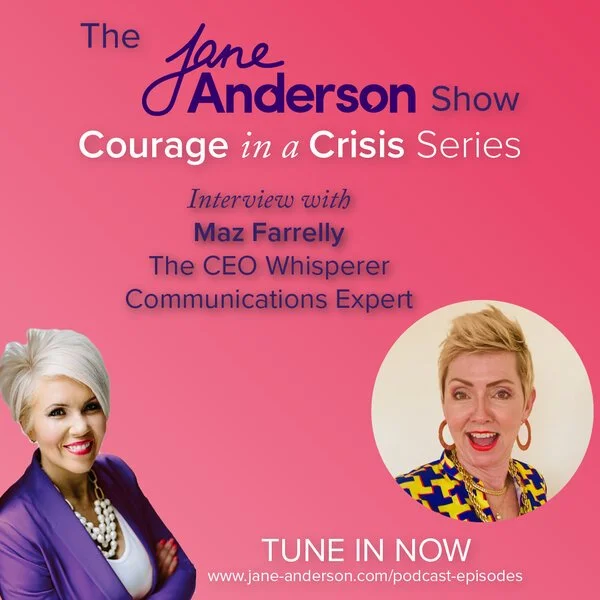
That was the heart of my conversation with Maz Farrelly, the television producer, speaker and trainer behind some of Australia's best-known shows. I recorded it for The Jane Anderson Show during the Courage in a Crisis series, when COVID-19 had moved most of us onto Zoom and everyone was competing for attention at the same time. I had a list of the people I would want beside me in a crisis, and Maz was on it.
Maz's career runs from fashion styling in London to reality television to a speaking and training practice, and she describes her work now as making people "the absolute best version of them they can be". Her message for experts, consultants and leaders is simple, and it is not comfortable: if your audience isn't engaged, the problem is probably your delivery rather than their attention span.
Listen to Episode 54 on Apple Podcasts, or read on for the lessons you can use in your next meeting, keynote or video.
From Fashion Stylist to "CEO Whisperer"
Maz describes her career as "very crazy" and says she wouldn't change a thing. She began as a stylist in London, moved into television, and ended up making comedy, entertainment and reality shows. Her credits include five series of Big Brother, The X Factor, The Farmer Wants a Wife, The Celebrity Apprentice and Dancing with the Stars, and she helped create Q&A for the ABC.
Then, as she puts it, she looked at television one day and realised she didn't love it anymore. What she did have was a skill set. For years she had paid attention, around the clock, to what makes people watch, and every decision she made was about engaging an audience who could choose to do something else. In her words, she was competing with your children, with exercise, with books and even with the weather.
She now applies that to people. One friend called her a "horse whisperer for humans" and another called her the CEO whisperer. She helps people with how they dress, move and pitch themselves, and with how they tell their story.
It Is Not Their Job to Be Interested. It Is Yours to Be Interesting.
If one idea from the episode is worth taking away, it's this one. Maz says it to clients constantly:
"It is not my job to be interested in you or your business. It is your job to be interesting."
She is clear that this isn't meanness. It's how everyone behaves. If your website isn't interesting, she won't click through. If your post isn't interesting, she won't watch. And she reminds us that being on a stage, a podcast or a screen is a privilege, not a right. You earn it.
The same goes for meetings. If you invite people to one and it isn't interesting, they may be looking at you, but they aren't listening. Maz's example will be familiar to anyone who has sat through a conference session while mentally planning a haircut.
I love this about Maz. She is one of the kindest people I know, and she is also fiercely honest. She speaks for the audience, and the audience is, as she says, everybody.
She also makes a point to the corporate and government groups she works with. People tend to say their audience is different from hers. But three million people, she tells them, buy her product every time it's available, and it adds nothing to their lives except a little entertainment. Wouldn't it be lovely, she asks, if three million people bought your product every time? Her answer is to deliver your message in a way people want to hear.
Is It Really "Fatigue"? Maz's Challenge to Speakers
Maz is blunt on this one. Remember, this was recorded during the height of pandemic video calls, when "Zoom fatigue" was everywhere.
Maz describes telling a charity panel:
"There isn't charity fatigue and there isn't Zoom fatigue, you're just not doing it well enough."
Her reasoning is that it's easy to say the audience is tired. It's harder to admit that your storytelling isn't strong enough, especially when you're up against competing demands on people's time and money. And if screens were the problem, she asks, when was the last time you had Killing Eve fatigue or Tiger King fatigue?
A note on the research. Maz's argument is about the quality of the content and the delivery, and it is her view. Stanford researchers later published a peer-reviewed analysis that identified four factors they say contribute to video-call exhaustion, including constant close-up eye contact, seeing yourself on screen, limited movement and higher cognitive load. You can read their summary on the Stanford News site. The two ideas aren't necessarily in conflict. Whatever the medium does to us, a presenter who is interesting gives people a reason to stay.
PowerPoint isn't the problem either
Maz uses the same logic about slides. She says there is nothing wrong with PowerPoint if you use it properly, and offers Brené Brown as an example. In Maz's telling, Brown's well-known TEDxHouston talk worked because of how she used a slide: she described her research, asked what happened next, then clicked to a slide that said "breakdown". Maz's point is that the slide was interesting, surprising, entertaining and vulnerable. Had Brown narrated a long list of misfortunes instead, Maz says, it would not have worked.
Maz's Three Rules of Content
Maz has three rules of content. Hit one and you're doing really well, she says; hit two and you're good; hit all three and she'll give you a job. They took her 25 years to distil, and they are very simple.
1. Make me laugh
"Comedy trumps everything," says Maz. You don't need to be a comedian. One line in your introduction is enough, and it doesn't need to be a boast. When she presented to conferences about her work on big reality shows, she'd say something wry about the "nonsense" on television and then add that she makes it. It lands because it's funny rather than "look at me, I'm so magnificent".
Laughter gives room for energy. Even a joke about how unfunny you plan to be will do the job.
2. Make me cry
Maz is clear she doesn't mean upsetting people. She means emotion: "Make me care."
On Big Brother, her team had to get viewers to care about 12 to 15 housemates within about 90 minutes, so much that they would stay for 100 days. They did it by telling a story about each person in around 90 seconds that was full of interest and comedy. Her view is that if you don't care about something on TV, it's dead, and people won't care about why you do your business unless they feel emotionally attached to you.
3. Surprise me
"We love surprises," says Maz. It's why we wrap presents, and why TV shows lift the cloche or open the door on the reveal.
The best example she knows: Susan Boyle
For Maz, the best piece of content ever made is the Susan Boyle clip. In her telling, Susan went from being unknown to appearing on Oprah within days, and it was not just because she was a great singer. The story made you laugh, made you cry and surprised you. Maz now runs a workshop called How Susan Boyle Can Help You Get a Job, where participants play Susan Boyle Bingo and tick off every moment of laughter, emotion or surprise.
Her suggestion: open a bottle of wine one evening, watch the clip, and tick the boxes yourself.
And keep it simple
"Simple is everything," says Maz, who adds that it takes a really long time to work out something simple. People are complicated, so make your message uncomplicated.
Win the Prime Real Estate
Maz's other big rule is that you have to grab attention quickly. She calls the first thing the audience sees "prime real estate".
Here's her example for speakers. When your session name and your name are on the opening slide, the audience already knows both. They've paid to be there or they're on the schedule. Yet they sit and look at that slide for a long time as people walk in. Use it to make them interested, make them laugh or set the tone. "Put a joke on it," she says. What you shouldn't do is tell them what is already on the brochure.
The same applies to what people say on TV. Statements like "I really want to win" or "I'm giving it 110%" are, in her words, "dead white noise".
A practical tip for online meetings
For Zoom meetings, Maz likes to set the scene. She has around five slides up at the start as conversation starters, such as:
You're stuck in a reality TV show for a month. Which one, and why?
You're in a car chase. What's playing on the radio?
What song plays every time you walk into a room?
She also asks a lot of questions, runs little quizzes and interacts with people by name, because she wants them to engage rather than watch.
Leaders Set the Tone
Maz also shared a story that shows how powerful the tone of a room can be.
When she worked on The Big Breakfast, she was producing an interview with Arnold Schwarzenegger. They had seven minutes with him, and his publicist and team made it very clear that the time was tight and that everyone should be polite. Paula Yates, who Maz says wasn't interested in famous people, greeted him with a rude nickname. Maz thought it was all over.
Instead, Arnold started laughing, and kept laughing, and the room laughed with him. He then told the story of how Paula had earned the nickname. Maz's takeaway is that he chose the tone of the room, and everyone followed.
"I think that leaders forget that sometimes," she says. If you walk into a meeting warm, kind and ready to laugh, people will leave warm and kind too. I wrote about a related idea in Your energy shapes your presence and influence.
Maz also told me about Mary J. Blige, who said that Chaka Khan once advised her to "get out of your own way". Maz recognised herself in it.
Trojan Horse Training and the Book Behind It
Maz describes her training style as "Trojan horse training". People write to tell her they laughed their heads off and then went home and wrote 32 pages of notes. They weren't supposed to notice it was a lecture. If she just shouted five facts at them, she says, they wouldn't go in, so she weaves information into stories and makes it funny, emotional or surprising so that it sticks.
That is also how she approached her book, Not Famous: Stories to Help You Navigate the Biggest Show of All, Life. She didn't want to write a memoir, because, in her words, "who cares?" She wanted a book that benefits people. She has a list of about 100 stories about what she has learnt from the people she has worked with. Each chapter follows the same structure: a story, what she learnt from it, a reiteration, and a short exercise to help you remember it.
When we recorded, the book was a limited edition written for a CEO summit, and Maz was taking it to publishers. The lesson holds for anyone building a thought leadership practice. Your own stories are the material, and a clear structure is what turns them into something other people can use. I explore this in The Power of Your Personal Story.
Frequently Asked Questions
What is the most important rule for making content interesting?
Maz's starting point is that it isn't your audience's job to be interested; it's your job to be interesting. From there, she suggests aiming for laughter, emotion or surprise, and keeping your message simple.
What are Maz Farrelly's three rules of content?
Make me laugh, make me cry (meaning make me care), and surprise me. Maz says that if you get one of the three you're doing really well, two is good, and all three is the standard she would hire for.
Is "Zoom fatigue" real?
Maz argues that it isn't the screen that exhausts people but content that isn't engaging enough, and she points out that people happily binge-watch shows for hours. Stanford researchers have separately identified features of video calls that they say contribute to exhaustion, so both the medium and the content may play a part.
How can I make online meetings more engaging?
Maz likes to open with a few conversation-starter slides, such as "which reality TV show would you be stuck in?", then asks questions, runs quizzes and uses people's names to keep them involved.
What is "prime real estate" in a presentation?
It's the first slide or opening moment, when the audience already knows your name and topic. Maz recommends using it to interest, amuse or set the tone, rather than repeating what's on the brochure.
What is Trojan horse training?
It's Maz's term for teaching through entertaining stories, so that people absorb the information without feeling they have been lectured.
About Maz Farrelly
Maz Farrelly is a television producer turned speaker and trainer. Her credits include Big Brother, The X Factor, The Farmer Wants a Wife, The Celebrity Apprentice and Dancing with the Stars, and she helped create ABC's Q&A. She is the author of Not Famous. At the time of our conversation, she invited listeners to connect with her on LinkedIn as Maz Speaks, and her website is mazspeaksglobal.com.
Conclusion
Maz's advice is easy to remember and hard to do well: stop assuming people owe you their attention, and give them a reason to stay. Make them laugh, make them care, surprise them, keep it simple, and use your opening moments well. Whether you're presenting to a boardroom, writing a post or recording a video, the principle is the same, and it matters more when everyone around you is competing for the same eyeballs.
Work With Jane Anderson
If this conversation made you think about how interesting your own message is, here are some ways to take the next step:
Women With Influence: Join a community of B2B women consultants, coaches and advisors building world-class practices.
1:1 Coaching: Work directly with me on your personal brand and business growth strategy.
Grow With Influence: Build a structured, sustainable consulting or advisory practice.
Tune in to Episode 54 to hear Maz's stories in full and find out how to make people laugh, care and sit up and listen.
Key Takeaways from Today’s Episode:
-
Maz says it isn't anyone's job to listen to you; it is your job to be interesting. Being given a stage, a podcast or a meeting slot is a privilege you earn.
-
Maz's view is that "fatigue" is often a sign that the content and storytelling aren't strong enough. She argues that people don't tire of things they find gripping.
-
Maz's three rules are to make people laugh, make them care and surprise them. Meeting one is a good start; meeting all three is her standard.
-
Simple messages take the longest to refine. The first slide or first line is prime real estate, so use it to set the tone rather than repeat what's already on the schedule.
-
As Maz saw when Arnold Schwarzenegger laughed instead of walking out, the leader in the room sets the mood everyone else follows.
-
Trojan horse training weaves facts into stories that make people laugh, care or feel surprised, so the learning sticks.