Podcast is also available on the versions below:


Get Notified Of Future Episodes on Apple Podcasts | Spotify | Youtube
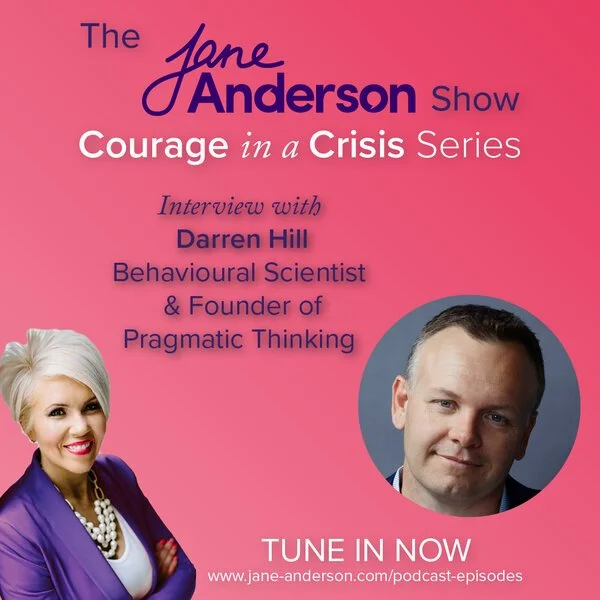
What do you do when twelve months of work disappears in four days?
That is the situation behavioural scientist Darren Hill describes in this episode of The Jane Anderson Show, part of my Courage in a Crisis series. Darren is the co-founder, with his wife Alison, of Pragmatic Thinking, a behaviour and motivation strategy company based on the Gold Coast. Pragmatic Thinking has made the Australian Financial Review's Fast 100 list three years running, and Darren is a published author who appears regularly on Sky Business, Channel Nine and in the Financial Review. He has also been recognised by the Professional Speakers Association as an educator of the year.
In this conversation, Darren does two things at once. He tells the story of what COVID-19 did to his own business, and he explains what behavioural science tells us about how people respond when a crisis hits. Listen to the full conversation on Apple Podcasts.
The episode was released in August 2020, during Australia's second wave. Darren is clear that it is a once-in-a-century event that nobody has lived experience of. But he returns again and again to older, steadier patterns of human behaviour, and those patterns apply to any expert who is leading through a crisis.
Before You Pivot: Finish What You've Already Built
I open the episode with an observation from my own client work. Some of the experts I work with were selling well before COVID-19 because they were delivering well. When work dropped off or was pushed to the following year, many used the time to build the collateral they should already have had: websites, newsletters, landing pages and brochures.
I also noticed that a couple of clients believed they had to pivot simply because everyone was telling them to. They didn't need to. They needed to finish what they had already started, and my encouragement is to ask whether you can still deliver the work you have already built before you spend time changing direction.
My second prompt is to reconnect with your community: reach out and ask what they need help with.
What Happened When 12 Months of Work Disappeared
Pragmatic Thinking had around 15 or 16 people on the team before COVID-19. Like travel and events, the vast majority of its work was delivered face to face. Darren remembers the dates clearly: 13 to 16 March, when each day brought another announcement from the prime minister. In four days, he says, the business watched twelve months of work disappear.
There was a personal layer too. Someone in the Hills' own household was in the highest risk category, so the restrictions had to be taken extremely seriously while all revenue had stopped overnight.
Darren credits the business's conservative approach for giving them room to think. Some business models grow as fast as possible and run at a loss. Pragmatic Thinking had always aimed to grow while maintaining a profit, which gave it enough cash and foundation to make decisions that were not purely reactionary.
Even so, the team had to shrink by four people. Darren describes it as something they never wanted to do, and says every one of those people has since found work, a couple of them with pay rises. He would hire any of them back in a heartbeat. The cruel timing was not lost on him: the day the business learned it had made the Fast 100 list for a third consecutive edition was also the day it had to give four staff notice. It should have been a major marketing moment. Instead, he says, it felt like a label from a previous world.
Three Decisions That Kept the Business Viable
I asked what made the biggest difference in keeping the business viable and retaining so many staff. Darren offered three things.
1. Know the Language of Your Business
For founders, he says, the language of the business is the numbers: cash position, staffing costs and the figures that sit underneath them. In the first week of the crisis, the Hills made sure they knew their numbers inside and out, which allowed them to make intelligent early decisions rather than misplaced ones.
The principle applies beyond founders. For a marketing team, the language might be the language of the customer. The point is to understand what your team or business is really made of before you decide anything.
2. Move Fast
The second decision was speed. The team did not dilly-dally, and Darren is blunt about why: "a wrong decision made quickly is forgiven", whereas no one forgives a decision that is never made. That applied to what value Pragmatic Thinking would offer clients as well as to staffing decisions.
3. Match Your Mindset to the Moment
The third is the one Darren says he has discussed most with clients. Early in a crisis or trauma, optimism is not in the mix. "Optimism's great on everything, but it's not good on grief."
He uses a familiar example. When someone close to you dies, you don't want to hear that there will be better days. You want practical help, and the person who turns up with a meal or mows the lawn is the one you remember. The same applies to leaders. Early in a crisis, he says, it is time to be realistic, practical and useful. A message that everything will be the best thing ever would have been insensitive while his team were having their hours reduced or being let go.
Optimism does have its place, once the grief and trauma have passed, and Darren's advice is to check the temperature before choosing when to use it. At the time of recording, he felt that moment had arrived for most industries, although some would reach it earlier or later. I added that this crisis looked different from the GFC because some industries were thriving while others were struggling, so the temperature check matters even more when you are working with a range of clients.
Antifragile: Choosing a Word That Frames the Year
Every year, the Pragmatic Thinking team chooses a single word as a contextual beacon, a practice Darren says is common among people he knows. Their word for the year, set in January, was antifragile. It was about how the business would get stronger from setbacks, and Darren jokes that they then got themselves a hell of a setback to learn from.
The term was popularised by Nassim Nicholas Taleb in his book Antifragile: Things That Gain from Disorder. Darren's own description is that antifragile thinking is not about bouncing back but about bouncing forward: becoming a stronger, more resilient business and learning lessons that could never have been learnt without the stress. He says the word has never been more powerful for the team than it is now.
The crisis also forced innovation. Darren estimates that in a couple of months the team innovated more than it had in two years. It embraced a fully distributed work model, closed one of its physical offices and now treats itself as a live laboratory for clients who are making similar decisions.
The Motivation Curve: Novelty, Adrenaline and the Dip
When I asked for his behavioural science advice, Darren began with honesty: nobody has a double PhD dissertation in COVID response. What we can do is lean on time-honoured patterns, and he describes a predictable sequence of responses to a novel event.
1. Novelty. At first, everything is new and different. Working from home was suddenly a permanent arrangement rather than a one-off, and for many people that sparked energy and curiosity.
2. Adrenaline. Next comes an adrenaline response. People map a short-term plan, perhaps for the next month or the next few weeks, and productivity skyrockets. Darren compares adrenaline to jet fuel: it burns out fast.
3. The dip. Eventually that state can't be maintained. Motivation wanes and, if people stay down there too long, they can end up with lowered productivity and a lowered sense of self-worth. Darren links this to identity. Work is a third of our lives and, for people in solo practice, closer to two thirds, so when results disappear people start to question who they are and what value they offer.
His advice is to rewrite your own motivation curve before you head into the dip. In practice, that means shelving your grand plans and coming back to being useful.
Chunk It Down and Go Back to What You Know
Darren calls the first step "chunking down": breaking things into smaller pieces. The worst thing to do right now, he says, is to start building an app that will take three or six months to build, followed by another marketing cycle of three to six months. Instead, ask what the people you are connected to need right now, whether you are in your own practice or inside an organisation.
He encourages a minimum viable testing ground: come up with the concept, sell the concept, and build it once it has an audience. Inside an organisation, that might mean getting enough key champions on board for a solution to move before you invest in building it.
The same logic applies to big long-term projects such as a book. Darren says there is nothing wrong with writing one, but anything long term while everything else in the world has gone short term is "like oil and water". A book needs energy, promotion and capital behind it, and he asks what happens if you go broke before you can publish it. I echoed the point: at the time of recording, it was not the time to start a podcast or write a new book. It was the time to pull out your list of past clients and find out what problems they have today.
Darren also identifies a common trap for people building a thought leadership practice. They try to escape the pain of their previous career by moving away from it, whether that is real estate, government or sales, and sell into a field they only have opinions about. His advice is the opposite: go back to what you know best, the place where you have the most time, and give value back to that audience. The pain, he says, is what taught you the lessons, and those lessons can be shared.
You Are Not a Bother: Reaching Out When Everyone Is Busy
I raised a fear I hear often: everyone says they are busy, so people worry they will be annoying if they reach out. Is that a cop-out, or is it real?
Darren answers from his own experience. He has a voice in his head that says he is lazy, and there is enough evidence to show that he isn't. His point is that "just because a narrative or a belief is tenacious doesn't make it real." Whether you are a bother is not your decision to make; it is the other person's. If you honestly believe you can offer a better pathway, then standing in the way of that makes little sense.
He is not describing a hard sell. If you believe the value is genuine, the fact that people are busy is exactly why you might try a couple of times. Much depends on the value you have given your audience in the past, and Darren points to experts who look after their communities by genuinely caring rather than building a list and hammering it when they need something.
He shared a related idea from a conversation with a friend: "leaders in a crisis don't find themselves, they find a way." You might be a leader of one, a solo practitioner, but you still need to lead your customers.
I add a reframe from my own work. Shift your mindset from being a marketer to being a leader. Your newsletter is not marketing; it is leading. Your phone calls are not marketing either. Otherwise, I would call it spam.
The Stories We Tell Ourselves
Darren takes the idea one step further. The voices in our heads are, in his words, fiction: an interplay of neurons that creates stories, which are only real if we believe them. He traces our ability to communicate about abstract ideas to a cognitive revolution roughly 70,000 years ago, when humans learnt to talk about fiction based on reality. Many of the voices in our heads, he says, were taught to us by other people and by society.
The encouraging part is that once we recognise a story as fiction, we can pick up our own pen and write a different one.
Virtual Delivery Is Here to Stay
Near the end of the conversation, I ask Darren about the work he and Alison have been doing in virtual delivery. Darren's view is that a live, facilitated virtual experience is here to stay. Pragmatic Thinking has invested heavily in a virtual studio and gone down to the detail of which camera angles suit which types of content and how to apply the neuroscience of learning on camera.
He expects face-to-face work to focus on experience and emotional connection, while virtual handles much of the content delivery, because it is a useful way to be led in real time by an expert. He believes the team is leading the way on this and encourages every expert to think about how their offering needs to adjust. People will still need to run businesses while socially isolated, and they will need help to solve new problems.
I agreed that moving from "I can just do that on Zoom" to a genuinely engaging virtual experience takes work, and recommended other experts have a look at what the team has built.
About Darren Hill
Darren Hill is a behavioural scientist and co-founder of Pragmatic Thinking. He is a published author, a regular media commentator and the co-creator, with Alison Hill, of a virtual facilitation studio.
Frequently Asked Questions
How should leaders communicate in the early stages of a crisis?
Darren Hill says early in a crisis or trauma, optimism is not what people need. Leaders should be realistic, practical and useful, and then choose the moment to talk about better days once the grief and loss have passed.
What is the motivation curve in a crisis?
Darren describes a predictable pattern: an initial novelty phase fuelled by curiosity, an adrenaline phase with short-term planning and high productivity, and then a dip as that fuel burns out. His advice is to rewrite your motivation before the dip, by chunking things down and focusing on being useful.
Should I pivot my business during a crisis?
My observation is that many experts do not need to pivot. They need to finish the collateral and programs they have already designed, and check whether they can still deliver them.
What should experts do instead of launching a big new project?
Darren recommends testing a concept with the audience you already know and building it only once it has an audience. Long-term projects such as a book are not wrong, but they sit awkwardly alongside short-term conditions and need energy, promotion and capital.
Is it a bother to contact clients when everyone is busy?
Darren says the belief that you are a bother is a tenacious story rather than a fact. If you genuinely believe you can help, being busy is a reason to try more than once, and it is up to the other person to decide.
What does antifragile mean in business?
In Darren's description, antifragile thinking is about bouncing forward rather than back: becoming stronger and more resilient by learning lessons you could never learn without stress. His business chose it as its word for the year.
Is virtual delivery here to stay?
Darren believes live, facilitated virtual experiences will remain, with face-to-face work focusing more on experience and emotional connection.
Conclusion
Darren Hill's story is not one of easy wins. He lost a year of work in four days, had to let good people go, and still found room to innovate. What carried the business through was something close to common sense: know your numbers, decide quickly, meet people where they are, and stay useful.
As he puts it, when none of us knows the way, start by looking for the north. Care about your audience, move fast, don't navel-gaze for too long, and find a way.
My own prompt sits alongside that advice. Before you change course, ask whether you have really used everything you have already built, and whether the people in your community know you are there to help.
Work With Jane Anderson
If this conversation resonated, here is how to take the next step:
Women With Influence: Join a community of B2B women consultants, coaches and advisors building world-class practices.
Grow With Influence: Coaching for B2B practices.
1:1 Coaching: Work directly with me on your personal brand and business growth strategy.
Tune in to hear a candid conversation about courage, practical leadership and staying useful when the ground shifts under your practice.
Key Takeaways from Today’s Episode:
-
Darren says the first week of the crisis was spent understanding cash position and staffing costs, which allowed intelligent early decisions rather than misplaced ones.
-
In his view, a wrong decision made quickly is forgiven, but a decision that is never made is not.
-
Early in grief or trauma, practical support matters more than optimism. Check the temperature before choosing when to be optimistic.
-
Novelty and adrenaline eventually burn out. Rewrite your own motivation before you hit the dip in productivity and self-worth.
-
Shelve long-term builds, test the concept with the audience you already know, and build it once it has an audience.
-
A belief that you are a bother can feel real without being real. Reach out and let the other person decide.
-
Jane's advice is to check whether the work you have already designed can still be delivered before you change direction.