I was talking to Rachel (not her real name, but a very real person), a woman in my community recently, who was working on getting her newsletter up and running. She'd organised new branding and professional photographs, but they wouldn't be ready for another couple of months.
She just had her old photograph and was worried that it wasn’t quite right and that her newsletter wouldn’t look as professional as she wanted it to.
‘Should I just wait until everything's ready?’ she asked me.
‘No,’ I told her. ‘Just get started.’
The photo was perfectly fine, maybe it wasn’t as good as the ones coming, but it would certainly do the job until they arrived. But she didn’t want to go out into the world with something that felt less than perfect.
That's something I see quite often with the women I work with. They're building their practices, developing their expertise, and working towards becoming world-class at what they do. They have high standards, which I absolutely encourage (I do too!), but we can’t let those standards get in the way of actually making progress.
World-class is the goal
What is a world-class practice? When I talk about building a world-class practice, I'm talking about becoming exceptional at what you do. It's about developing a reputation for excellence, delivering real value to your clients, and creating a business that stands out for all the right reasons.
And of course, how you present yourself is part of that. Your branding, website, marketing materials, and client experience all contribute to how people perceive you and your expertise.
But we can’t always dive straight into that level. That’s not to say you don't have to have world-class thinking. You should always have world-class thinking around your area of expertise. But it can take time to build up everything around that thinking to the level of world-class.
Unfortunately, in trying to become world-class, we can sometimes find ourselves slipping into perfectionism. Perfectionism can be a bit like quicksand. You start worrying about one little thing that isn't quite right, then another, and before you know it, you're completely stuck. The more you overthink things, the harder it becomes to move forward. And one of the most common problems with perfectionism is when we become so focused on getting everything right that we end up doing nothing at all.
Embracing world-class ways of working
I've created this model around perfectionism versus being world-class.
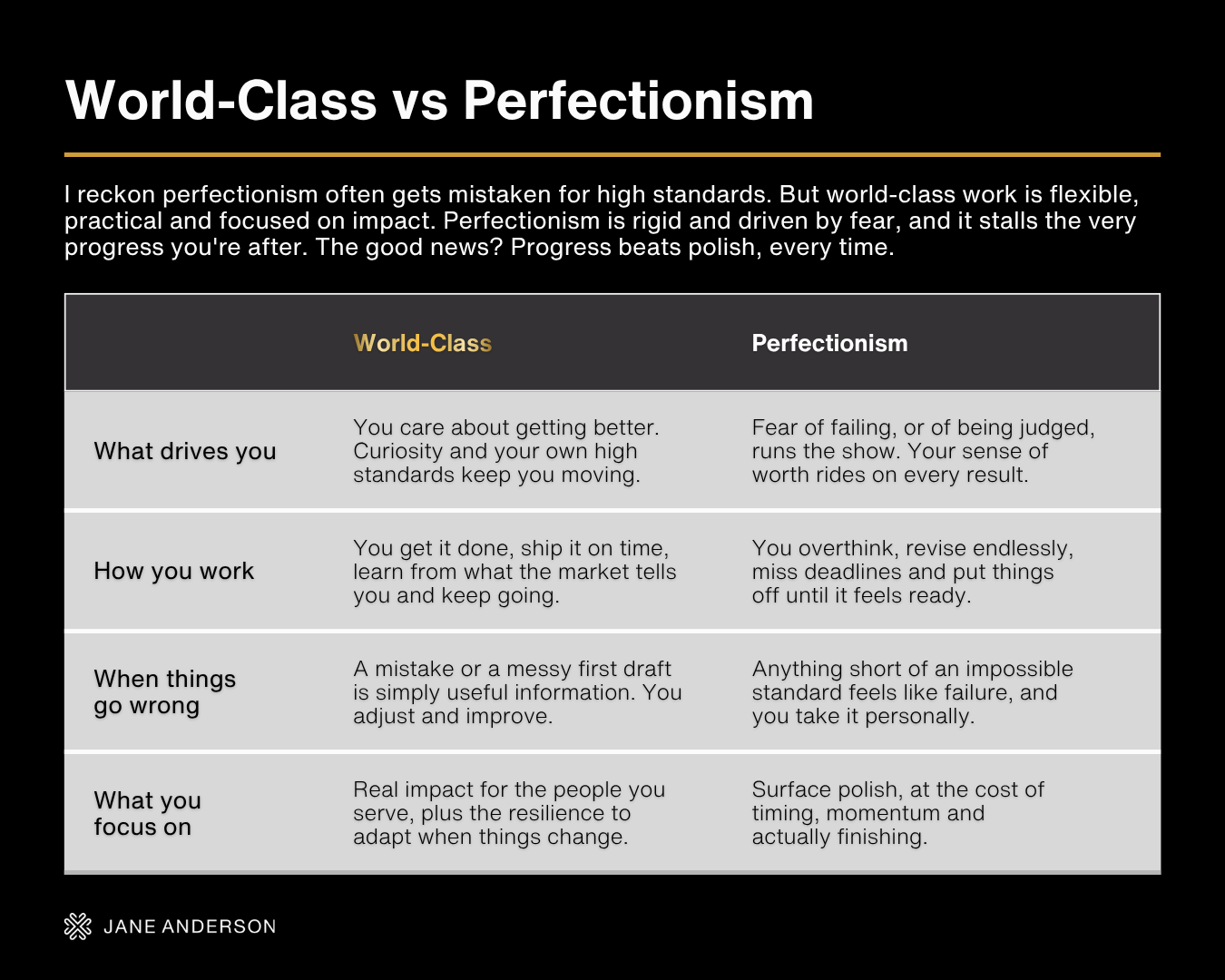
As you can see, there are some significant differences between world-class and perfectionism in how we approach our work, what drives us, and how we respond when things don’t go to plan. The biggest difference is what drives you.
When you’re striving to be world-class, you’re motivated by curiosity and a desire to keep getting better. You have high standards, but you also recognise that there’s always room for improvement. So you don’t dwell on the things that aren’t exactly right. You get things done, put your work out into the world and learn from the feedback you receive. And when things do go wrong – and of course things will go wrong – you recognise that this is simply useful information. So you adjust and improve.
Perfectionism, on the other hand, is usually driven by fear. You’re worried about how you’ll be perceived – worried about failing, being judged or producing something that doesn’t meet your expectations. So you keep fixing, changing, revising, second-guessing, and putting things off until you’re completely ready. And when things go wrong when you’re in this stage, then it feels like failure. You take it personally, and it can stop you from taking any further steps at all.
And even when you do put yourself out into the world and take action, it can be difficult to recognise your achievements when you’re stuck in perfectionism.
Being world-class means being willing to continuously improve

My nephew Luca is an Australian youth tenpin bowler. He's only 15, but he's been bowling since he was a toddler. That means he’s been putting in years of hard work and practice already.
Recently, he achieved something pretty incredible. He bowled his first perfect game, scoring 300 points. In a perfect game, every bowl is a strike. No mistakes at all.
This was amazing! Incredible really! And it might seem like achieving that perfect score means he's achieved everything – there's nothing left to improve. But of course, that's not really how it works. He won't always be able to bowl a perfect game, and he certainly didn't start with games scoring 300 at 2 years old. He'll have off days, make mistakes, or develop new habits. And even with a perfect score, there are still places and things that he will want to improve in his overall bowling game. So Luca is back at training, practising, and working on getting even better.
Luca, at just 15 years old, is teaching us how to be world-class. When someone succeeds or has incredible achievement, we tend to focus on the result. We see Luca’s perfect score, but we don’t necessarily see all the years of practice, the mistakes and the small improvements that made it possible.
That's what being world-class is all about. It’s not about getting everything perfect. It’s about continually working to become better at what you do. This is a world-class way of working.
Even when you've been running your practice for years, and you're doing outstanding work, there will always be opportunities to improve. You can refine your processes, strengthen your client experience and find new ways to deliver value.
Being a high achiever but not a perfectionist
Luca’s story teaches us that you can strive to be exceptional, to achieve extraordinary things and still recognise that there’s always room to improve. You don’t have to be perfect to be a high achiever. Interestingly, research backs this up, finding that striving for high standards can be a positive thing, particularly when it isn't accompanied by excessive worry about mistakes or what other people think.
In other words, you can be ambitious, set exceptionally high standards for yourself, and be a high achiever without expecting everything you do to be perfect. It's when that fear of getting things wrong takes over that perfectionism becomes a problem.
There's a great book by Lynne Cazaly called Ish, which is about overcoming perfectionism. One of the things I love about Lynne's approach is how light she is about getting things done. She's very much of the mindset, ‘Yeah, that'll do. Just start there and see what happens.’
Her approach really helped me when I was getting my own practice off the ground. It reminded me that sometimes you have to be willing to put something out into the world before it's exactly how you'd like it to be. You can always make it better as you go.
And that's exactly how I approach helping people build world-class practices. Of course, I want you to have exceptional branding, beautiful marketing materials, and an outstanding client experience. But I also know you might not have the time, money, or resources to achieve all of that right now. As long as you have your world-class thinking, then everything else can develop as your practice grows.
Are you building a world-class practice?
If you've been putting something off because you're worried it isn't quite ready, perhaps it's time to ask yourself whether you're striving to be world-class or getting caught up in perfectionism.
There's a wonderful speech by Theodore Roosevelt called The Man in the Arena, which Brené Brown often references in her work. Roosevelt said:
‘It's not the critic who counts. Not the man who points out how the strong man stumbles, or the doer of deeds could have done them better. The credit belongs to the man who's actually in the arena, whose face is marred by dust and sweat and blood, who strives valiantly, who errs, who comes short again and again because there's no effort without error and shortcoming. But who does actually strive to do the deeds. Who knows great enthusiasms, the great devotions, who spends himself in a worthy cause, who at the best knows in the end the triumph of high achievement, and who at the worst, if he fails, at least he fails while daring greatly so that his place shall never be with those cold and timid souls who never know victory nor defeat.’
Isn't that wonderful? To me, that's what being world class is all about.
Just start with what you've got, learn from the experience, and keep making it better. If you’re ready to get started, ask yourself:
Is there something you've been putting off because it isn't quite perfect?
What would happen if you gave yourself permission to get started?
What's one small step you could take today to start building momentum?