Why generic business advice rarely works for consultants
Article summary
Consulting businesses don't grow the same way other businesses grow, yet many experts seek advice from coaches who have never built a high-trust consulting practice. This article explores the seven capabilities your coach should understand, plus one often-overlooked area that can have a significant impact on growth: adult learning design.
As thought leaders, consultants, and experts, we often consider ourselves a bit different from a typical business owner. We’re focused on providing programs, speaking and developing IP around our chosen expertise, and often work with corporate organisations or deliver to large events.
But we still also have to run a business just like every other Australian business owner. This means sending out proposals and invoices, marketing, running a website, managing a VA or a larger team, keeping our calendars up to date and booking meetings, as well as handling the bigger-picture items, like strategy and hiring decisions.
Because we have to run a ‘business’ as well, sometimes it’s tempting to go to a ‘business coach’ when we need a bit of elevating. Coaching is a great idea. The problem is that most business coaches come from a small-business, online marketing, or agency background. They understand funnels, social media, and lead generation, but they've never built or scaled a high-trust consulting practice.
As a result, consultants often receive advice that doesn't match how expertise in an expert’s business actually grows.
The difference between businesses and expert businesses
Consulting businesses operate differently from a typical business. Consultants aren’t selling products or even (really) services. They’re selling expertise, judgement and trust. Their buyers aren’t casual consumers making one-off purchases. They’re executives, procurement teams, senior leaders and boards making significant and strategic decisions on behalf of organisations.
The buying cycle is different. The sales process is different. The economics are different. And, most importantly, the goals are different. Because of that, advice that might be perfect for other business models simply doesn’t move the needle inside a consulting practice.
If you’ve had this experience before, the problem isn't coaching. It's that you had the wrong kind of coaching.
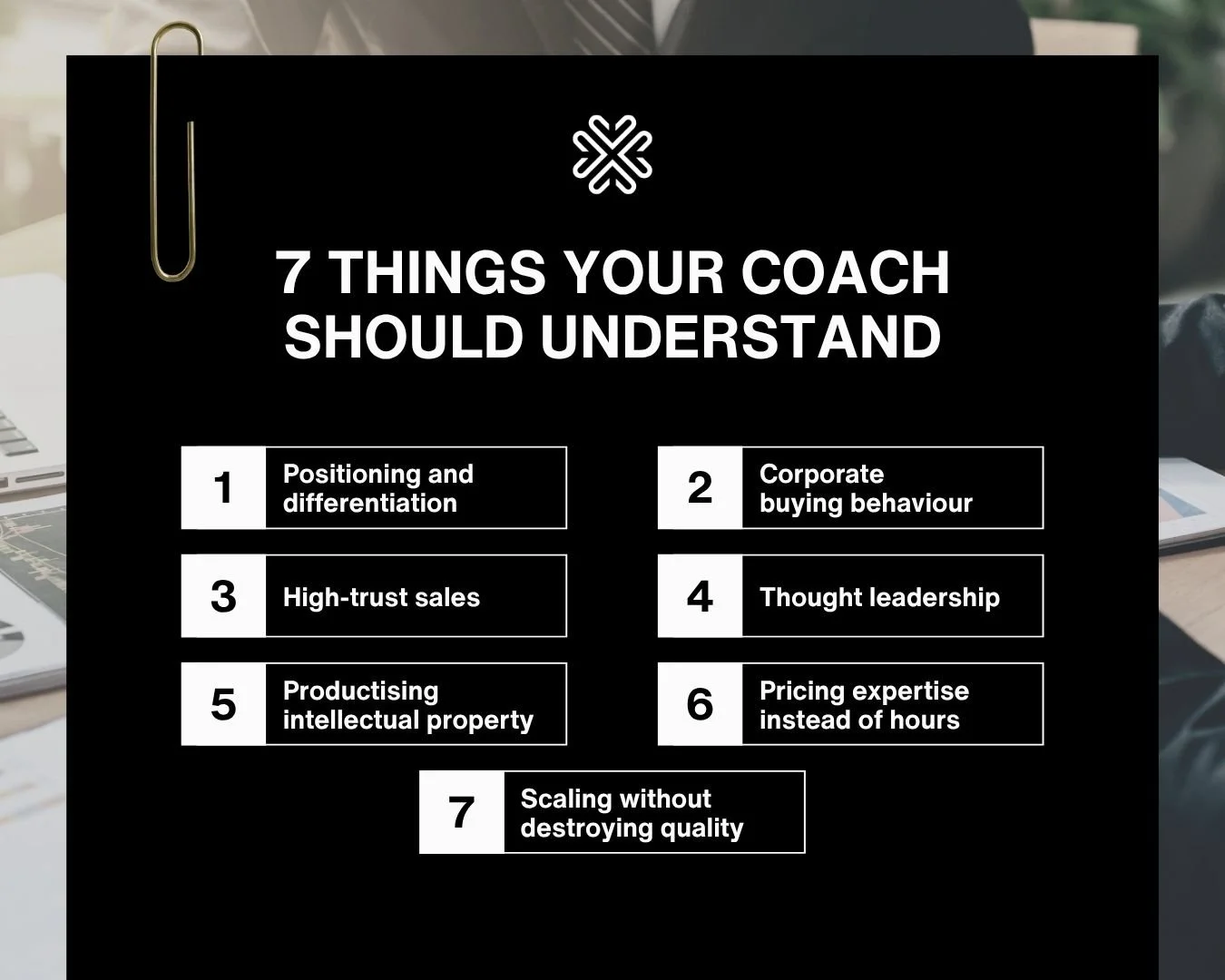
7 things your coach should understand
1. Positioning and differentiation
One of the biggest mistakes consultants make is assuming expertise automatically creates demand. And sometimes typical business coaches might think the same think. But if expertise created demand, we’d all be on easy street! Unfortunately, it doesn’t.
The market is filled with highly capable people who struggle to stand out. It’s your positioning that allows you to create a place in the minds of other people. It’s what people think about you and even say about you when you’re not in the room.
Establishing your positioning is one of the most important tasks of a thought leader. You don’t want to be known for everything – you want to be known for the right thing. A coach who understand this can help you become known for a specific problem, outcome or idea rather than becoming another generalist in a crowded market.
2. Corporate buying behaviour
Most consultants sell into organisations rather than directly to consumers. That means that they need to anticipate longer sales cycles, multiple stakeholders, bureaucratic procurement processes and internal business cases.
This can feel like a frustratingly slow decision in a normal business, but it’s just a typical part of the process for organisational buying. A coach who understands this can help you navigate complex and highly-stratified sales environments and create organisationally-focused sales proposals, instead of applying strategies designed for simple consumer purchases
3. High-trust sales
Consultants aren't selling products. They’re helping people make important decisions, and bringing compounding value into organisations. This might mean working on strategy, advising leadership, helping create culture change or working through transformation. But whatever it is, clients are often placing significant trust in your expertise.
In these situations, being trusted matters a lot more than being persuasive. The best consulting coaches understand how to build credibility, reduce perceived risk, and create confidence throughout the buying process.
4. Thought leadership
Your average business coach often doesn’t understand thought leadership (it’s not just posting on LinkedIn!). That’s not because they aren’t good at their job, but because they simply haven’t been part of the thought leadership world.
But as an expert, you know that it’s your thought leadership that helps your clients trust you and trust your expertise long before they ever meet you. A coach who understands this can help you develop a body of work that reinforces your positioning and creates more opportunities for the future.
5. Productising intellectual property
As you’re probably well aware, there are only so many hours in a day to sell. And no one wants to be selling all the time either. For experts, our goal is to build growth by turning our expertise into frameworks, methodologies, programmes and repeatable assets.
A coach who can help you productise your expertise will also help you scale your impact without having to rely only on one-to-one delivery, which can be time-consuming and deliver lower revenue returns.
6. Pricing expertise instead of hours
Too many consultants still price based on time. But our clients don’t buy hours. They buy outcomes.
A coach who understands expert businesses can help you shift the conversation from effort to value, impact, and results. They can help you see the outcomes you create, help you define that value, and show you how to explain that potential ROI in your sales meetings.
7. Scaling without destroying quality
There are a lot of great business coaches out there who understand how to generate leads. But there are far fewer who understand how to grow your impact without working more hours or reducing the client experience.
As a consulting business grows, the challenge shifts from winning work to maintaining quality. More clients, more workshops and more programmes can quickly create capacity issues if your expertise exists only in your head.
A coach who understands expertise businesses can help you build frameworks, methodologies and delivery systems that allow you to grow without compromising client outcomes.
Adult learning design – the capability most coaches miss
I have been a trainer for nearly 35 years. And over the course of my career working with thought leaders, I’ve come to realise that adult learning design is one capability that can have an enormous impact on your growth. And it’s also one that’s very often forgotten.
Most often the goal of a consulting engagement isn’t simply to transfer information, but to create change. That means helping people develop new skills, adopt new behaviours, make better decisions or achieve specific outcomes. And much of that comes from a strong understanding of adult learning design.
I have seen this at work. I recently worked with a consultant who had built a successful business over almost two decades. She was respected, experienced, and getting great revenue. But she was also exhausted. After every programme she felt totally depleted, and she just couldn’t see how she could continue growing the business at the pace she wanted.
When I reviewed her facilitator guides and delivery approach, the issue became very clear. She was doing almost all the work – speaking for about 85-90% of the time. Participants were receiving information, but there was limited opportunity for participation, reflection or assessment. The programmes contained a huge amount of content, but they weren't designed around adult learning principles.
So we made that change, redesigning her programmes around learning outcomes, participant engagement and behaviour change. And the results were almost immediate.
After the first redesigned programme, she told me she'd never felt so energised at the end of a workshop. Rather than feeling exhausted, she felt like she could walk straight back in and deliver another session. The commercial impact was just as significant. The client expanded the engagement by $350,000 and decided to roll the programme out across every department in the organisation.
Choosing the right coach
The coach who understands funnels, lead generation, and marketing may help you attract more prospects, but consulting businesses need more than leads.
They need positioning. They need thought leadership. They need intellectual property. They need pricing confidence. They need delivery systems that create measurable outcomes for clients.
Before you hire your next coach, ask yourself:
Has this coach worked with consultants before? Do they understand positioning, trust-based sales, IP, and the realities of selling expertise?
Does this coach understand the challenge I’m trying to solve? Do they have a lived experience of being both the buyer and the seller?
Will this coach help me become more valuable or simply more visible? Can they help me improve how I create outcomes that generate referrals, repeated work, and sustainable growth?
I’d love to know your thoughts . . .