How do you prove you're the real deal when nobody trusts what they're seeing anymore?
Article summary
We're entering a trust crisis where polished content is no longer enough to earn credibility. Discover the proof signals that help thought leaders, consultants, and experts build trust with clients in an increasingly skeptical world so they can demonstrate they’re the real deal.
In May 2023, an AI-generated image showing an explosion near the Pentagon spread rapidly across social media. The image looked authentic enough that it briefly caused confusion online before authorities confirmed it was fake.
What made the story so remarkable wasn't the image itself. It was how many people believed it without question. That’s because until the very recent past, you could believe your own eyes. But now… we’re just not sure.
Recently, major brands have begun using AI-generated influencers and digital avatars in their marketing. Some look so realistic that customers don't even realise they're not real people at all. The technology is impressive (amazing really!), but it raises questions. In particular, if anyone can look credible online, how do buyers know who to trust?
As thought leaders and experts, we used to worry about being seen. Being visible and positioned and known. But now, in the AI age, people aren’t asking, ‘Where can I find you?’ They’re asking, ‘Can I trust you?’ And, maybe more importantly, ‘Are they the real deal?’
We're entering a trust crisis
In today’s modern world, we’re already in a trust crisis. The 2025 Edelman Trust Barometer – one of the most cited annual trust studies globally – found that 70% of respondents said government officials, business leaders and journalists deliberately mislead them. 64% also struggled to discern credible information from misinformation. The 2026 edition reinforces this, describing ‘a world retreating towards insularity’. As economic uncertainty and rapid technological change continue to reshape the world, people are placing their trust in fewer institutions and relying more heavily on what’s familiar – their communities, networks and relationships.AI has only increased this trust crisis. Artificial intelligence has dramatically lowered the cost of creating content. Today, almost anyone can build a professional website, write convincing copy, create polished social content, produce videos and establish a credible online presence in a matter of hours. But all of this just leads to more uncertainty Accenture's Life Trends 2025 report found that 62% of consumers now say trust is an important factor when engaging with a brand (up from 56% in 2023), with 59.9% of consumers doubting online authenticity as AI-generated content floods their feeds. The same report found 38% of consumers encountered fake product reviews in 2024, and 52.8% regularly question the authenticity of reviews they read.All of this makes it harder than ever for us to build trust with our clients. And that means that our customers and clients are now asking themselves, is this for real? Was this written by a person? Did this result really happen? Can I believe what I’m seeing? Are they really who they say they are?
Authenticity isn't proof enough anymore
For the past decade, authenticity has been one of the biggest buzzwords in marketing. We’ve been told to be authentic, to share our stories, show more personality, let people see you, warts and all.
All of this still matters, but I don’t think authenticity is enough anymore. At least it’s not enough to combat our trust crisis. What we need now is proof. People don't just want claims, anymore. They want evidence.
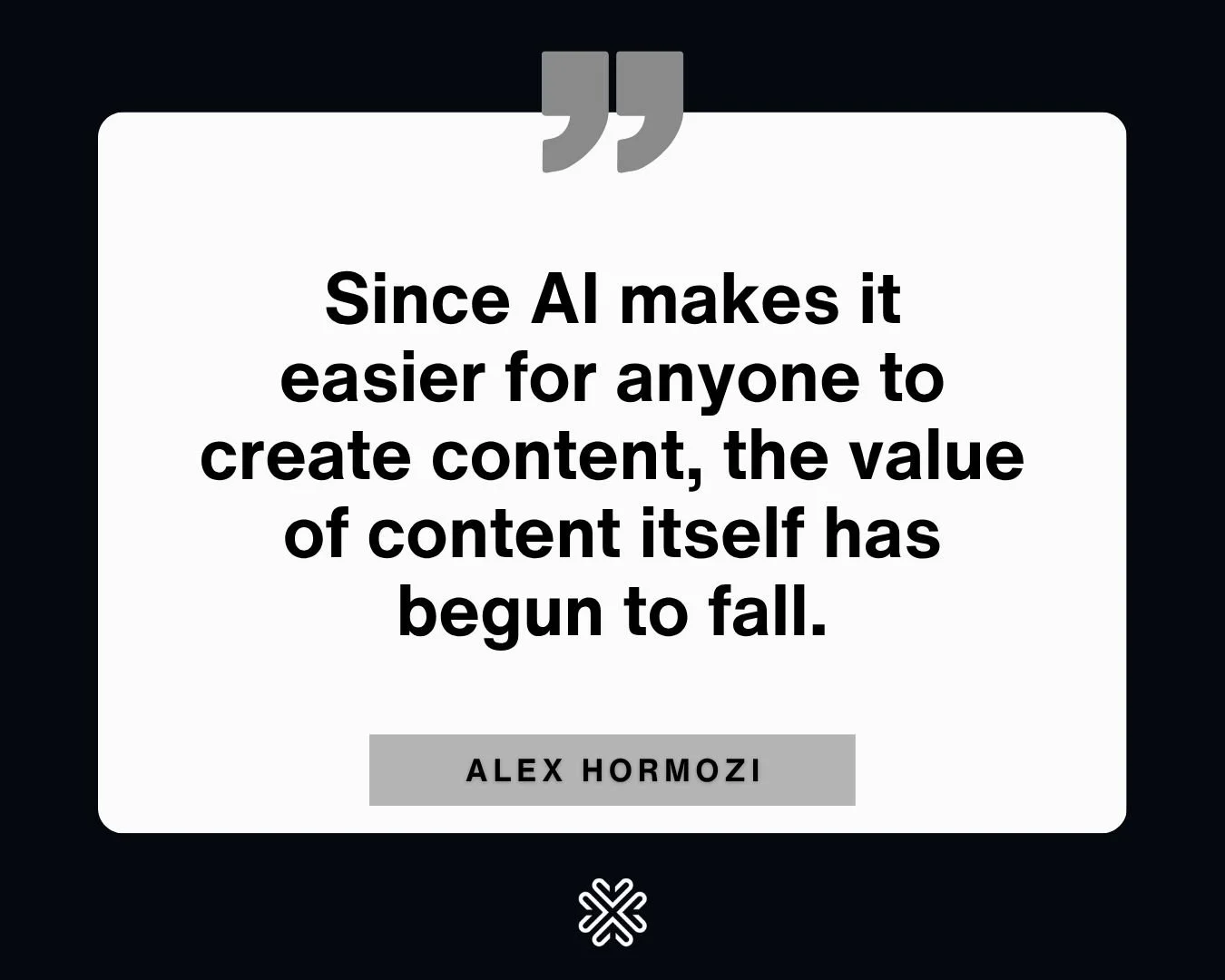
One of the most interesting ideas I’ve heard recently comes from entrepreneur Alex Hormozi. He put out a simple argument – since AI makes it easier for anyone to create content, the value of content itself has begun to fall.
He’s not saying that the content isn’t useful – but it’s just not that difficult to create, so it’s simply not worth as much anymore. That’s leading to the rise of the ‘prove it’ economy.
For experts, consultants, coaches and speakers this represents quite a significant shift. We have been taught that our marketing should be about making claims. We should be talking about our expertise, our experience and our services. We told people what we knew and hoped they would trust us.
But to provide proof we need to do much more. We need to show, and not just tell, what we’re capable of.
How to show your proof
But how do we do this as thought leaders. How do we prove we’re the real deal.
I’ve seen experts tackle this in a myriad of different ways, and all of them can work very well, as long as they are creating a situation where potential clients can experience their expertise before making a buying decision. The goal here is to show people how you think. Not just tell them you're an expert.
So what does proof look like in the thought leadership world?
What proof looks like now
There are many different ways to prove you’re the real deal, but the strongest trust signals tend to have one thing in common: they provide evidence that your expertise works.
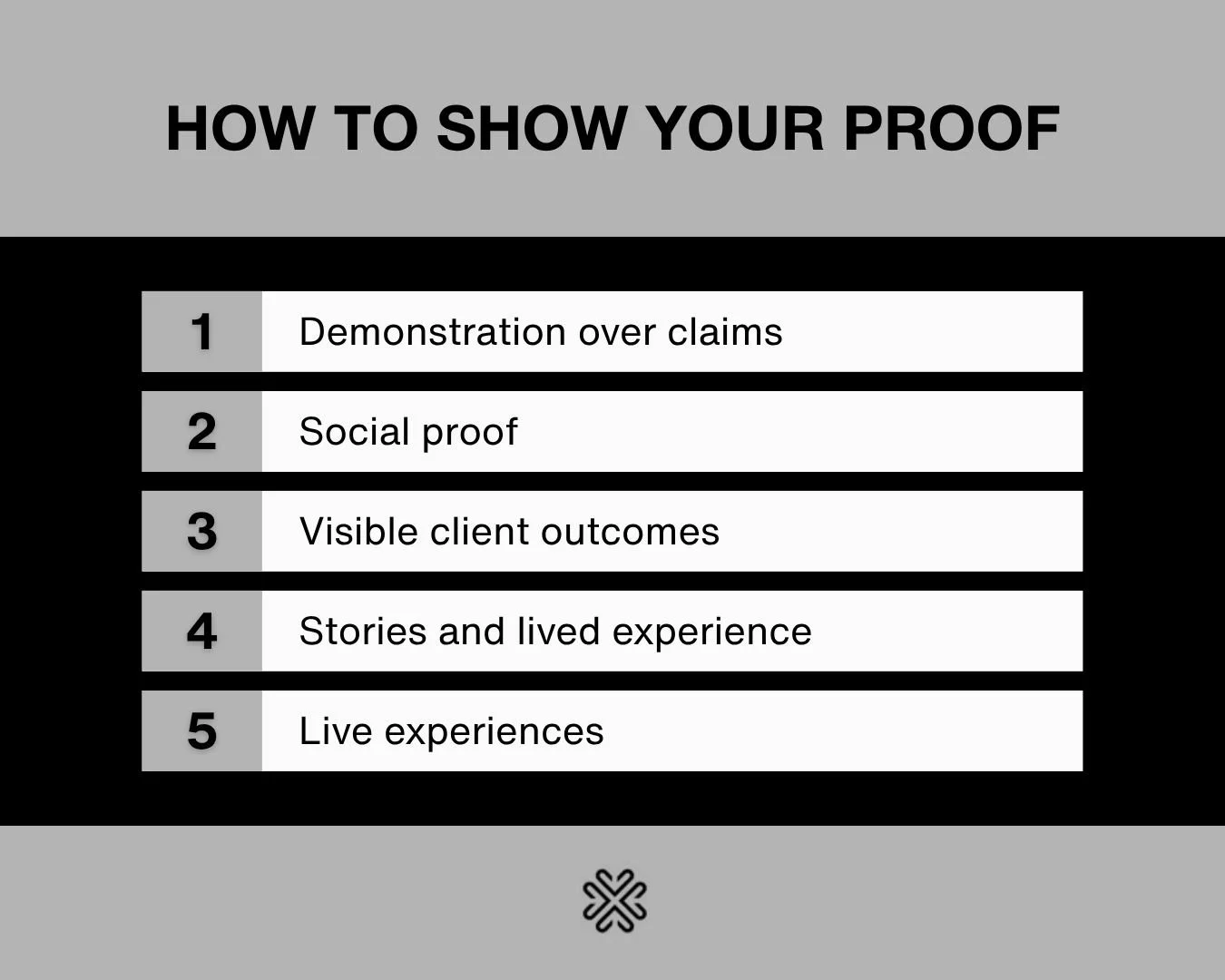
Demonstration over claims. One of the most effective ways to build trust is to let people see your expertise in action. Coaching clips, workshop excerpts, audits, interviews and live problem-solving sessions allow potential clients to experience how you think and work, rather than simply taking your word for it. People want to know, do you actually know how to solve my problem?
Social proof. Recommendations, reviews, testimonials and referrals provide evidence from people other than you. While a single testimonial can be fabricated, dozens or even hundreds of recommendations from real people become much harder to dismiss and help validate your credibility.
Visible client outcomes. Buyers don't just want to know what you do. They want to know what changed because of your work. Showing results, transformations, behavioural change, implementation outcomes and return on investment helps prospects understand the real value of your expertise.
Stories and lived experience. AI can generate content, but it can't replicate your life experiences. The stories, lessons and observations you've gathered throughout your career provide a level of perspective and humanity that helps people connect with you and trust your expertise. Be ready to show them.
Live Experiences. There’s nothing like an experience of being able to connect in the flesh so clients can have a sense of you energy an essence in real life, breathing the same air as you and to determine if you’re who you say you are. If a potential clients can get belly to belly, put you on the spot and ask you the questions that matter to them, elevating trust is much easier.
Why proof isn’t enough without rigour
Proof strategies are becoming increasingly important. But the most sophisticated buyers – those that experts and thought leaders are often looking to work with – are often looking one step further. They aren’t just evaluating the proof; they’re also evaluating the thinking behind it.
I’ve noticed this particularly when working with highly educated and experienced professionals. They aren’t impressed by polished content and even chic videos. What they’re looking for is rigour.
But what does that mean? Well, it means they want to know that your thinking and ideas have been testing. That your methodologies and frameworks have been refined through iterations and experience. That your recommendations and advice is grounded in evidence rather than opinion.
Most importantly, they want to see that your judgement is still intact. That you’ve thought critically about the problem, challenged assumptions and can apply your expertise to unique and new situations rather than simply repeating information or slapping on the same old framework Band-Aid.
As AI makes information more accessible, this kind of deep rigourous thinking becomes more and more valuable. And that’s what clients are looking for when they ask if you’re the real deal.
How to audit your proof signals
Since trust is becoming one of the most valuable assets in our business, it’s worth taking a step back and thinking about how easy it is for people to trust you.
Ask yourself:
What proof exists that your expertise works?
Where can people see (really see) your thinking?
Can prospects observe you solving problems?
What experience can you create for others to connect with in person that
is accessible?Do your testimonials feel credible?
Are your results visible?
What evidence supports your claims?
Would a sceptical buyer believe what you've published?
Your goal isn’t to be the most perfectly trustworthy person in the world. That’s just not possible. Your goal is to understand where your trust signals are strong and where you might need to work on strengthening them.
In today’s trust-light environment, the experts who make it easy for others to see their proof will have a huge advantage.