What A Spanish Fishing Village Can Teach You About Your Sales Strategy
One of the biggest myths in any business, whether you’re a B2B thought leader, consultant or corporate executive is that if you just do good work, you’ll eventually get noticed.
Unfortunately this isn’t always the case.
Every day, capable individuals pour time, money and energy into products, services and ideas without getting the traction they deserve. And often this comes down to a single problem – they create the products and solutions without understanding whether the market really wants them.
The market tells you what it wants
Last week you might remember I mentioned Mark and I managed to finally go on our belated honeymoon. We found ourselves in the stunning Spanish city of Cádiz.

Founded 3,000 years ago by the Phoenicians, Cádiz is a port city perched on the Andalusian Atlantic coast, with a beautiful shoreline and an ocean-going history to match.

Walking along the foreshore you’d of course understand why it makes a fantastic fishing destination. The sea crashing along the shore was deep and blue, and you could imagine it teaming with fish. The homes along the front were prettily coloured too, which became more interesting once I’d heard the story of how local fishermen used pigeons to test the market for their sales.
As the story goes, before there were cell phones or radios, fishermen trained homing pigeons to carry messages from the fishing boats out at sea and the restaurants, markets and merchants back on land. After making their catches, the fisherman would send the pigeons off with details of the fish they had available using the coloured homes to guide them.
Those who wanted to buy would then be aware of what was on offer and could send back that information to the fisherman heading into shore. The fisherman could then prepare their catches according to the demand of the day, and as they pulled into port, the buyers would already be there waiting for their fresh catches.
Whether this story is perfectly true, or a myth created for tourists, it’s hard to say, but the principle behind still matters. The cleverest sales strategies don’t assume that people will come simply because something exists. It pays attention to interest first (restaurants and individuals want fresh fish), looks for signals (what’s available and generally in demand), and then tests its theory before overinvesting (sending messages to see what’s wanted).
Why should we test before we build?
In today’s rapidly changing market when trends and demand fluctuate on a whim, market research is vital. We want to show the world what we have to offer and check for genuine demand before doing all of the work to create it.
The risk if we don’t is overexposure. Research out of MIT suggests that a very high proportion of new products fail after launch (some summaries going as high as 80-95%). These failure rates remain high even among products that do reach the market, which is a huge cost and shows the risk of building before validating demand.
Overexposure can look like many things. For example, it might be a consultant who spends six months building an online course nobody asked for. Or a founder who invests heavily in a new service before testing whether clients actually value it. Or a thought leader who launches a rebrand based on internal preferences rather than market feedback, only to find the messaging doesn’t connect.
Meanwhile, the businesses gaining traction are often doing the opposite. They’re testing ideas early through conversations, workshops, waitlists, keynote topics, pilot programmes, surveys or smaller offers. And then they’re paying close attention to what people respond to before investing heavily in scaling it.
This research then shows their success with research showing that companies that invest more in market research achieved about a 25% higher success rate overall.
’Let rejection refine the argument’ – How Canva scaled globally
Before Canva became one of Australia’s most recognised tech companies, Melanie Perkins was testing many of the same ideas through Fusion Books, a school yearbook business. It gave her early insight into how everyday people struggled with existing design tools and what they actually needed from a simpler platform.
Instead of building in isolation and hoping people would come later, the idea evolved through real user behaviour, feedback and demand signals first. That approach reduced guesswork and strengthened her positioning long before Canva scaled globally.
As Perkins herself said, ‘Let rejection refine the argument.’ All data becomes part of your sales strategy – whether positive or negative – it all matters.
The beautiful bonus of confidence
The cherry on top of testing for demand is that by proving there’s a market for your service, you’ll inherently gain confidence.
And we all know how crucial self-confidence is for making sales as a consultant. As I’ve said in the past: If you’re not convinced, your clients won’t be either. You need to be convinced you’re offering real value to your client to have an effective sales strategy.
So test for demand, gather the evidence, then build.
As management consultant Peter Drucker once said, ‘Ideally, marketing should result in a customer who is ready to buy. All that should be needed then is to make the product or service available.’ Because the smartest sales strategies still follow the same principle the fishermen of Cádiz understood centuries ago – test the demand before bringing the boat home
How to test the demand
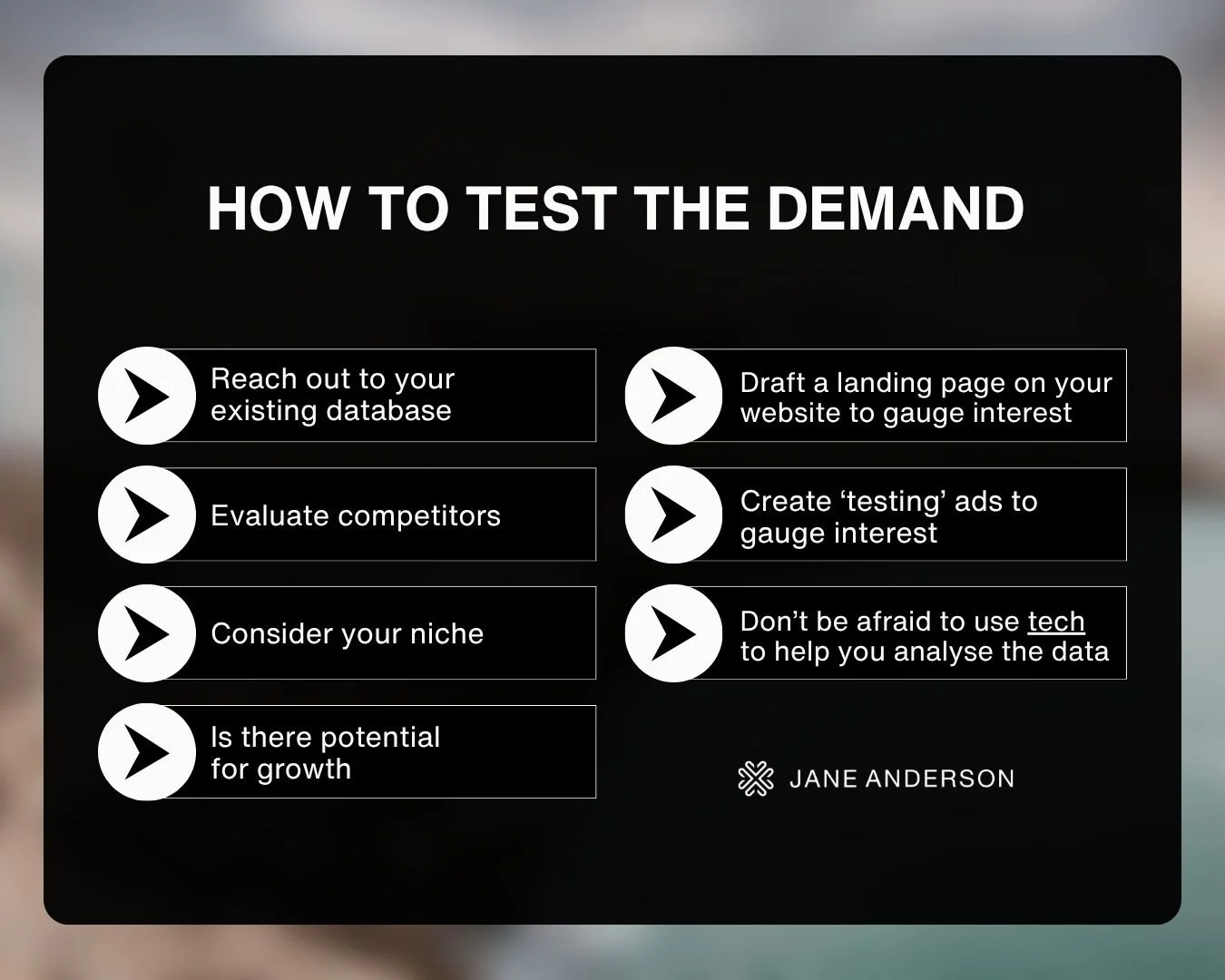
A crucial step of a consultant’s sales strategy is measuring the demand for their service. But how do you do that? While every practice is unique, here are some steps you can take:
Reach out to your existing database – call, email or send out an e-newsletter. You can even undertake a survey.
Evaluate competitors – how many consultants are offering the same thing?
Consider your niche – what can you offer that sets you apart from your competitors?
Is there potential for growth – i.e. is it scalable?
Draft a landing page on your website to gauge interest
Create ‘testing’ ads to gauge interest – i.e., new product/service coming soon
Don’t be afraid to use tech to help you analyse the data