

When Satya Nadella became CEO of Microsoft, he quickly identified a problem within the company that he termed ‘productivity paranoia’. This was a disconnect where leaders relied on visible activity (meetings, emails, hours logged) as a proxy for real output, while employees felt burnt out from doing more than ever.
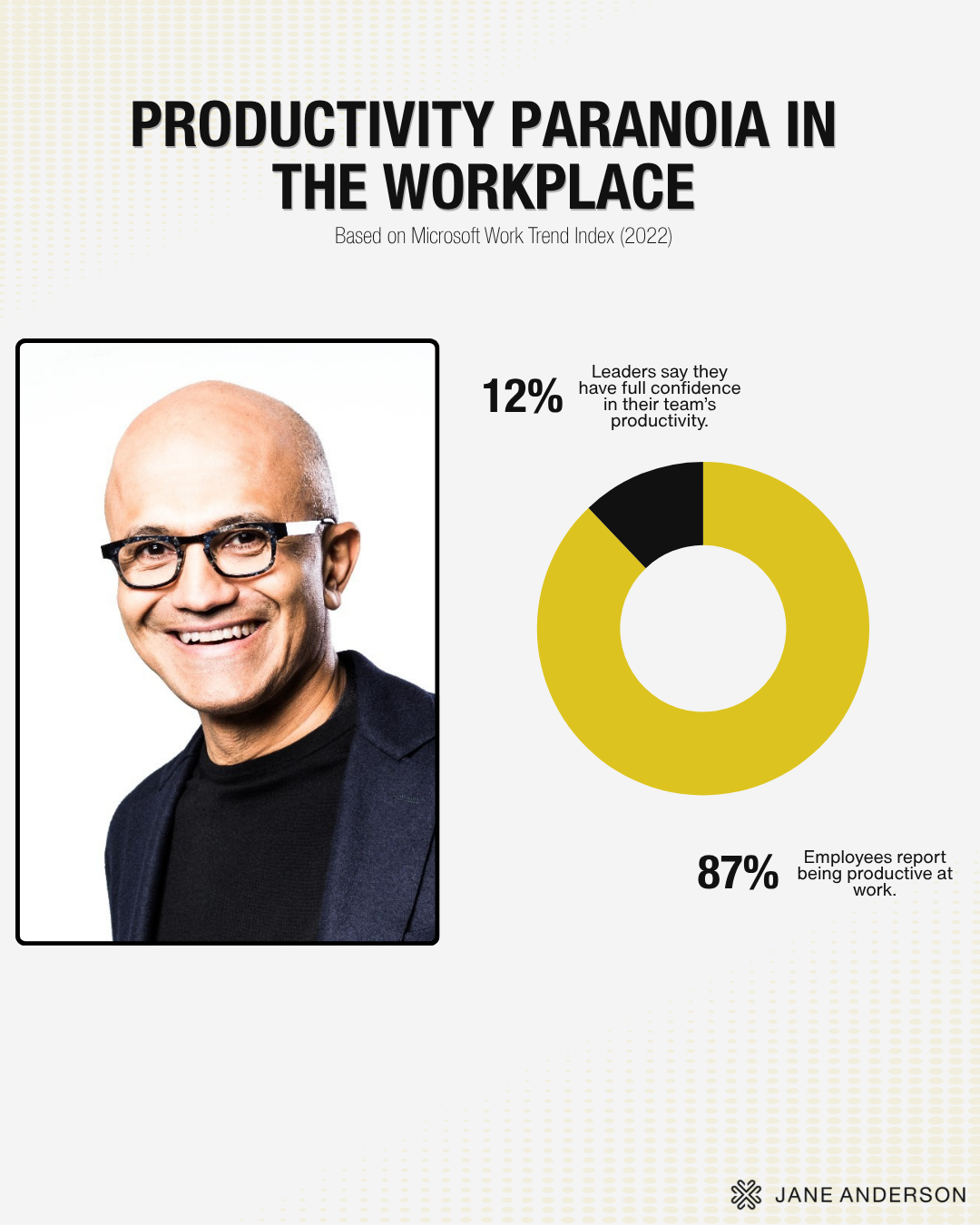
Stepping into the CEO role, he made deliberate changes. He publicly told employees to skip meetings they didn't need to attend, cutting what he described as bloated bureaucracy. He protected space for deeper thinking by practising mindfulness each morning before engaging with emails or meetings – a habit he credits to sports psychologist Michael Gervais. And more recently, he deliberately excluded senior executives from certain AI strategy meetings to reduce internal friction and move faster.
This wasn’t just a shift in how he led – it also led to a shift in the culture of the entire team and impacted outcomes across the board. Employee satisfaction scores rose approximately 30% between 2014 and 2022, with staff reporting higher levels of empowerment and better cross-team coordination. Microsoft's market capitalisation grew from around $300 billion when Nadella took the helm in 2014 to over $3 trillion a decade later – a more than 1,000% rise in share price, outpacing the S&P 500's 185% growth over the same period. Wedbush Securities analyst Daniel Ives described it as ‘the biggest transformation of a tech company potentially ever.’
And none of this happened because Nadella did more. It transformed because he became more intentional with where his attention went.
And that’s the insight most people miss: your personal productivity is not just about performance. It directly shapes your influence.
The productivity trap high performers fall into
Most capable professionals are incredibly productive, but most often it’s in the wrong way and doing the wrong things.
They’re responsive and reliable. They deliver to their clients, they create content, send emails and answer phone calls. But even though they’re doing a lot, in fact, they’re incredibly busy, they aren’t actually moving the needle on their influence.
That’s because, as we see from Nadella’s example, influence – real influence – doesn’t come from being the most productive person in the room. It comes from being the most clear, considered, and strategic.
What the research tells us
This isn’t just a nice idea; it’s backed by what we see in leadership research. Studies consistently show that leaders operating in reactive environments make poorer decisions and are perceived as less effective.
Tony Schwartz’s work through The Energy Project highlights that energy and focus – not time – drive performance, with decision quality improving significantly when leaders manage their attention intentionally.
Research from McKinsey found that nearly half of senior executives admit they aren’t spending enough time on strategic priorities. But when they do, this limits their ability to influence direction with others, with their teams and with the overall organisation.
The challenge is that being clear, considered and strategic requires space. When you create space, your influence expands. And when we fall into the trap of being busy over being strategic, we risk losing influence that we might have already gained.
Strategic space leads to real productivity
So how do we change the way we approach productivity? Rather than taking on more and more ourselves, we elevate our systems to give us real space.
As James Clear says, ‘You do not rise to the level of your goals. You fall to the level of your systems.’ In other words, your productivity system is either strengthening your influence… or quietly eroding it. How can you tell?
Look at your day. If it’s filled with back-to-back meetings, constant emails and reactive tasks, your attention gets split in too many directions. Your voice and your thinking gets lost in the noise. You’re busy, but you can’t seem to find the time for deep thinking or making strategic plans and decisions. You’re present and working hard, but you don’t seem to have any impact.
Now, imagine if you can create space. Space that allows you to complete that strategic deep thinking that can guide your decision making. When you have space then your thinking sharpens, your positioning becomes more clear and you’re able to make moves that allows you to truly influence others.
Why real productivity – not overwork – drives influence
At an executive or thought leader level, productivity isn’t about doing more. It’s about how you show up, and what that signals to others. Whether unconsciously or not, people are constantly assessing three things:
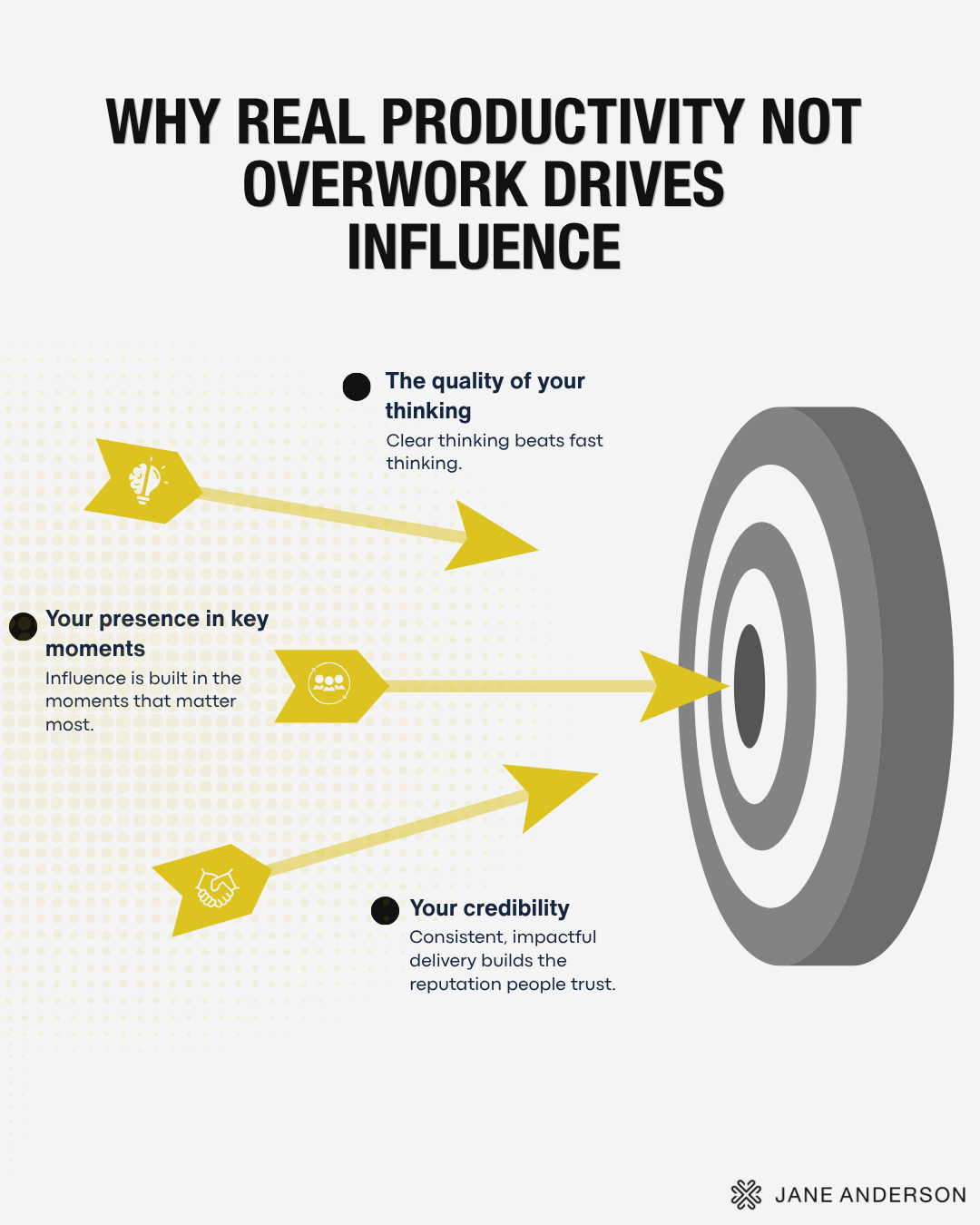
1. The quality of your thinking
When you’re rushed, your thinking becomes reactive. You move quickly, but not always clearly. Influence requires perspective, not just speed. This means that you need to be able to step back, connect the dots, and make decisions that move things forward.
2. Your presence in key moments
Influence isn’t built in every interaction. Instead, it’s built in a handful of important moments. This might be a board meeting or a difficult conversation handled well. It could be a decision point that strategically alters your business or work. How you show up in these moments matters.
3. Your credibility
People are always asking:
Are they prepared?
Do they follow through?
Do they bring clarity?
Your productivity is visible. This isn’t just how busy you are – anyone can be busy. But it shows up in how consistently you deliver impactful work that moves the needle for yourself, your clients, or your organisation. It signals how seriously you should be taken. And over time, that becomes your reputation.
The benefits when you get this right
When your productivity is working for you, not against you, you’ll notice:
You feel calmer, even in high-pressure environments
Your ideas land more clearly and with more authority
You’re invited into more strategic conversations
You’re trusted with bigger decisions
Your reputation shifts from “reliable” to “influential”
You’re no longer just delivering work. Now, you’re shaping outcomes.
On the other hand, there are real consequences and real costs when you get this wrong.
You’re seen as busy, but not strategic
Your ideas feel undercooked or rushed
You miss key moments to influence direction
You second-guess yourself because you haven’t had time to think
Others step into the space you’re not occupying
How to make the shift from activity to impact
If you want to elevate your influence, the question changes. You don’t ask, ‘How do I get more done?’ But ‘What actually matters for my influence?’
3 practical steps to strengthen your productivity (and your influence)

1. Identify your ‘influence work’
Ask yourself:
Where do I need to be at my best?
Which conversations, projects, or decisions actually shape outcomes?
Then protect that time – fiercely. This is absolutely not the place to compromise, not if you want to build influence.
2. Design your week before it begins
Influential people don’t start Monday reactively.
They:
block time for thinking
prepare for key conversations
reduce or delegate low-value activity
If you don’t design your week, someone else will.
3. Create thinking space (non-negotiable)
This is the most resisted action, but it’s almost one of the most important.
Even 60 to 90 minutes a week of uninterrupted thinking time can transform:
how clearly you communicate
how confidently you show up
how strategically you operate
This is where influence is built..
Your opportunity is now
Satya Nadella didn’t become more influential by doing more. He implemented strategies that allowed him, and everyone else in his organisation, to protect and focus his time, attention and energy. That shift is what changed the way he led. And that same opportunity sits in front of you.
So if something needs to change, start by giving yourself space and protecting where you place your attention because it’s this attention that shapes your thinking, and your thinking that shapes your influence.
I’d love to hear your thoughts…
