Are you spending all day writing proposals?
If you’re spending hours creating beautiful proposals that never turn into revenue in your business, something needs to change. But before you feel too uncomfortable, you should know that you’re not the only one who is experiencing this.
I recently had a coaching session with a brilliant client Rachel, who’s building an incredible practice. She’s attracting enquiries from strong potential clients thanks to her marketing. But every new conversation ends with the same question – ‘Can you send me a proposal?’
She then goes back to the office, opens Canva, builds a custom document, exports it as a PDF, crafts the email, and finally sends it off. Then she repeats that process at least five more times per week. Each week she’s losing at least two full days to proposal writing – and many of those prospects won’t say yes.
These proposals are taking far too long, and far too much of her energy. She’s now just exhausted and not seeing the business growth that she deserves because she simply can’t keep up with the proposal demands.
When I asked her, ‘Have you been discussing the investment with your clients when you’re in the meeting.’
She said, ‘No. First, because I have to go away and work it out. But secondly, I'm also too scared to talk about the pricing in case they say no.’
The fear behind the proposal
For many consultants and service based business owners, including Rachel, proposals become a safe space to hide. The real issue isn’t Canva, or the time spent tailoring proposals. The real issue is the fear of rejection and lack of ability to adapt in the meeting.
When you avoid talking about pricing in the meeting, telling yourself, ‘I’ll go away and work it out’, you miss the chance to have a real conversation about value, fit and outcomes. You’re also not able to overcome any objections the client might have to working with you. All that the client has to make a decision on then is your price.
As Seth Godin reminds us, ‘Perhaps the reason price is all your customers care about is because you haven’t given them anything else to care about.’
When you hesitate to discuss value, you lose the opportunity to help the client understand the impact of your work. And then you shift from being an advisor to an order taker. You’re no longer guiding the client toward a decision that would solve their challenges. Instead, you’re just stuck waiting for their verdict, like a cashier at a fast food restaurant.
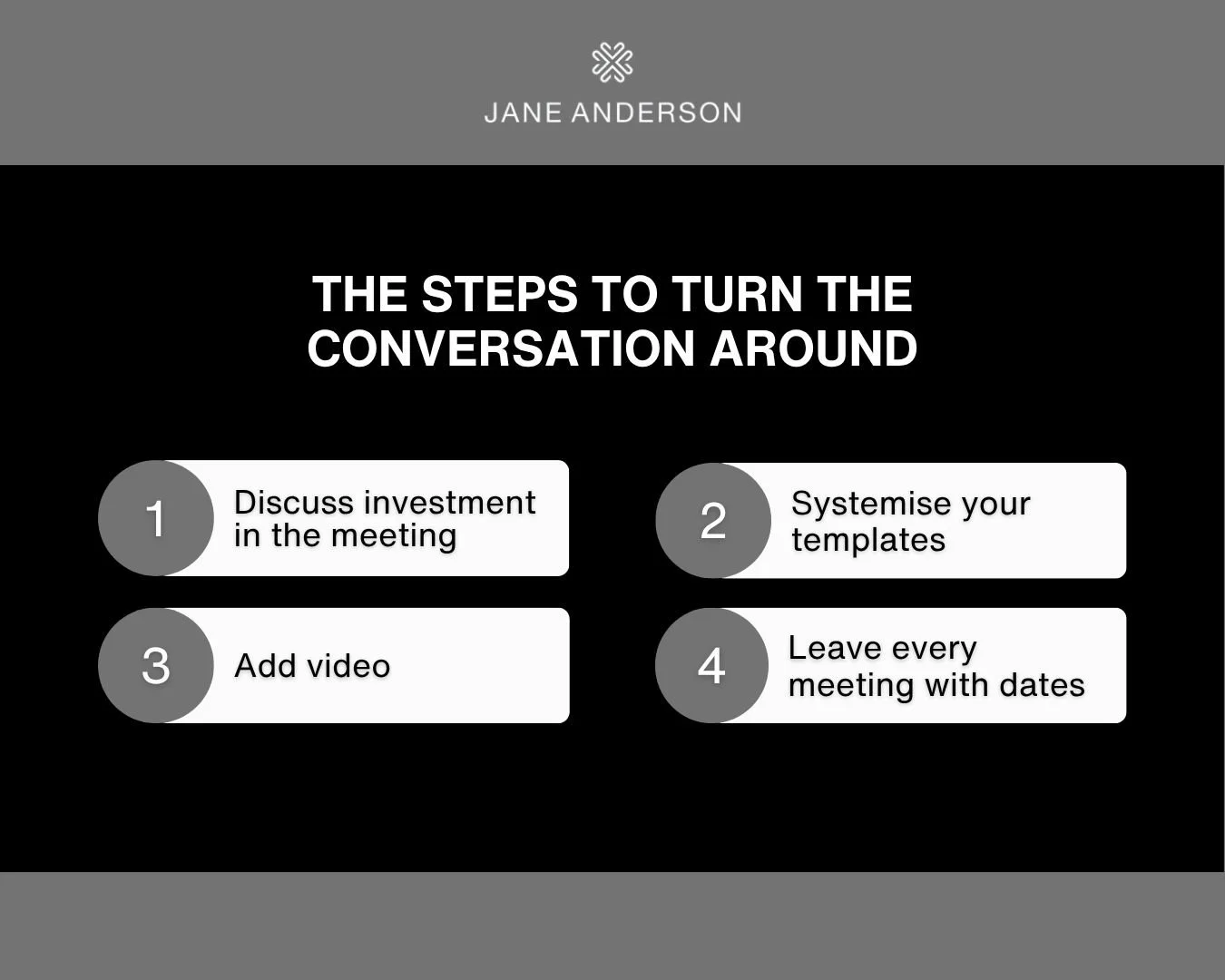
The fix is to turn the conversation around
The mistake my client was making was using the corporate proposal as the conversation. But in fact, a proposal needs to confirm a conversation, not replace one. Here are the steps that I teach my clients when they find themselves in this situation:
1. Discuss investment in the meeting
You must discuss investment when you’re in your sales meetings. This gives you an opportunity to field any objections and concerns and observe the client’s reaction to you.
As The Challenger Sale research shows, the most successful salespeople don’t just respond to client requests, they lead with insight. When you avoid pricing conversations or custom-build every proposal, you move from trusted advisor to order-taker.
Even if you just give a range, for example, ‘look I'd have to work out the final amount but it would be somewhere between between $50K-$60K’ – say it out loud to the client. You’ll quickly figure out if you’re talking to the right client, and if they’re interested or ready to act.
The goal for sales meetings is to get to an answer, whether that’s yes, no or maybe. Any of those (even the no!) are better than endless follow-up limbo.
2. Systemise your templates
Have a core document ready. This is your ‘greatest hits’ deck that covers what you do, includes outcomes and, of course, your glowing testimonials. This is your base for all your proposals and when you have that in place it means that you can just tailor it slightly to each client.
The ultimate goal is to not have to start from scratch each time. In Rachel's' case we were able to teach her EA to do it for her so that it was ready for her to review by the time she got back to her desk.
3. Add video
Much of the time, the person or people that you’re meeting with in your sales meetings won’t have the final (or at least only) say in ultimately engaging you. According to Gartner’s research on B2B buying behaviour, most decisions now involve multiple stakeholders (in fact, six to 10 decision makers!) who keep researching even after the meeting. So when your client needs to take your proposal to a committee or another person, record a quick video walking them through your proposal.
A video lets your personality, warmth and energy do a lot of the heavy lifting. In fact, no one can sell you better than you. My client is a great example of that. She had such a bubbly, engaging personality, but that just didn’t come out through her proposal. She needed to showcase who she really is. And having a video to back up her proposals really did that for her.
4. Leave every meeting with dates
The dream outcome of your sales meeting, of any sales conversation, isn’t ‘I’ll send you a proposal.’ No. The dream outcome is ‘When are we doing this?’
To get this you need to make it easy for your client to buy. As Gartner’s research shows, in today’s corporate environment, buying is a challenge for clients. When you provide the buyer with helpful information that makes their lives easier, they’re three times more likely to buy from you (and buy a bigger deal too).
The mindset shift
If you’re worried that you’ll find talking about pricing in your sales meetings, try to think of it this way. This isn’t about being pushy. It’s about leading the conversations and finding a way to get the client the product or service that will be most helpful for them.
Your goal here is clarity, for both you and your client. When you discuss pricing early, simply your process and bring your energy through video, you build trust faster and create more space to do what you actually love, deliver outstanding work that will actually help your clients.
It’s like taking a Ferrari from first gear to fifth. In first, you’ve got speed, but you’re not using it. But when you streamline your proposals, speak about pricing with confidence and showcase who you are, you and your practice will move faster, you’ll move into fifth gear.
So next time you’re heading into a meeting, ask yourself, "Am I going to be an order taker or an advisor?" Am I writing proposals or closing opportunities? Am I in first gear or fifth?