Energy, Not Time, is the Real Constraint
When I work with leaders, thought leaders and business owners, I often hear a very similar story. ‘I don’t seem to be having the impact that I should be. I just need more time!’
Feeling a lack of impact isn’t an unusual problem for high-level leaders or those operating under the pressure of responsibility. From the outside, a lot of people would think you’ve technically ‘made it’. But from the inside, there are heavy feelings of having to be constantly switched on, making decisions while feeling fatigued, constantly having to deal with complexity and reacting rather than shaping the outcomes.
For many of these high performers it looks like the problem is simply not having enough time. But time is rarely the true constraint.
On the other hand, I’ve worked with people who have similar roles, similar pressures and exactly the same amount of time – yet they’ve also had a dramatically different level of impact. Why is that? They still have full calendars and a high degree of responsibility. They’re still making complex decisions where the consequences really matter. Yet one feels stretched and reactive, while the other feels calm, focused and influential.
The difference isn’t time. It’s energy.
Energy management vs time management
Energy management vs time management
Many of us have been conditioned to equate high performance with time management. And of course, time management matters. Efficient systems and good support give you the foundation for better results and more impact. But it can’t stop there. Because you can have all those things and still not be an impactful leader or a high performer if you aren’t able to harness your energy.
Tony Schwartz and Jim Loehr famously laid this out in their book The Power of Full Engagement. They said, ‘The number of hours in a day is fixed, but the quantity and quality of energy available to us is not.’
That single idea reframes performance entirely and challenges one of the most deeply ingrained assumptions about high performance. We’ve been taught to optimise time, to manage diaries and to squeeze more in. But time is fixed. Energy is not.
I worked with a senior leader who appeared, from the outside, to be thriving and succeeding in her role. Her calendar was relentlessly full and board expectations were justifiably high. But market volatility also meant that every decision carried weight. This leader was staying across strategy, stakeholders and regulatory pressure, but she was constantly stretched.
She was still meeting her KPIs, but the depletion showed up in her leadership. Her thinking (and patience) narrowed under the pressure. With her team she found herself defaulting to control rather than influence and her conversations became more transactional than strategic. She had to do something.
Her first instinct was to try to further optimise her time. So she reshuffled her diary again, delegated more to her team and blocked out space for ‘thinking’. But the underlying strain remained. And nothing really changed.
When she came to me, we took a look at her work, and how she was feeling, and it quickly became obvious that she didn’t need more time – she needed more energy. She began structuring her week around high-energy periods, protecting the time and space she needed for recovery and reducing low-value activities that disproportionally drained her.
Before long her energy stabilised, her judgement sharpened and her presence strengthened, even though the demands of the role hadn’t changed. But what had changed was her focus on her energy.
Energy as a performance driver
A useful metaphor is to think of your leadership capacity, whether that’s as a business owner, an executive or a thought leader, as a power grid. Time is the infrastructure. It’s necessary, but it’s fixed and finite. Energy is the electricity flowing through it.
You can expand the grid, add more connections and increase demand, but without sufficient power the system can’t perform. The constraint isn’t the wiring. It’s the supply.
When you’re looking to harness high performance in your leadership, this matters because others draw from your energy. Your presence sets the current in the room. When your energy is steady and strong, thinking sharpens and confidence builds. When it’s depleted, the entire system operates below capacity.
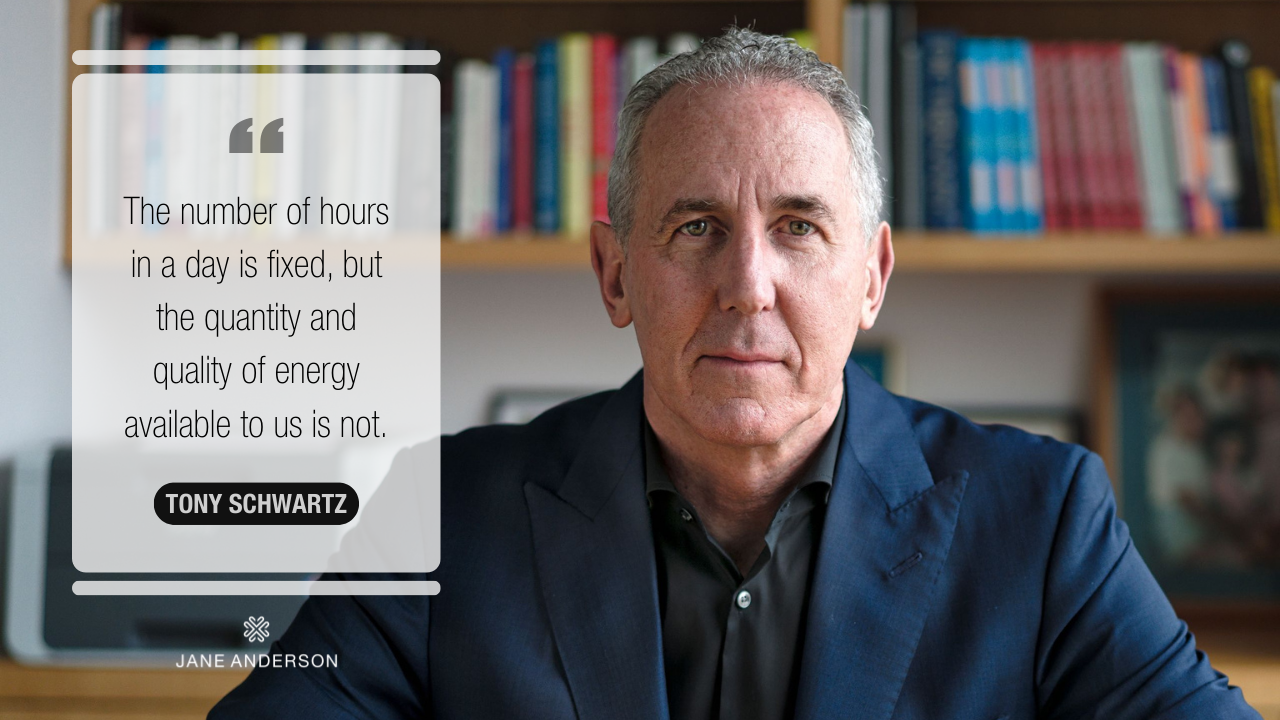
Tony Schwartz’s research through The Energy Project, much of it published and referenced in Harvard Business Review, consistently shows that managing energy is a more powerful driver of sustained performance than managing time.
One of Schwartz’s most critical findings is this – executive effectiveness declines sharply when people operate in a constant energy deficit, even if they remain outwardly productive. In other words, you can be busy and depleted at the same time. In fact, many high performers and leaders are. But when you’re trying to perform at a high level or in a senior leadership position, that depletion doesn’t stay hidden for long.
This is why energy is not a personal wellbeing issue. It’s a leadership issue. And whether you’re ‘leading’ a large corporate team, or a small team within your own practice, this matters.
With well-managed energy
When you can create strong, well-managed energy you’re able to think more clearly and communicate with greater presence. You’re able to absorb pressure and work within it rather than amplifying it. Your teams and clients see you as grounded, decisive and trustworthy. And your confidence feels steady rather than brittle because your authority doesn’t rely on pressure or force.
When you can manage your energy deliberately those around you will trust you with bigger, more complex decisions. People see you as the one to turn to in times of uncertainty. In fact, you can create more stability simply through how you show up. And your influence compounds over time because it’s sustainable.
Without well-managed energy
On the other hand, when energy is unmanaged, the consequences are predictable, and predictably negative. You become reactive. Small issues feel heavy and strategic thinking gives way to short-term firefighting. Because of this urgency and lack of energy, communication becomes rushed or blunt. Your influence erodes not because you’ve lost your capabilities, but because you’ve run out of capacity.
Over time, this erosion will affect your reputation. Stakeholders, team members and clients may not be able to articulate it, but they sense it anyway. Then their confidence wavers and their trust softens. Opportunities that used to appear regularly simply move elsewhere.
How to manage your energy
When you can actively manage your energy good things happen. You get a major uplift in your performance. You’re able to sustain focus for longer, regulate emotion more effectively and make better decisions under pressure.
But to make the shift to managing your energy well you have to being by moving from asking, ‘How do I fit more in?’ to asking, ‘What state do I need to be in?’ That question changes your priorities, boundaries and behaviour, and allows you to bring more energy into your current infrastructure.
Here are a few practical steps to start this process.
1. First, treat energy as a strategic asset. Energy fuels judgement, presence and credibility. It deserves the same attention as financial or reputational capital.
2. Second, identify energy leaks, not just time leaks. Some meetings, decisions or dynamics cost far more energy than others. Awareness is the first step to choice.
3. Third, build renewal into your work. Energy is restored through intention, meaning, recovery and boundaries. Even if you’re a senior leader, this isn’t indulgence. It’s actually what sustains long-term performance.
The people who make the greatest impact in their work and industry over time are rarely the busiest. But they are the most energised. This isn’t because life is easier for them, but because they understand the true constraint.
Time sets the limits of your calendar, but energy determines the limits of your impact.