Embody your work – don’t just say it, become it
One of the most common things I hear people say when they’re first trying to become leaders in their niche or industry is, ‘I don’t know if I have anything to say.’
These are exceptional people who have spent years building their expertise, solving complex problems and advising others, yet they’re still hesitant to share their thinking or even define what that thinking is. They often assume they aren’t ready, or not expert enough or even not different enough from others in their industry.
In almost every case, that’s simply not true.
What’s actually happening is much simpler. They have the knowledge, but they haven’t developed embodied thinking around it. In other words, there’s a gap between what they know and what they can confidently articulate and stand behind when the pressure is on.
This gap is what holds thought leadership and creative thinking back.
The illusion of not knowing enough
One of the biggest barriers for leaders and thinkers is the belief that their expertise should feel impressive. If you’ve fallen into the trap, you probably know how upsetting that can feel. You might feel that your own work feels so basic, so easy to understand, that it’s simply not worth sharing. You assume others know it, so you discount it, and over time, that familiarity hides the value of what you know.
But just because it feels easy to understand to you, does not mean that it is to everyone. In fact, it usually isn’t! Remember, you’re the one who has been thinking, creating, and conceptualising around your area of expertise for quite some time. But most others haven’t. They simply don’t know what you know.
One of the women in our Women With Influence community often falls into this way of thinking. She’s a brilliant thinker who has provided deep insight about how to manage difficult conversations. Yet she often forgets how much work she’s done in this space, and because it feels second nature, she questions whether it’s worth sharing.
This was particularly true when it came to writing her first book. But once she got started, she realised how much she really knew – and that not knowing enough was just an illusion.
She truly knew her work, but it wasn’t until she started working on her book that she began to really and truly embody it.
Why does embodying your work matter?
The Stoic philosopher Epictetus said, ‘Don’t explain your philosophy, embody it.’
For those of us involved in deep thinking, this means that it must go beyond just intellectual knowledge and become part of your DNA. This means that your ideas can show up without needing review or prompts, you’re able to apply it across different situations, and you can explain it clearly even without preparation.
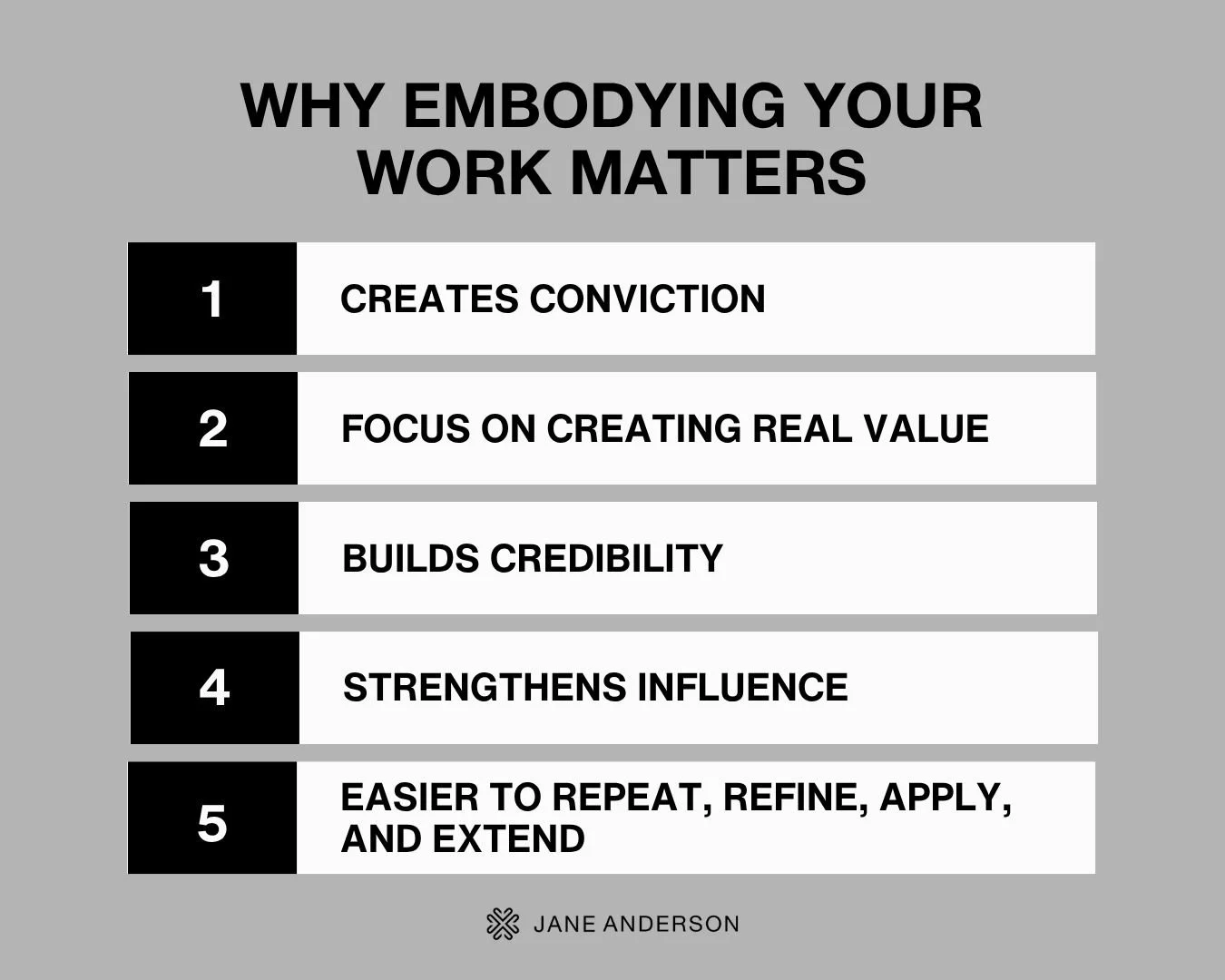
This matters because embodied thinking is what creates conviction. When your thinking is internalised, you don’t need to rely on scripts or carefully constructed language. You trust what you know, and that means you can focus on applying this to your clients or audiences in order to give them real value.
Most importantly, this is where credibility is built. Your clients aren’t just looking for polished language. They’re looking for clarity and conviction. They want to know that your thinking holds up not just in the room, but when they apply it in their own lives or work. And this is also where your influence begins to compound. When your thinking is embodied, it becomes easier to repeat, refine, apply and even extend. It becomes something others can truly rely on.
Where you may lose connection
Even very highly competent and capable people can lose connection to their own thinking, particularly in the modern world. In fact, one of the most common patterns is overreliance on external inputs.
When you find yourself constantly looking to other people’s frameworks or tools, to outside articles or research, not to stay on top of what’s going on in your industry or space (which is absolutely essential), but because you’re not feeling confident, this can create distance from your own perspective.
Another risk is where you don’t have space to truly think. Sometimes we can find ourselves in the trap of creating and delivering without also having time protected just to reflect and ideate. When this happens, we can fall into surface-level outputs that just don’t have the depth that we are really looking for – and that can also make us lose connection with our own thinking.
Increasingly, AI also plays a role. When we use it well, to support our thinking, that’s just what it does. But too often, people are using AI to replace their thinking, often without even realising it. When that happens, those people can become less and less confident in what they know because they aren’t fully engaging with their own ideas.
How to build embodiment in your thinking
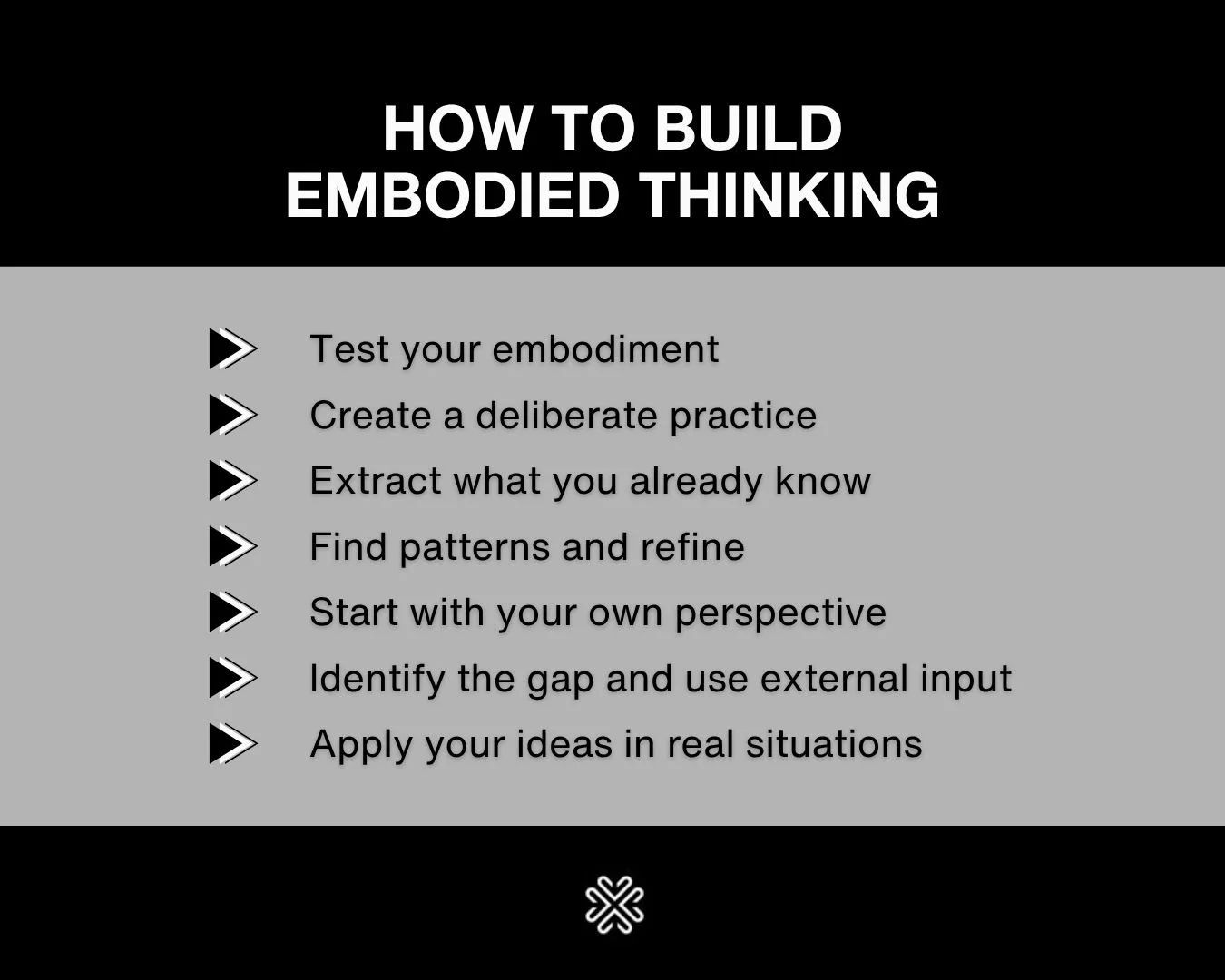
When it comes to building embodied thinking, the first step is to test whether you’re there or not. Ask yourself, if you had to step on stage tomorrow and speak on your topic, could you do it without notes?
If the answer is yes, then you’ve likely embodied your thinking. But if the answer is no, you may understand it, but it hasn’t fully become yours yet.
In that case, know that you can absolutely build this embodiment, you just have to create a deliberate practice.
Start by extracting what you already know by listing 10 things that you know about your area of expertise. You can probably do it really quickly, and you’ll find that those ideas come out faster than you expected, and often with more depth than you anticipated. Don’t edit anything or refine anything at this stage.
Once it’s visible, look for patterns, themes and connections and look to expand or refine these. But instead of beginning any creating with research or external input, start with your own perspective. Then identify where there are gaps and use external input, like AI tools, to help you figure out what you want to explore next. This keeps your thinking at the centre of the process.
Finally, apply your ideas in real situations. Use them in client conversations, decision-making and when you create your solutions. When you use it daily, your thinking will become part of who you are – and that is true embodiment.
Your thinking becomes your identity
At a certain point, your thought leadership stops being about what you’re producing and starts becoming about your identity. This is true embodiment – and it’s not something you switch on and off. It’s part of who you are. It shapes how you interpret problems, respond to challenges, communicate with others, and even create new ways of thinking about problems and solutions.
For consultants, thought leaders, and business leaders, this is where true value sits – in shaping how others understand and approach their challenges.